

Jamaica Customs Agency Launches Canine Programme
By: , March 31, 2026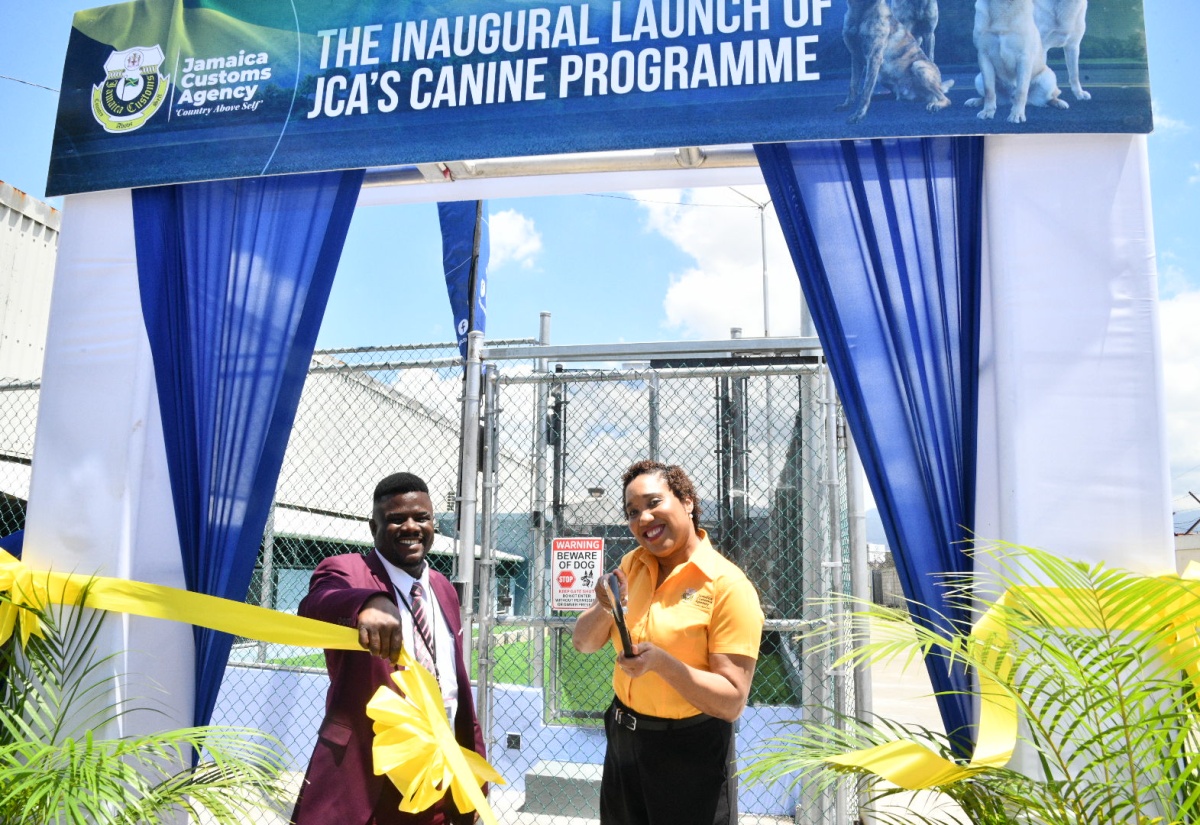
Photo: Michael Sloley
Chief Executive Officer (CEO) of the Jamaica Customs Agency (JCA) and Commissioner of Customs, Dr. Velma Ricketts Walker (right), and Deputy CEO, Border Protection Division, Marlon Lowe, cut the ribbon to officially launch the JCA's Canine Programme at Newport West, Kingston, on Monday (March 30).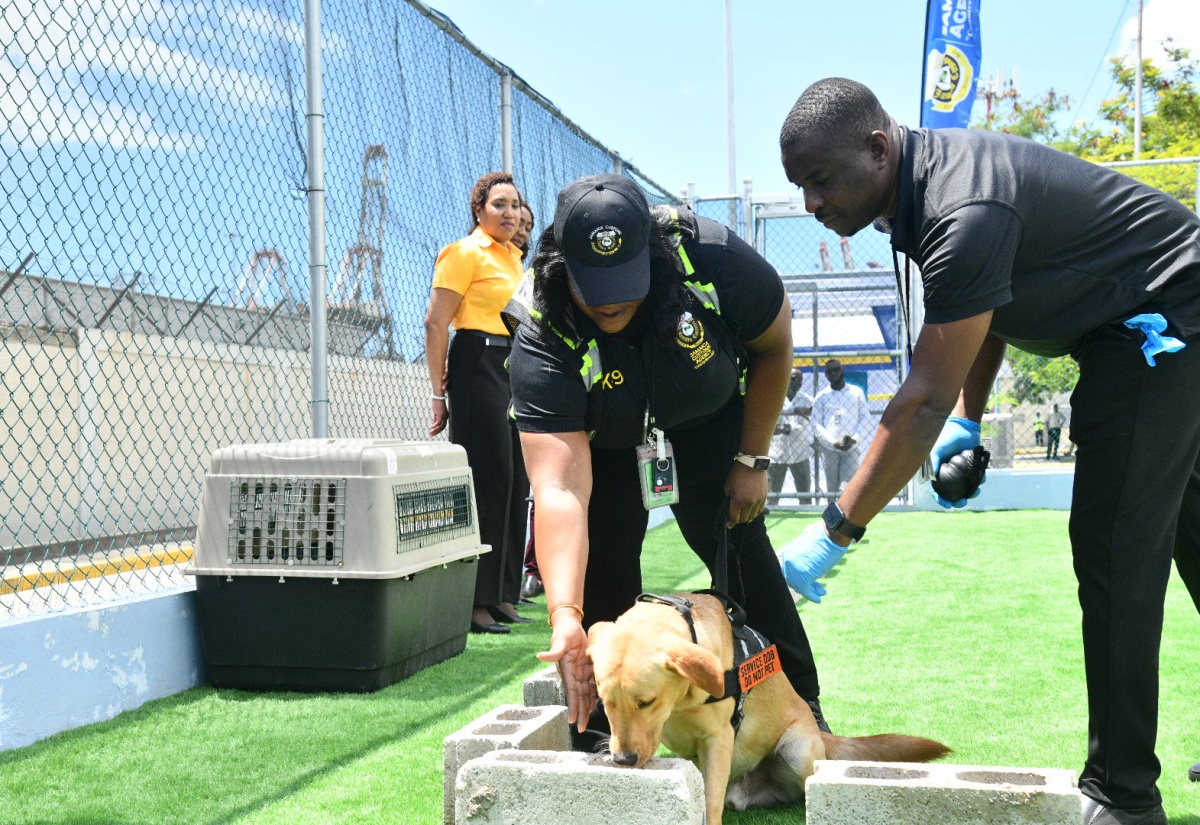
Photo: Michael Sloley
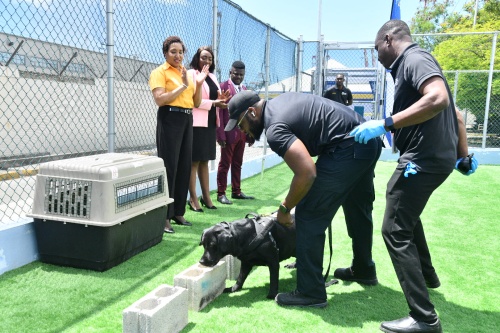
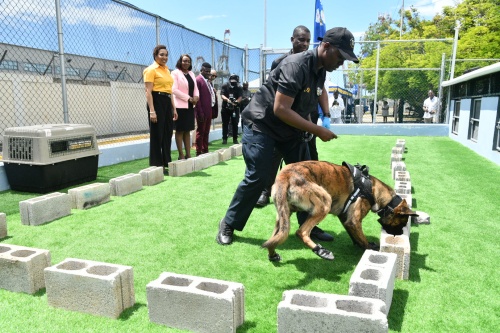
Dog handler, Tanya Bourne (left), and canine partner Cooper demonstrate specialised skills at the launch of the new Jamaica Customs Agency (JCA) Canine Programme at Newport West, Kingston, on Monday (March 30). Observing is Supervisor, Contraband Enforcement Team, JCA, O'Neil Smart.The Full Story
The Jamaica Customs Agency (JCA) has launched its new Canine Programme, equipped with 12 staff and eight specially trained dogs that can detect firearms, ammunition, narcotics, currency and other illegal items at Jamaica’s ports.
The approximately US$600,000 investment represents a crucial milestone in the JCA’s mission to safeguard the nation’s borders and facilitate safe and secure trade and travel.
It will enhance interdiction efforts, ensuring that unregulated, restricted and prohibited goods that threaten the economy and national security do not enter the country.
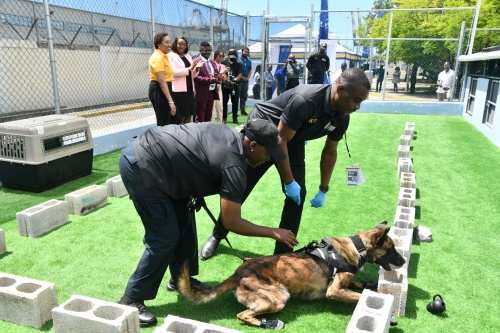
Chief Executive Officer (CEO) of the JCA and Commissioner of Customs, Dr. Velma Ricketts Walker, said that the programme, with the eight “silent guardians of our borders”, is already making an impact.
“Even in this early phase, the canine team has supported the detection of contraband, demonstrating their effectiveness in real operational settings,” she said.
Dr. Ricketts Walker was speaking at the official opening of the kennel, located at the JCA’s Newport West location on Monday (March 30).
She noted that the canine team brings heightened detection capability, enhanced operational efficiency and serves as a powerful deterrent against criminality, in a world where illicit trade is no longer predictable or straightforward.
“We confront organised transnational networks, synthetic drugs that devastate lives, firearms that fuel violence, and consignment techniques designed to defeat traditional controls. Technology alone cannot detect everything. There’s need for instinct, there’s a need for speed, there’s need for precision, and that is what our canine team brings to this mission,” she pointed out.
Dr. Ricketts Walker said that the country’s borders are not just lines on a map but active spaces that must be constantly monitored, protected and managed across land, sea and air.
“The canine unit now strengthens that system. It enhances our ability to validate intelligence, it enhances our ability to sharpen targeted, routine and high-risk inspection, and it increases detection with speed and accuracy,” she said, noting that it directly addresses the need for modern, effective, and efficient contraband-detection mechanisms.
“As Commissioner, there have been many defining moments, moments of challenge, moments of uncertainty, and moments where the question was ‘are we truly equipped for what we are facing?’ Because the truth is, those who seek to exploit our borders are not standing still. They are evolving. They are adapting and they are becoming more sophisticated, and so we were faced with a choice. We could remain comfortable or we could become more adaptable, so this Canine Programme is our answer,” she said.
The opening of the Newport West kennel represents the first phase of the Canine Programme, with the second phase to involve the opening of another facility in Montego Bay.