


Jamaica Urged to Reimagine Economic Model for Climate Resilience
By: , March 31, 2026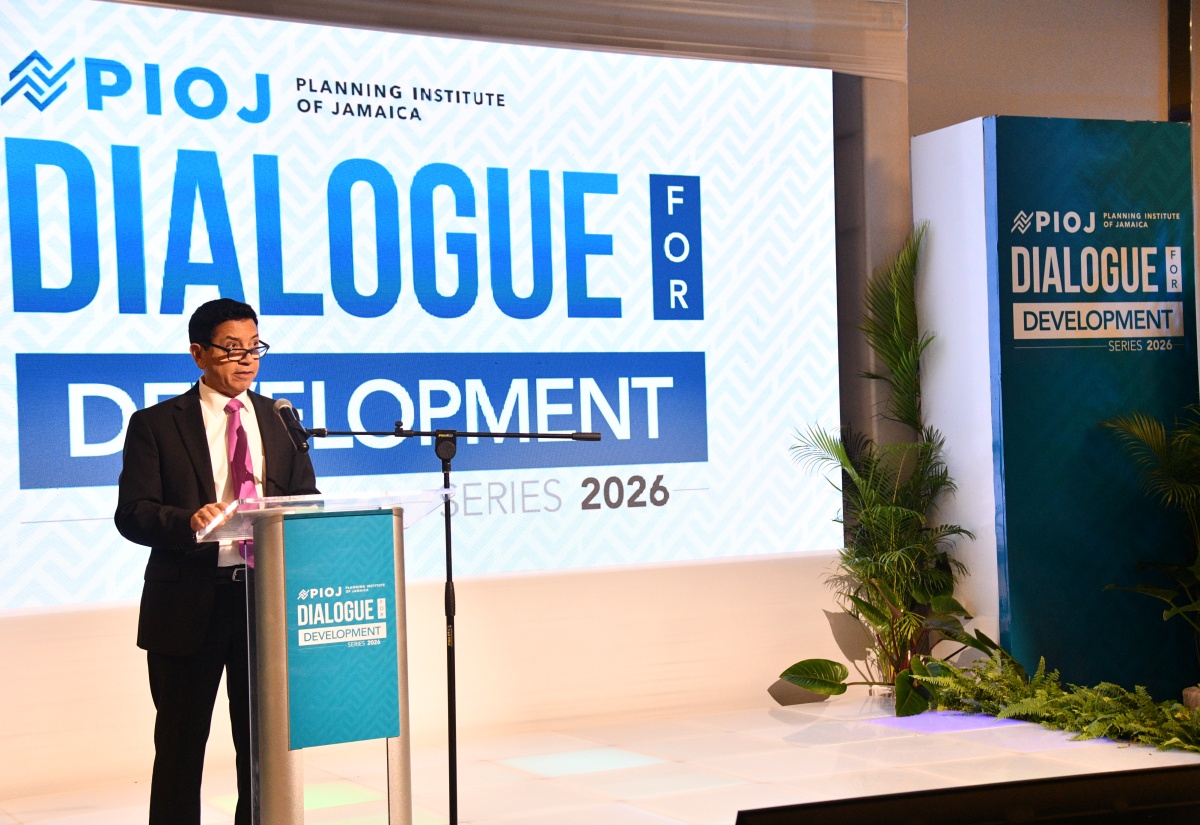
Photo: Michael Sloley
President and Founder of Washington DC-based data analytics and business consulting company, NoBrainerData, Dr. José Miguel Guzmán, addresses the Planning Institute of Jamaica (PIOJ) Dialogue for Development Distinguished Lecture Series 2026, held recently at The Jamaica Pegasus hotel in New Kingston.The Full Story
Jamaica is being urged to craft a strategic roadmap that reimagines its economic model, enabling the nation to better withstand external shocks, particularly those driven by climate change.
The call was made by President and Founder of Washington-DC-based data analytics and business consulting company NoBrainerData, Dr. José Miguel Guzmán, as he addressed the recent
Planning Institute of Jamaica (PIOJ) Dialogue for Development Distinguished Lecture Series 2026, held at The Jamaica Pegasus hotel in New Kingston.
Dr. Guzmán emphasised that building national resilience demands a fundamental rethinking of how Jamaica values care work and invests in social infrastructure.
“We cannot build national resilience on the back of informal, unpaid, and untrained labour,” he declared, stressing that caregiving must be elevated to the same level of priority as essential physical assets.
“Care employment must be treated as critical resilience infrastructure. This approach transforms a demographic liability into an economic asset, ensuring that the recovery from future shocks does not come at the cost of long-term development or widening inequality,” Dr. Guzmán stated
The international population development specialist argued that Jamaica must move beyond reactive responses to economic and environmental shocks, embedding long-term resilience within its national development planning framework.
Regarding Jamaica’s economic performance, Dr. Guzmán highlighted that the International Monetary Fund (IMF) has commended the country for its management of recent global shocks and natural disasters, describing its response as agile, prudent, and supportive of growth.
He cautioned, however, that the next phase of Jamaica’s development will demand deeper structural reforms. Quoting the IMF’s assessment, he noted that “a multipronged approach is required to overcome supply-side constraints to growth”.
Dr. Guzmán further cautioned policymakers against what he termed “risk-blind planning”. warning that such an approach could trigger a “reversal trap” in national development”.
“If recovery repeatedly rebuilds yesterday’s systems, restoring the same vulnerabilities in the exact locations with the same fragmentation, then the next event wipes out the same investments again, and public spending drifts into a recurring cycle of repair rather than sustained progress,” he explained.
Dr. Guzmán underscored that policies and infrastructure must be deliberately designed to account for Jamaica’s future climate realities, population size, and structure, treating these factors as integral to both fiscal and social planning.
He further emphasised that this is “no longer an optional add-on but a fundamental requirement for national sustainability”.
The Dialogue for Development Distinguished Lecture was held under the theme ‘Harnessing the Future: Reimagining Sustainable Development’.
First staged in 2011, the series was established by the PIOJ as a platform to engage civil society and other stakeholders in dialogue on issues critical to Jamaica’s national development.