

Work Continues on National Radiological Emergency Response Framework
By: , September 15, 2026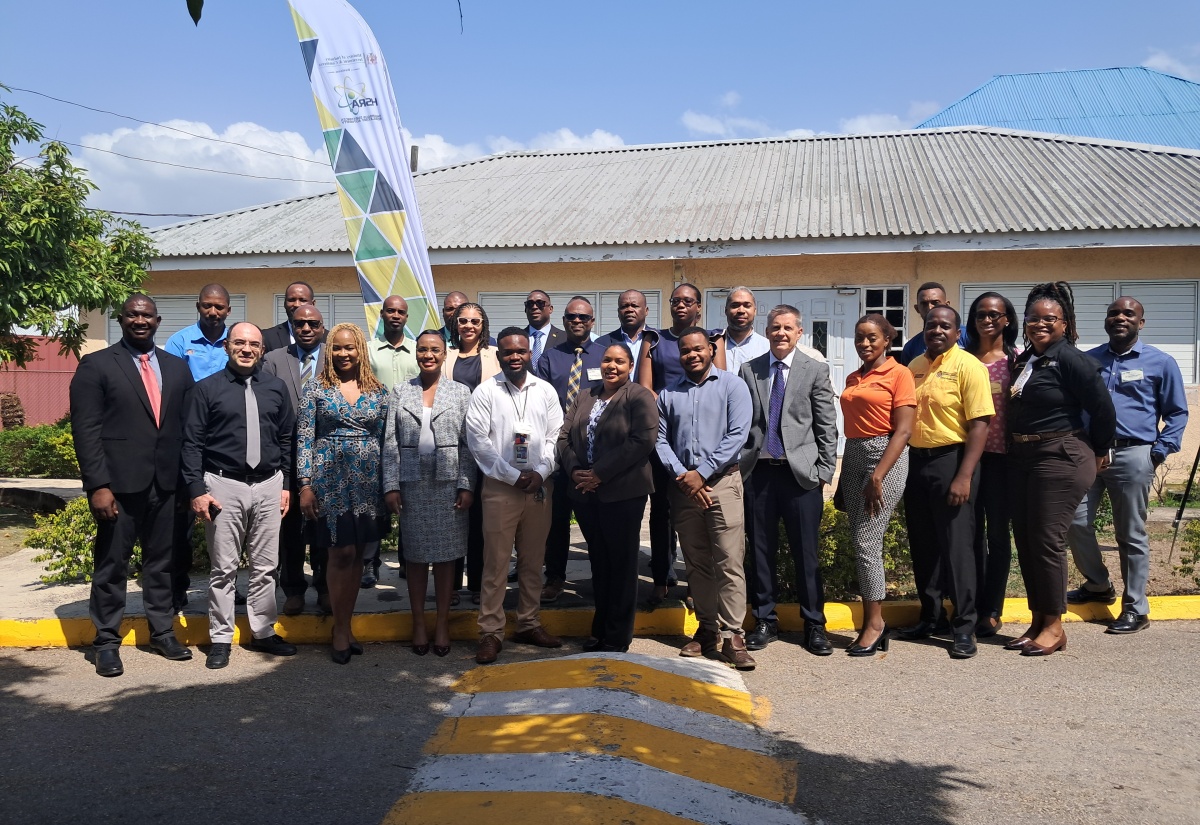
Photo: Sherika Williams
Participants in the International Atomic Energy Agency (IAEA) National Training Course on Arrangements for Preparedness and Response in Case of Nuclear or Radiological Emergency pose for a group photograph during the opening ceremony at the Hazardous Substances Regulatory Authority (HSRA) head office in Kingston on September 14. The five-day training, being implemented through the IAEA’s Technical Cooperation for Latin America and the Caribbean (TCLAC) and its Incident and Emergency Centre (IEC), is helping to advance Jamaica’s national radiological emergency response framework.The Full Story
Efforts to finalise Jamaica’s national radiological emergency response framework are being advanced through a five-day training course involving more than 40 participants from approximately 15 agencies and institutions.
The International Atomic Energy Agency (IAEA) National Training Course on Arrangements for Preparedness and Response in Case of Nuclear or Radiological Emergency began today (September 14), at the Hazardous Substances Regulatory Authority (HSRA) head office in Kingston.
The training, which runs until September 18, is being implemented through the IAEA’s Technical Cooperation for Latin America and the Caribbean (TCLAC) and its Incident and Emergency Centre (IEC).
Participants are drawn from the HSRA, Office of Disaster Preparedness and Emergency Management (ODPEM), Ministry of Health and Wellness, Jamaica Constabulary Force, Jamaica Fire Brigade, National Environment and Planning Agency (NEPA), National Solid Waste Management Authority (NSWMA), Maritime Authority of Jamaica and other key stakeholders.
Director General of the HSRA, Dr. Cliff Riley, told JIS News that the training is critical to advancing work already under way to establish a comprehensive national plan for responding to radiological incidents and emergencies.
“We already have a draft radiological incident emergency response plan, and throughout this activity these institutions will have a better idea of what their roles and responsibilities should look like, and how those roles and responsibilities are shared and implemented in other countries,” he said.
Dr. Riley explained that the plan is intended to establish clear arrangements for coordination, management and command during a radiological emergency, while ensuring that the response is integrated into Jamaica’s wider disaster risk management framework.
“What we aim to achieve is to finalise a really logical and comprehensive response plan that covers the coordination, the management and the command for all activities that involve radiological materials,” he said.
He noted that a radiological emergency could result from an accident, deliberate act or natural hazard, including earthquakes and fires, making it necessary for agencies to understand their respective responsibilities and how they will work together.
The response framework will also address communication with the public, which is particularly important given the invisible nature of radiation and the potential for misinformation and panic during an emergency.
Dr. Riley pointed out that “unlike with most materials, for radiological materials, you can’t see the harm, you can’t feel the harm but the effects will be felt in the long term.”
The Director General said work is also being undertaken with ODPEM and other stakeholders towards establishing an incident command and coordination mechanism that can link radiological emergency response with the national emergency operations structure.
This, he said, would help to ensure that resources and information are coordinated effectively and that public communication is managed through a clear and unified approach.
The training is being supported by IAEA experts, including specialists sharing international experience in the planning and management of radiological emergencies.
Dr. Riley said the international expertise will help Jamaican agencies to assess the draft framework, refine their respective roles and strengthen the technical capacity and confidence of personnel who would be required to respond.
Speaking at the opening ceremony, North East Region Coordinator at ODPEM, Marlon Brown, underscored the importance of the multi-agency approach, noting that no single institution can manage a radiological emergency on its own.
“A radiological emergency cannot be managed by one agency. It requires a coordinated response, technical precision and a multi-agency approach,” he said.
Mr. Brown said the training is providing participants with specialised knowledge and practical skills that will be essential to strengthening Jamaica’s emergency management capabilities.
“Developing these competencies is not just an academic exercise. It is an imperative step towards securing our national emergency framework against low-probability, high-impact incidents,” he said.
The training will cover critical areas, including command and control structures, operational arrangements, accident response, radiation monitoring, emergency communication and cross-agency cooperation.
Participants will also take part in practical exercises and simulations to strengthen their understanding of their respective roles.
Mr. Brown encouraged participants to fully engage in the sessions and use the knowledge gained to strengthen their agencies’ preparedness arrangements.
For her part, Chief Technical Coordinator (CTD) in the Ministry of Industry, Investment and Commerce, Latoya Richards-Franklin, highlighted the importance of collaboration in ensuring that Jamaica’s radiation-safety arrangements are effective.
She said the objective is not only to establish the necessary legislative and institutional arrangements but also to ensure that the various systems are properly connected and able to operate effectively.
Mrs. Richards-Franklin noted that Jamaica’s continued partnership with the IAEA is important to strengthening the country’s capacity to manage radiological risks and protect its citizens.
She stressed that preparedness must begin well before an emergency occurs, noting that “preparedness does not begin when an emergency occurs. It begins long before that [with] proper planning, clear responsibilities, procedures, the right resources and equipment, and most importantly, people who are trained and ready to respond,” she said.
Mrs. Richards-Franklin highlighted that although Jamaica has been fortunate not to experience a major radiological emergency, the country must use that opportunity to strengthen its preparedness.
The training, she said, “gives us an opportunity to put the necessary arrangements in place before such an event occurs, and we must use that opportunity wisely”.
At the end of the training, participating agencies are expected to have a clearer understanding of their roles and responsibilities and identify areas requiring further strengthening.
The initiative forms part of Jamaica’s wider efforts to enhance its radiation-safety infrastructure and ensure that the country has the systems, expertise and trained personnel necessary to respond effectively to a radiological emergency.