



Total Loss and Damage from Hurricane Melissa Estimated at $1.952 Trillion
By: , March 6, 2026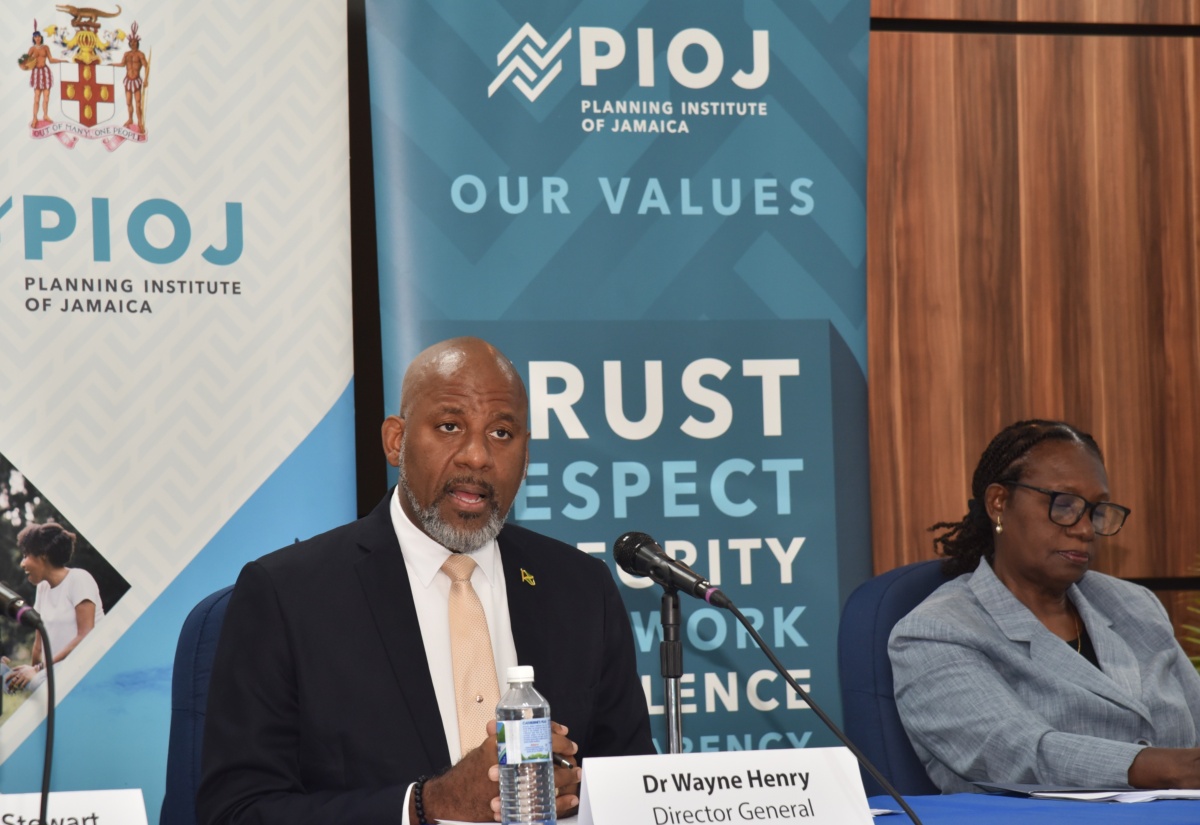
Photo: Mark Bell
Director General, Planning Institute of Jamaica (PIOJ), Dr. Wayne Henry, responds to a question during the PIOJ’s quarterly hybrid media briefing on the performance of the economy for the period October to December 2025 on Tuesday (March 3). At right is Deputy Director General, PIOJ, Claire Bernard.The Full Story
Total damage and losses associated with the passage of Hurricane Melissa are estimated at $1.952 trillion (US$12.2 billion), says Director General, Planning Institute of Jamaica (PIOJ), Dr. Wayne Henry.
This figure is equivalent to 56.7 per cent of Jamaica’s 2024 gross domestic product (GDP).
It is up from earlier estimates from the Inter-American Development Bank (IDB), which placed the cost for physical damage at US$8.8 billion, equivalent to 41 per cent of the country’s 2024 GDP.
Dr. Henry was speaking on Tuesday (March 3), during the PIOJ’s quarterly hybrid media briefing on the performance of the economy for the period October to December 2025.
He indicated that the figure represents more than four times that of Hurricane Gilbert, previously the costliest hurricane in Jamaica’s history.
He informed that the findings emerged from a comprehensive damage and loss assessment (DALA) prepared by the United Nations Economic Commission for Latin America and the Caribbean in collaboration with the Government.
Dr. Henry said that the assessment examined the hurricane’s impact across the social, productive, and infrastructure sectors.
The social sector focused on the affected population, education, health, housing, and culture. The productive sectors analyzed agriculture and livestock, fisheries and aquaculture, tourism, commerce, and industry, while the infrastructure sector analysis comprised transportation, power, water and sewerage, and telecommunications.
Dr. Henry said that the report included a cross-cutting assessment of the effects suffered by the environmental sector and the overall macroeconomic impacts.
Hurricane Melissa caused severe damage across six most-affected parishes, namely Westmoreland, St. Elizabeth, St. James, St. Ann, Trelawny, and Manchester.
Dr. Henry said that the cross-sectoral impact disrupted lives, livelihoods, and economic, social, cultural, and environmental systems. Housing, tourism, education, health, agriculture, energy, transport, telecommunications, and other economic and social infrastructure were significantly affected, with damage and losses recorded islandwide.
He pointed out that prior to the hurricane, Jamaica’s economy was projected to record real GDP growth of 2.2 per cent for fiscal year 2025/2026. However, the post-disaster estimates indicate a contraction, with real GDP initially projected to decline by 4.3 per cent.
“This would translate to a reduction of 6.5 percentage points in the GDP growth rate for fiscal year 2025/2026. It should be noted, however, that based on the strength of the recovery to date, the current outlook for fiscal year 2025/2026 has been revised to a point estimate of negative 1.4 per cent. This would now translate into a reduction of 3.6 percentage points in the GDP growth estimate for the current fiscal year,” Dr. Henry informed.
He said that the hurricane is also expected to trigger significant short-term fiscal slippage.
“The overall fiscal deficit is projected to be 3.5 per cent of GDP… compared with the balanced budget originally targeted. The fiscal out-turn will be adversely affected by developments on both the revenue and expenditure sides,” he said.
Dr. Henry shared that the DALA outlines recommendations to guide the recovery process across all assessed sectors.
“Anchored in the principle of Build Forward Better, these recommendations emphasise not only safer reconstruction but also the need to address underlying vulnerabilities, development gaps, and chronic risk drivers. Recovery efforts are structured across three phases – rehabilitation, resilient reconstruction, and building long-term resilience,” the Director General said.