


Study Shows Strong Potential for Sustainable Aviation Fuel Production
By: , April 17, 2026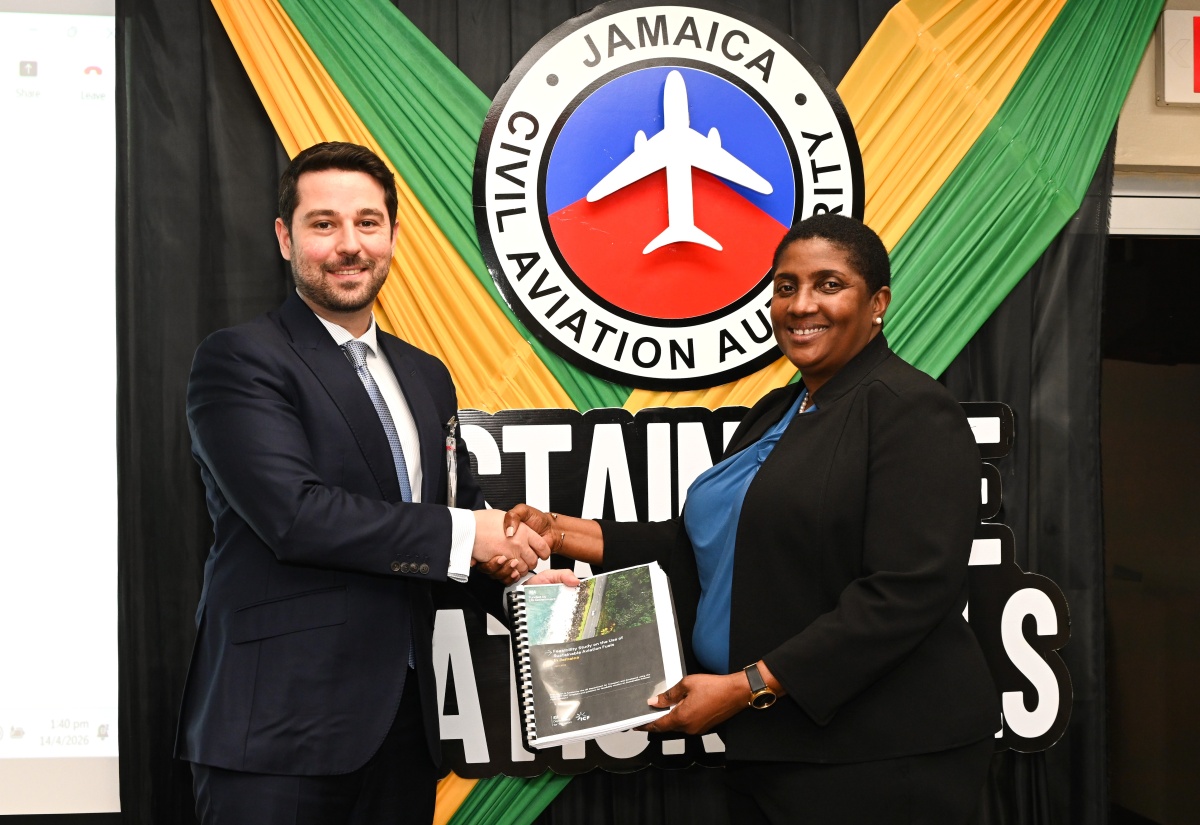
Photo: Contributed
Acting Director General of the Jamaica Civil Aviation Authority (JCAA), Nichole Morgan, receives the findings of a Sustainable Aviation Fuel Feasibility Study from Sustainable Aviation Senior Manager at ICF Consulting, Yasar Yetiskin, at the handover exercise on Tuesday, April 14, at the JCAA’s Winchester Road headquarters in Kingston.The Full Story
Jamaica has significant potential to develop a sustainable aviation fuel (SAF) industry, which could support economic growth, reduce carbon emissions, and strengthen energy security.
This is according to findings from a feasibility study presented to stakeholders at the Jamaica Civil Aviation Authority (JCAA), Winchester Road headquarters in Kingston, on Tuesday, April 14.
The study was conducted by ICF Consulting and forms part of a global initiative under the International Civil Aviation Organization (ICAO) Assistance, Capacity Building and Training for Sustainable Aviation Fuels (ACT-SAF) Programme.
The project, funded by the United Kingdom’s Department for Transport, examined Jamaica’s readiness to produce SAF using locally available resources.
Sustainable Aviation Senior Manager at ICF, Yasar Yetiskin, who presented the findings, highlighted the scope of the feasibility study.
“The study explored the role of sustainable aviation fuels in Jamaica’s aviation decarbonisation journey, as well as its role in creating jobs, attracting investments, and reducing the dependency on crude oil,” he said.
He noted that while aviation is an important driver of the economy, it is susceptible to environmental shocks such as extreme weather conditions, which makes reducing emissions a priority.
“What we have realised is that aviation is the backbone of Jamaica’s economy, connectivity, and long-term development, while its vulnerability to climate change makes emission reduction a national priority,” Mr. Yetiskin explained.
The study found that Jamaica possesses a diverse range of feedstock suitable for SAF production.
These include waste oils, municipal solid waste, agricultural residue, such as sugar-cane by-products, biogas, and industrial carbon dioxide. One important finding is that domestic resources could potentially meet or even exceed projected fuel demand.
“In theory, you could actually produce all your jet fuel demand using domestic feedstock,” Mr. Yetiskin said.
Currently, Jamaica uses approximately 200 kilotonnes of conventional jet fuel annually.
This is projected to increase to about 280 kilotonnes by 2050, with between 110 and 170 kilotonnes potentially supplied by SAF under medium-to-high-adoption scenarios.
The study outlines three development scenarios, requiring investments ranging from US$450 million to US$800 million, with the potential to create between 400 and 800 permanent jobs and up to 1,000 temporary jobs during construction.
Carbon emission reductions are estimated at between 1.6 million and 5.6 million tonnes.
Mr. Yetiskin emphasised that early action will be critical, noting that “waste oils… provide an opportunity to start producing SAF as soon as possible because they can be converted… with existing technologies”.
The findings provide a strong basis for policy development and investment planning as Jamaica advances efforts to decarbonise its aviation sector and build a sustainable energy future.