


Stricter Border Requirements Under New Motorcycle Helmet Standard
By: , April 8, 2026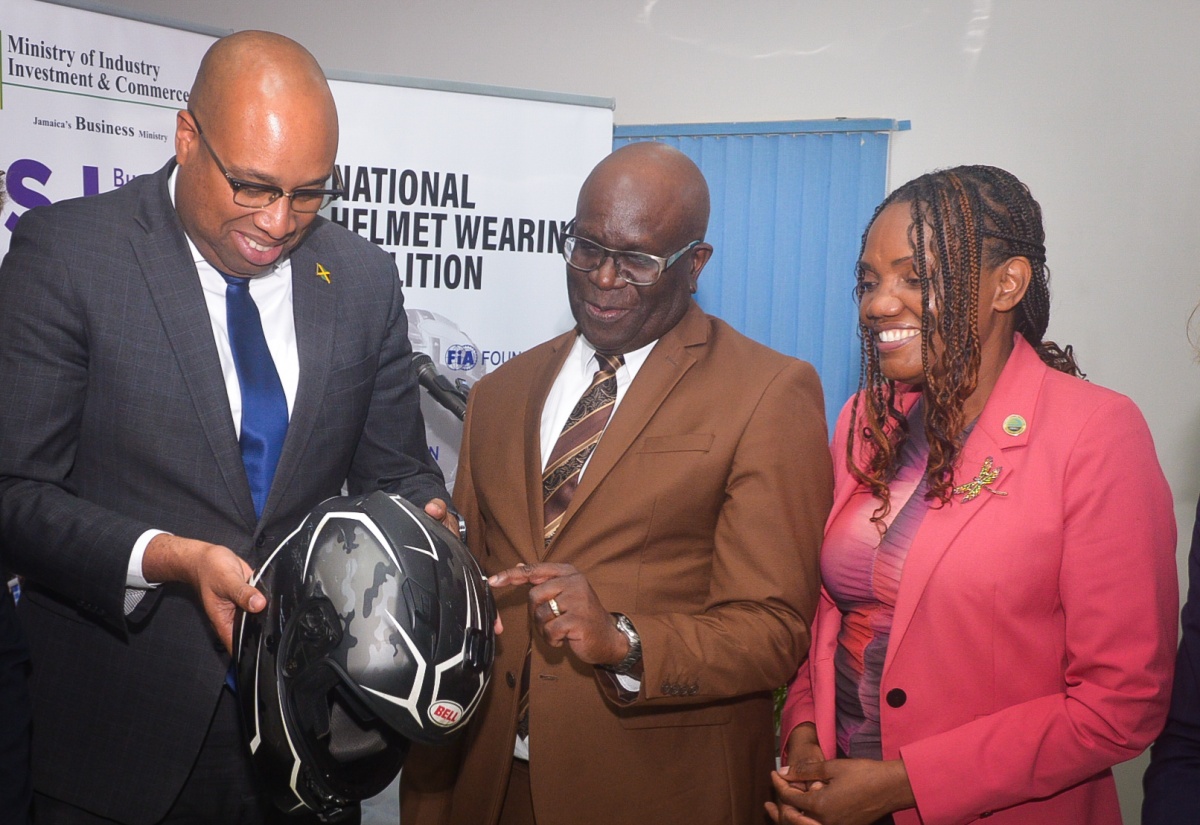
Photo: Dave Reid
State Minister in the Ministry of Industry, Investment and Commerce, Hon. Delano Seiveright (left); Executive Director of the Bureau of Standards Jamaica (BSJ), Dr. Velton Gooden; and Chief Executive Officer of the CARICOM Regional Organisation for Standards and Quality (CROSQ), Dr. Sharonmae Smith Walker, examine a helmet during the launch of the BSJ's Motorcycle Helmet Standard – JS 374:2025 Jamaica Standard Specification – Protective Helmets for Road Users, on March 31. The launch took place at the Jamaica Business Development Corporation (JBDC) Incubator and Resource Centre in Kingston.The Full Story
Stricter border requirements will be enforced under the new Motorcycle Helmet Standard, JS 374:2025 – Jamaica Standard Specification for Protective Helmets for Road Users.
The Standard, launched by the Bureau of Standards Jamaica (BSJ) on March 31, sets out comprehensive stipulations governing the design, quality, and performance of protective helmets.
It establishes minimum safety requirements to ensure that helmets used by motorcyclists and other road users provide effective protection, while also supporting stricter border enforcement to prevent the importation of non compliant products.
Among the stipulated requirements, helmets must be manufactured from high quality, rigorously tested materials that are resistant to wear, weather conditions, and ultraviolet (UV) exposure.
They must meet minimum thresholds for shock absorption to reduce the risk of head trauma in collisions, and demonstrate penetration resistance to protect against sharp objects.

In addition, straps and fasteners must be strong, secure, and resistant to slippage under stress, while the design must allow adequate peripheral vision to ensure safe riding. These specifications collectively ensure that helmets provide reliable protection and meet international safety benchmarks.
Addressing the launch of the Standard at the Jamaica Business Development Corporation (JBDC) Incubator and Resource Centre in Kingston, State Minister in the Ministry of Industry, Investment and Commerce, Hon. Delano Seiveright, highlighted the importance of the new Motorcycle Helmet Standard.
He noted global evidence from the World Health Organization (WHO), which indicates that wearing quality helmets reduces the risk of death by 40 per cent and the likelihood of severe head injury by up to 70 per cent.
Mr. Seiveright, in this regard, further underscored the importance of strengthening the surveillance mechanism at Jamaica’s ports of entry under the newly established Standard.
“Countries that have combined standards with enforcement and public education have seen significant reduction in fatalities and injuries. Jamaica is now firmly aligning with that proven global approach,” he noted, adding “this reinforces how absolutely important this initiative is.”
The State Minister pointed out that strengthening the surveillance mechanism at the ports of entry, “is something we have been working on aggressively over the years”.
“We have made significant progress. [This] has provided the technical foundation for consumer protection, compliance testing, and enforcement across the supply chain,” he added.
Mr. Seiveright, in this regard, reaffirmed that the Ministry is fully committed to supporting the BSJ in advancing the next critical phase of the Motorcycle Helmet Standard’s effective implementation and enforcement.
This, he noted, includes strengthening systems at Jamaica’s ports of entry to prevent non compliant helmets from entering the market, enhancing market surveillance to remove unsafe products already in circulation, building local capacity for testing and conformity assessment, and supporting Jamaica’s move to become a regional hub for helmet testing and certification.
“This is also about creating a fair and transparent marketplace. We want to protect consumers, we want to protect legitimate businesses, we want to prevent the dumping of unsafe low-quality products and, of course, we want to align Jamaica with international best practices in trade and product safety,” the State Minister further pointed out.
Mr. Seiveright emphasised that the initiative is fully aligned with the Government’s broader road safety agenda.
“Enforcement, public education, and safer infrastructure must work together. We must ensure that our roads are safer, are properly marked and properly lit. None of these can succeed without reliable standards and compliance and protective equipment,” he said.
The State Minister emphasised that the Standard “provides clarity for enforcement agencies… authority and measurable benchmarks”.
“To consumers, it provides confidence… and for every motorcyclist and family in Jamaica, it provides a greater chance of survival. The true value of this Standard will not be measured by its publication but by its impact. It is going to save lives, prevent and lessen injuries, and build out a stronger culture of safety across our country,” Mr. Seiveright maintained.
In his remarks, BSJ Executive Director, Dr. Velton Gooden, stressed that all importers and distributors will be required to ensure that the helmets they place on the Jamaican market fully comply with the specifications outlined in the Standard.
“For our colleagues in border control, for regulators, and enforcement agencies, it will serve to strengthen surveillance and compliance requirements,” he added.