



SDC Advancing Citizen Participation in Governance to Drive Social Change
By: , January 23, 2026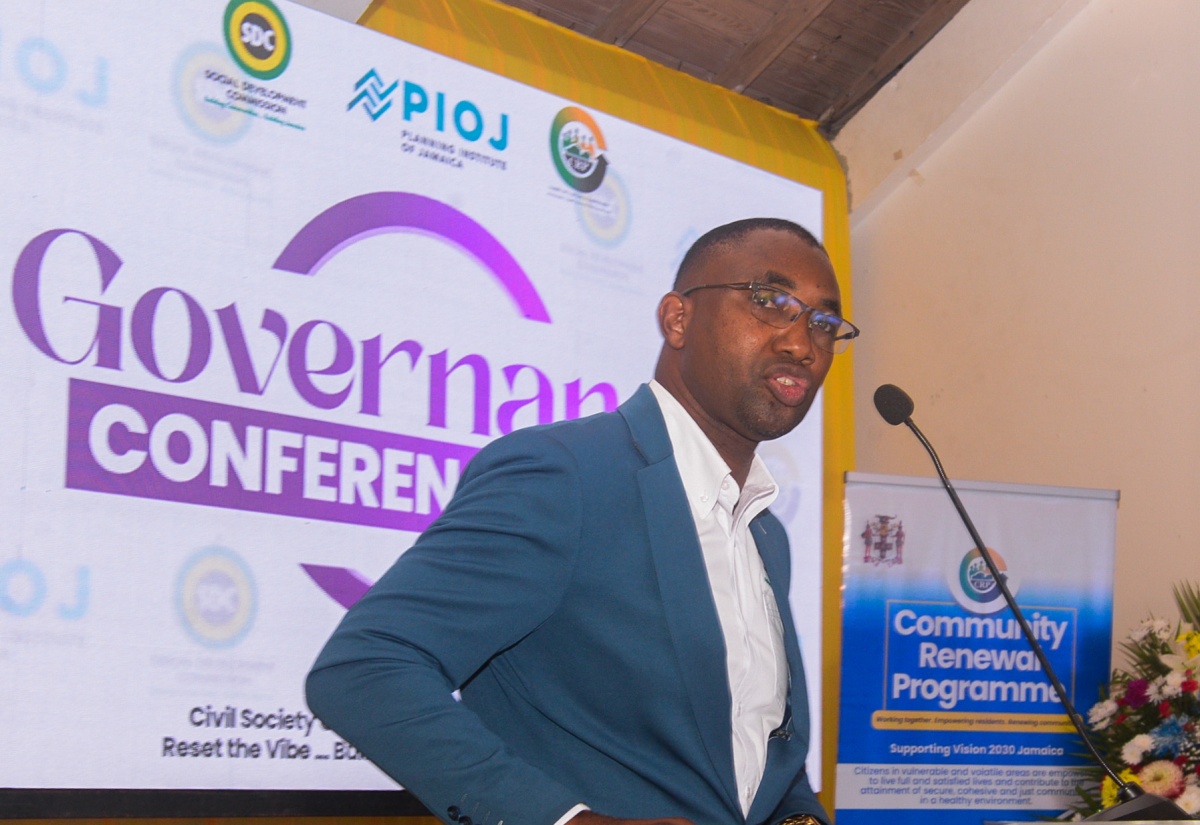
Photo: Dave Reid
Executive Director of the Social Development Commission (SDC), Omar Frith, addresses the SDC’s Greater St. Catherine Governance Conference on Wednesday (January 21) at the Caymanas Golf Club.The Full Story
The Social Development Commission (SDC) is advancing citizen participation in governance as a catalyst for social change.
Executive Director, Omar Frith, says a central feature of the Commission’s programme offering is its emphasis on participatory governance.
“When we speak of democracy, we speak of citizens’ empowerment. The SDC has a significant role in ensuring that there are structured mechanisms available at the community level through which citizens can actively contribute to decision-making, [and also that] they can identify problems that face their specific locations [and] articulate solutions. These solutions are going to go well for positive change in their spaces,” he said.
Mr. Frith was speaking with JIS News during the SDC’s Greater St. Catherine Governance Conference, hosted on Wednesday (January 21) at the Caymanas Golf Club.
In a move to strengthen the governance of civil society and community-based organisations, the SDC, in strategic partnership with the Community Renewal Programme (CRP) of the Planning Institute of Jamaica (PIOJ), hosted a series of five parish conferences and four financial management workshops.
The conferences engaged more than 300 dedicated community leaders across the parishes and equipped them with essential tools to build more resilient and accountable communities.
Mr. Frith said the SDC, through local governance mechanisms, aims to empower ordinary citizens to recognise that they are key stakeholders.
“Even government at a central level that must make decisions… those decisions are to be informed by what is relevant and what is evidence-based in your specific circumstances. The only way that kind of participation and our information can filter into decision-making is for citizens to have formal mechanisms and structures,” he said.
The Executive Director emphasised that participatory governance represents a critical pillar of democracy.
“While this is important, we are still in a culture, in spite of the fact that we have the benefit of democracy, where there are persons who see change and implementation as resident in the hands of the elected official, the central government authorities, and many people see themselves as victims or simply spectators in development,” he added.
The SDC’s participatory planning guide promotes governance in which an informed citizenry is empowered to engage in crucial planning and decision‑making processes, ultimately fostering stronger and more resilient communities.
The anticipated outcomes of the conferences include strengthening citizens’ engagement in local governance processes, leading to more effective community groups that positively impact quality of life, as well as improved transparency and accountability between executive bodies and their general membership.