

RTC Creating New Caribbean Civilisation – Chief Justice
By: , January 17, 2025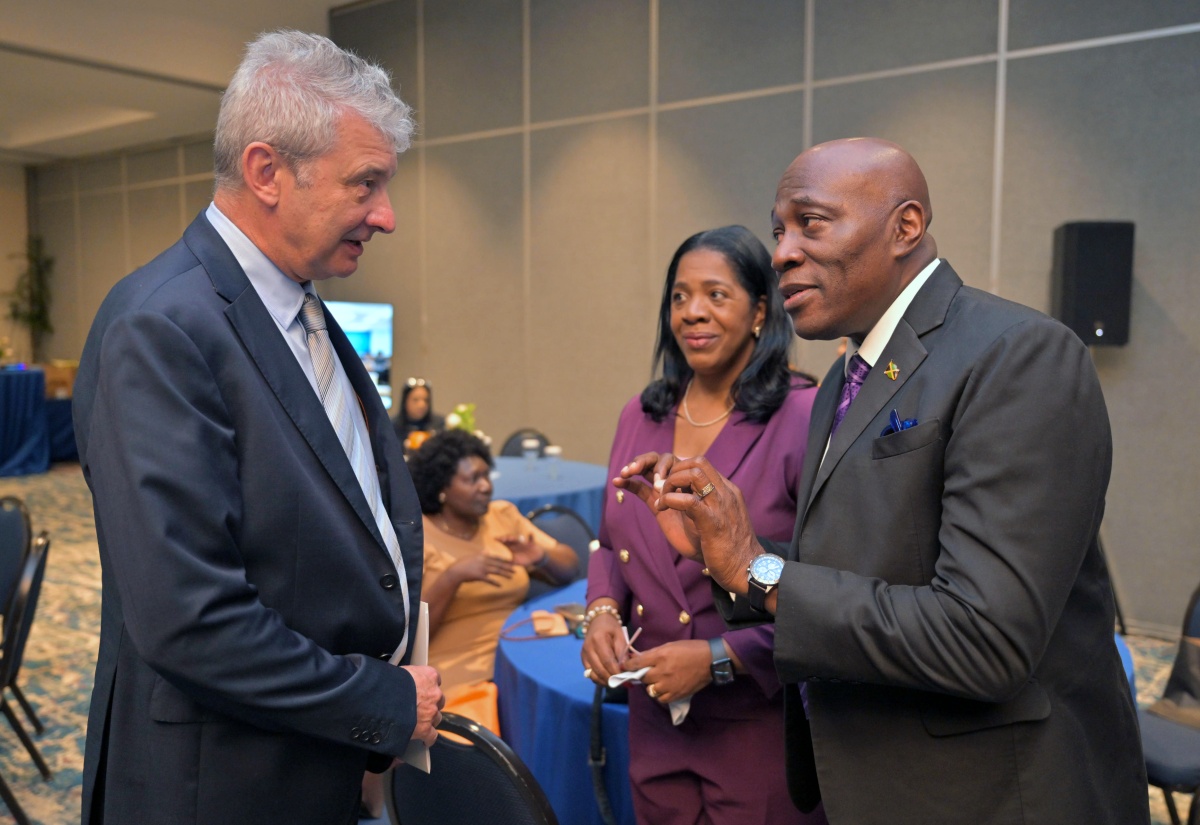
Photo: Yhomo Hutchinson
Chief Justice, Hon. Bryan Sykes (right), in conversation with Chargé d’Affaires, European Union Delegation in Jamaica, Piotr Byczkowski (left), during the recent Caribbean Court of Justice (CCJ) workshop, held at The Jamaica Pegasus hotel in New Kingston. Listening at centre is President of the Court of Appeal, Hon. Justice Marva McDonald Bishop.The Full Story
The Revised Treaty of Chaguaramas (RTC) is “creating a new Caribbean civilisation, not based on Colonialism and slavery but on economic development, the development of human capital, and the movement of persons and capital across the region”.
This was stated by Chief Justice, Hon. Bryan Sykes, at the recent Caribbean Court of Justice (CCJ) workshop, held at The Jamaica Pegasus hotel in New Kingston.
He also noted that the revised Treaty addresses the dispute resolution mechanism, adding that “this is where the Caribbean Court of Justice comes in”.
The revised Treaty was signed on July 5, 2001 by CARICOM Member States, in Nassau, The Bahamas, for the establishment of the Caribbean Single Market and Economy (CSME) and to enhance functional cooperation, including more efficient operation of common services and activities for the benefit of its peoples, accelerated promotion of greater understanding among its peoples and the advancement of their social, cultural, and technological development.
Mr. Sykes pointed out that articles in the Treaty are an “ambitious intention to rebuild our Caribbean societies”.
He said the forum was about the “referral of matters” to the CCJ and matters that may arise in the local courts that involve interpretation of the Revised Treaty, adding that the RTC has not figured in “our consciousness as judicial officers and as law students, but it should”.
“It is one of the most important Treaties that Jamaica has entered into since Independence,” the Chief Justice emphasised.
For her part, President of the Court of Appeal, Hon. Justice Marva McDonald Bishop, said the event was nothing less than a “groundbreaking, eye-opening and informative experience of immense value to the judiciary of Jamaica and to each of us individually”.
“It is a privilege for us, the judiciary of Jamaica, and I think I can speak on behalf of all of us, to be afforded this opportunity to explore this significant and crucial aspect of the regional legal framework under the guidance of these renowned experts and jurists who form the faculty,” she said.
Meanwhile, Chargé d’Affaires, European Union Delegation in Jamaica, Piotr Byczkowski, said the workshop formed a “critical component” of the EU support to the CCJ programme, a project that has already “achieved remarkable progress” in improving access and delivery of justice in the region.
“The programme’s objective is both far-reaching and profoundly impactful,” he said.
With financial support from the European Union’s 11th European Development Fund, the workshop sought to promote collaboration, knowledge-sharing, and adherence to international best practices, ultimately reinforcing the rule of law and the effective delivery of justice across the Caribbean region.