


Prime Minister Welcomes Historic US$6.7b Financing Package to Drive Jamaica’s Recovery and Resilience
By: , December 3, 2025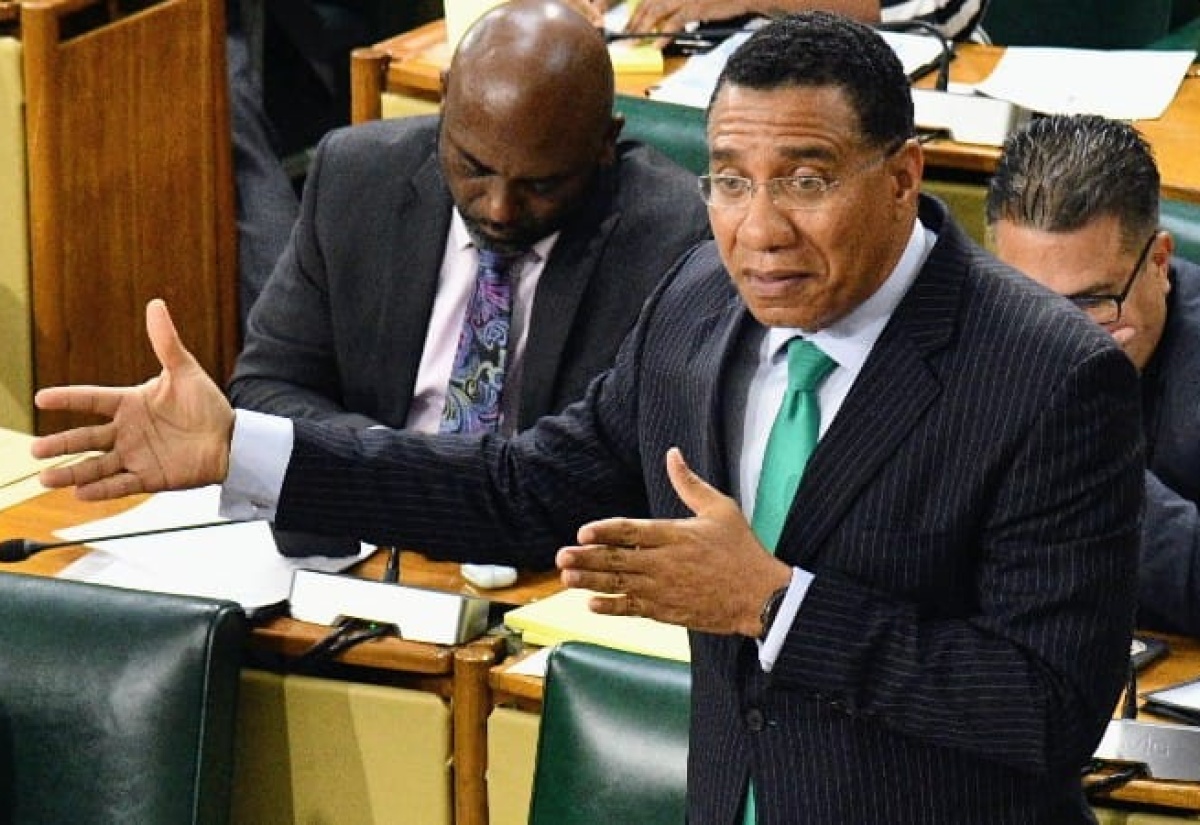
Photo: Michael Sloley
Prime Minister, Dr. the Most Hon. Andrew Holness, addresses the House of Representatives on Tuesday (December 2).The Full Story
Prime Minister, Dr. the Most Hon. Andrew Holness, has welcomed the three‑year coordinated financing package of up to US$6.7 billion, designed to support Jamaica’s recovery, reconstruction, and long‑term resilience in the aftermath of Hurricane Melissa.
The funds will be facilitated through CAF – Development Bank of Latin America and the Caribbean, the Caribbean Development Bank (CDB), the Inter-American Development Bank (IDB) Group, the International Monetary Fund (IMF), and the World Bank Group (WBG).
Addressing the House of Representatives on Tuesday (December 2), Dr. Holness stated that the package is the single largest and most comprehensive development financing arrangement ever assembled for Jamaica.
“It gives us the liquidity, the fiscal space and the multi-year investment framework required to rebuild stronger and more secure for our future. Securing support of this magnitude within one month of Hurricane Melissa is nothing short of historic. It reflects sustained, direct and proactive engagement at the heart of the recovery,” he said.
The Prime Minister further noted that the swift response from the international financial institutions (IFIs) represents a direct vote of confidence in Jamaica’s governance.
“It reflects the credibility we have built through the years of fiscal discipline in managing our economy, reducing our debt, strengthening institutions, and in managing corruption, which is the lowest of any period of government. Jamaica today stands as a credible, responsible and trustworthy sovereign, and it is that credibility which unlocked this extraordinary level of global support at our moment of greatest need,” Dr. Holness said.
The US$6.7-billion financing package comprises three main components, including US$3.6 billion in sovereign debt financing.
“This is for the Government to execute the national recovery and reconstruction programme over the next three years and includes up to US$1 billion each from the World Bank, IDB and CAF; US$415 million from the IMF under the large natural disaster window of the Rapid Financing Instrument (RFI) and US$200 million from the CDB,” Dr. Holness outlined.
The second component of funding comprises US$2.4 billion in private capital mobilisation. IDB Invest, the International Finance Corporation (IFC), and the Multilateral Investment Guarantee Agency (MIGA) will mobilise private investment through public‑private partnership models.
“It is important to note that mobilising private capital will be critical, not only to scale up recovery efforts but also to preserve fiscal space. It is not intended [that] the sovereign debt pool and the private financing pool will operate independent of each other. The plan is to use innovative public-private partnership solutions and structures that blend public and private finance and expertise throughout the recovery and reconstruction process,” the Prime Minister said.
The third component comprises grants and technical assistance.
So far, US$12 million in grants has already been mobilised from the IDB, the WBG and CAF, with additional support expected.
Dr. Holness noted that Jamaica already has in place a multi‑layered disaster risk financing framework, the product of years of strategic planning, disciplined financial management, and proactive investment in resilience.
He explained that this framework enabled a rapid early response and the immediate mobilisation of liquidity to meet the most urgent needs within days of Hurricane Melissa.
“Jamaica activated several instruments across our risk financing architecture.
We had approximately $5.3 billion in the Contingencies Fund and $1 billion in the National Natural Disaster Reserve Fund. We received US$91 million from the Caribbean Catastrophe Risk Insurance Facility (CCRIF)…, and then we had US$150 million under the Catastrophe Bond triggered immediately, based upon climate parametric thresholds,” the Prime Minister outlined.
In addition, US$300 million was available through the IDB’s Contingent Credit Facility (CCF), along with US$42 million – scalable to US$84 million – accessible upon request under the WBG’s Catastrophe Deferred Drawdown Option.
This facilitated an immediate inflow of critical liquidity to supplement the Government’s own contingency resources, bringing the total to US$662 million.
“This is the very definition of planning, preparedness and responsible governance. Our multi-layered approach ensured that Jamaica did not wait helplessly for external support. We were prepared and ready to act, ready to deliver and ready to protect our people. However, the scale of the disaster is without precedence in our history,” Dr. Holness said.
He noted that the widespread infrastructure damage, displacement of thousands of families, destruction of livelihoods and long‑term economic impacts “mean that additional financing is required to support the reconstruction effort and to build a more resilient Jamaica”.
“It is against this backdrop of strong national preparedness that the international community has now rallied behind Jamaica, recognising that we are not merely seeking help. We are ready to lead, ready to rebuild and ready to transform,” the Prime Minister emphasised.
Dr. Holness stated that he, together with Minister of Finance and the Public Service, Hon. Fayval Williams, met with the heads of the institutions to outline the next steps, align implementation pathways, and prepare for rapid disbursement.
“The message from the IFIs… could not have been clearer. They told us directly that Jamaica, already the case study of fiscal responsibility for the world, now has the chance to become the poster child for post-disaster recovery and reconstruction,” he said.
“They commended the Government for [our] decision to establish the National Reconstruction and Resilience Authority (NaRRA), noting that few countries act so quickly to set up a modern, best-practice central coordinating body to drive recovery with discipline, transparency, inclusivity and a long-term vision,” the Prime Minister added.
He further stated that these institutions are not viewing Jamaica as a country in crisis, “and for the record, neither is the Government”.
“We see this as an opportunity. They are looking at Jamaica as a global standard setter. The world is watching Jamaica, not just with empathy but with admiration, respect and expectations. We now have a rare opportunity to show what a small nation, united in purpose and confident in its future, can achieve on the global stage,” Prime Minister Holness declared.