


Prime Minister Hands Over State-of-the-Art Essex Valley Agro-Processing Facility
By: , February 5, 2026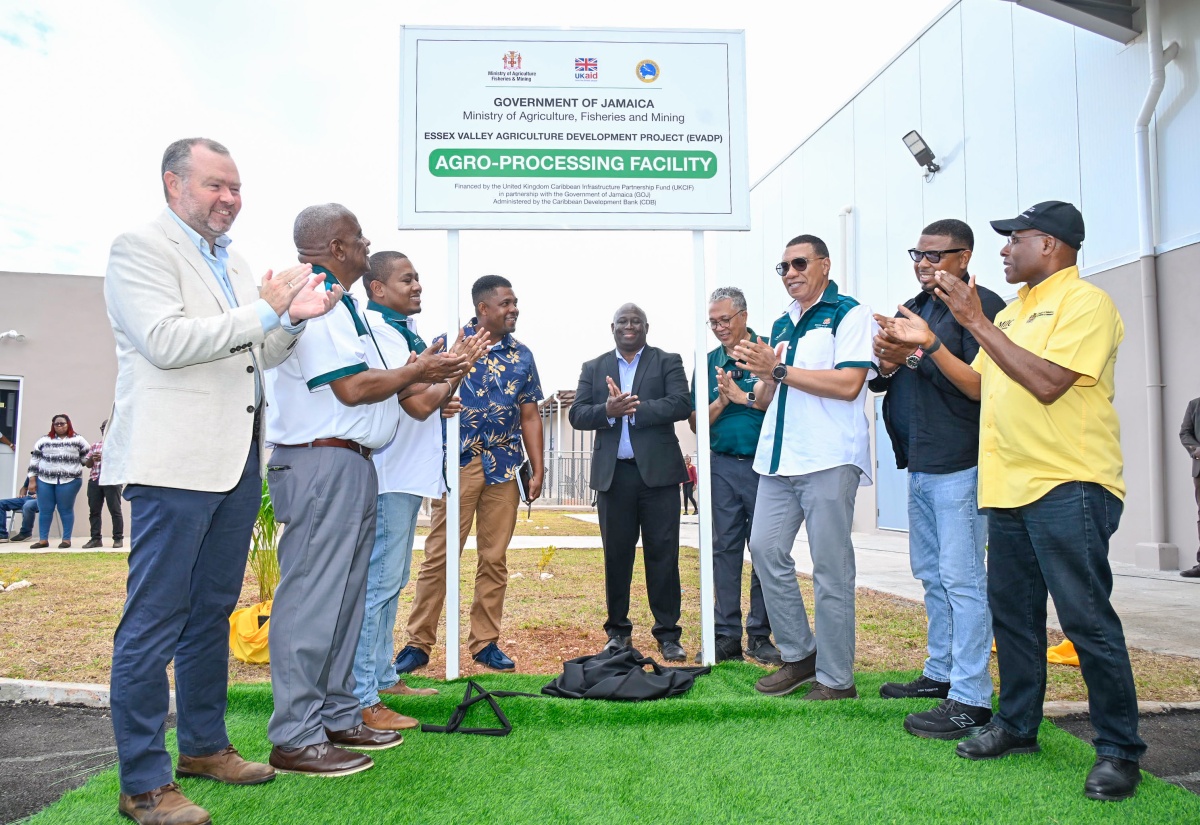
Photo: Donald De La Haye
Prime Minister, Dr. the Most Hon. Andrew Holness (third right), officially hands over the state-of-the-art Essex Valley Agro-Processing and Administrative Building in St. Elizabeth, on Wednesday, February 4. He is joined by (from left) Development Representative for Jamaica at the British High Commission, Andrew Bowden; State Minister in the Ministry of Agriculture, Fisheries and Mining, Hon. Franklin Witter; Minister of Agriculture, Fisheries and Mining, Hon. Floyd Green; Farmer, Marcus Vassell; Division Chief of Social Sector Division at the Caribbean Development Bank, Dr. Martin Baptiste; Agro-invest CEO, Vivion Scully; President of the Essex Valley Benevolent Society, Imran Powell; and Minister of Industry, Investment and Commerce, Senator the Hon. Aubyn Hill;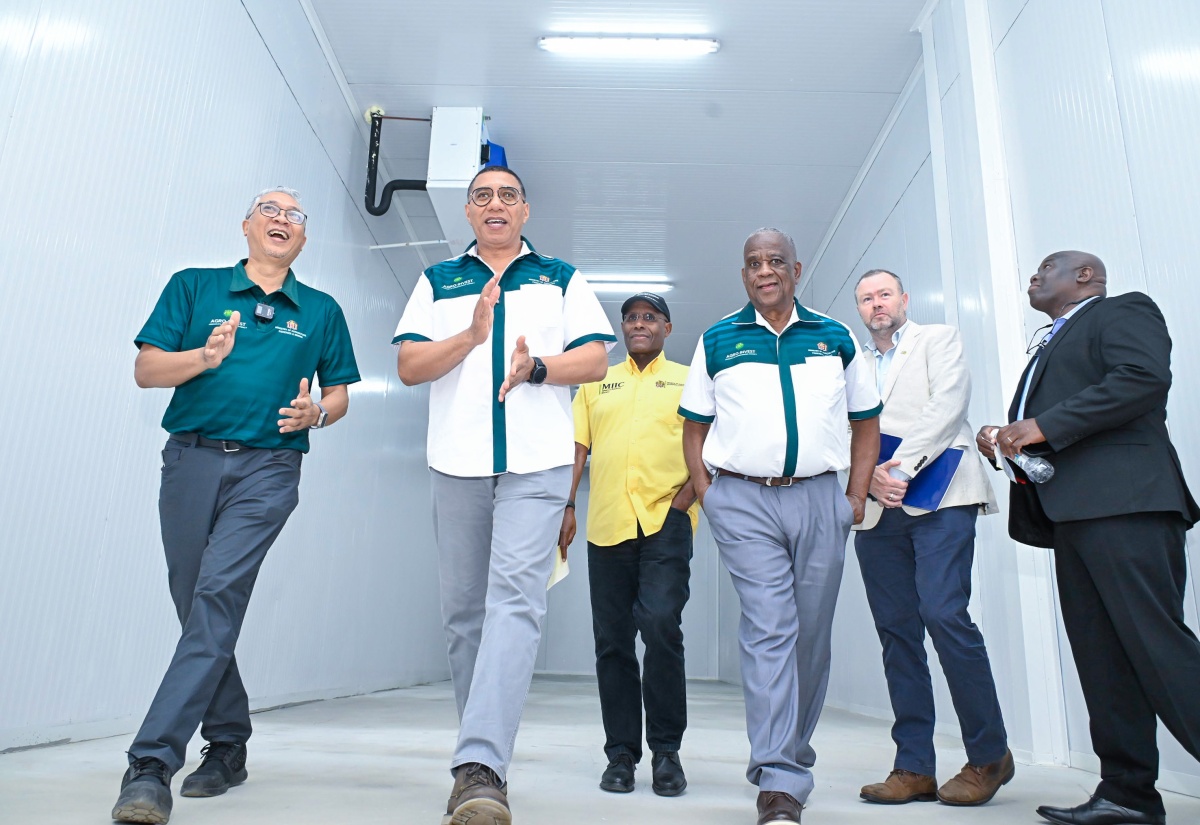
Photo: Donald De La Haye
Prime Minister, Dr. the Most Hon. Andrew Holness (second left), assesses the cold storage of the state-of-the-art Essex Valley Agro-Processing and Administrative Building in St. Elizabeth, which was officially handed over on Wednesday, February 4. He is joined by (from left) Agro-invest CEO, Vivion Scully; Minister of Industry, Investment and Commerce, Senator the Hon. Aubyn Hill; State Minister in the Ministry of Agriculture, Fisheries and Mining, Hon. Franklin Witter; Development Representative for Jamaica at the British High Commission, Andrew Bowden; and Division Chief of Social Sector Division at the Caribbean Development Bank, Dr. Martin Baptiste.The Full Story
Prime Minister, Dr. the Most Hon. Andrew Holness, on Wednesday (February 4), officially handed over the state-of-the-art Essex Valley Agro-Processing and Administrative Building in St. Elizabeth.
The facility was funded through a £53-million investment from the United Kingdom Caribbean Infrastructure Fund (UKCIF), in partnership with the Caribbean Development Bank (CDB).
It is touted as a breakthrough model for creating agricultural economic zones that will modernise farming and stabilise food prices for Jamaican consumers.
In his address, Dr. Holness pointed out that the new facility will help to manage the dramatic swings in crop output that send prices soaring one season and plummeting the next.
He said that given agriculture’s “big logistics operation,” the new infrastructure aims to cluster farmers together and give them end-to-end control of their supply chain from production through to processing, storage and distribution.
“So, you need storage, and what we have built here is a massive facility to store excess output, but more than that, we have cold storage and facilities that will allow for processing,” Dr. Holness outlined.
“So, if there is an excess of tomatoes, why not make paste or ketchup; if there’s pepper then make pepper mash, and so now we have the capabilities to do it close to the point of production and that is going to help to make the market far more efficient,” he continued.
The agro-processing facility sits on 24,000 square feet of land and has the capacity to handle approximately 17,000 kilogrammes of agricultural produce each week.
Farmers in the region will now be able to process fruits into juices, purées and concentrates; wash, grade and package vegetables for supermarkets; and safely store fresh produce for export markets.
Moreover, the accompanying administrative building will serve as a dedicated agricultural services hub, designed to streamline support for farmers and agro-processors throughout St. Elizabeth and other parishes.
“Jamaica has a long-standing outreach service to farmers through RADA, and the field officers have long been supporting farmers. In fact, the mother farm concept with agricultural cooperatives is something rooted in Jamaica. So, what we want to do with our agricultural economic zones or agro parks is to plan out all the support services for agriculture in a way that is efficient by virtue of accessibility,” Dr. Holness explained.
He said despite the gains in the sector, modern agriculture requires much more to include reliable distribution networks, steady access to inputs like fertiliser and irrigation supplies, effective transportation and improved farm roads.
The Prime Minister indicated that climate change and the emergence of new plant diseases are among the broader issues affecting agriculture. This demands increased investment in research, improved crop varieties and innovation, he noted.
“Another problem you face in agriculture is that there’s so much interest now, particularly from young people, and in particular young women who want to get involved in agriculture. They are asking, where is the farm land? So, they hear about agro invest and agro parks, and we (Government) have to increase the pace at which we bring more lands into production,” Dr. Holness underscored.
In the meantime, Minister of Agriculture, Fisheries and Mining, Hon. Floyd Green, said the plan is to replicate this hub model across the island.
He pointed out that the concept brings together storage, processing facilities and key government agencies, such as Agro-Invest, the National Irrigation Commission (NIC) and the Rural Agricultural Development Authority (RADA), in one central location.
“So, this is the model we’re going to replicate. In fact, already we are with a project going through the process around the old agro parks to get some of these infrastructure going, and all the new agro parks that we do going forward will have something like this one,” Mr. Green said.
For his part, Development Representative for Jamaica at the British High Commission, Andrew Bowden, noted that the Essex Valley Development Project forms part of a wider UK investment of £350 million across 13 major resilient infrastructure projects in the Caribbean.
He explained that these initiatives focus on strengthening water systems, roads, bridges, ports and climate-resilient agriculture across the region.