


PM Urges Jamaicans to Focus on Resilience Building
By: , September 24, 2026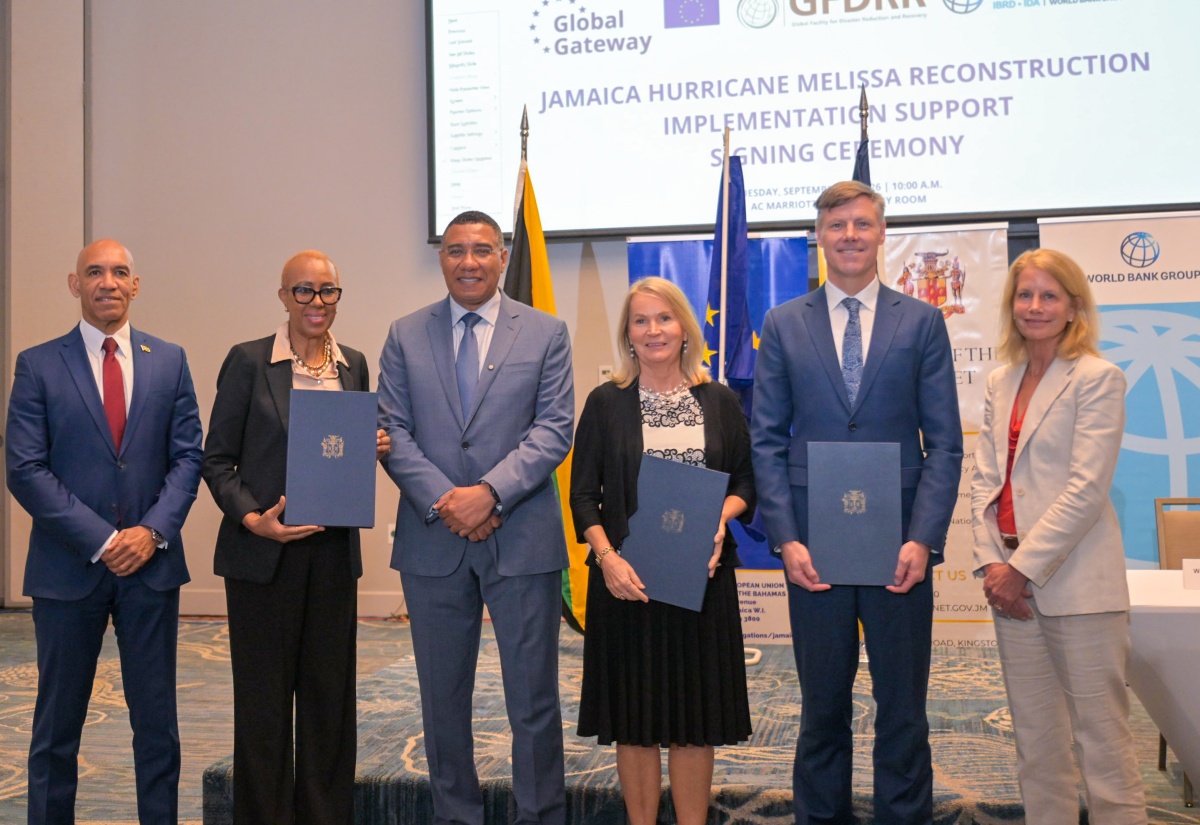
Photo: Yhomo Hutchinson
Prime Minister, Dr. the Most Hon. Andrew Holness (third left), participates in the signing ceremony of the Jamaica Hurricane Melissa Reconstruction Implementation Support Project at the AC Marriot Hotel in St. Andrew on September 22. From left are Chief Executive Officer of the National Reconstruction and Resilience Authority (NaRRA), Ambassador Major General (Ret’d) Antony Anderson; Minister of Finance and the Public Service, Hon. Fayval Williams; Head of the European Union Delegation to Jamaica, Belize and The Bahamas, Her Excellency, Dr. Erja Askola; Division Director for the Caribbean, World Bank, Dr. Achim Fock; and Head of Office, World Bank Jamaica, E. Gail Richardson.The Full Story
Prime Minister, Dr. the Most Hon. Andrew Holness, is urging Jamaicans to place resilience at the centre of their home investment decisions.
He noted that as climate alters weather patterns, threatening communities, lives and livelihoods, the choice of how and where to buy or build becomes crucial.
“Every day, Jamaicans are making decisions… about where they are going to build. I am reaching out to those people who have chosen to go and build houses in riverbeds, on unstable gully banks, on slopes that are known to be unstable, that we now must consider that the investment that you are making in your home in these areas that are prone to disasters, that we must reconsider them,” he said.
He said that persons should ensure that houses are better equipped to withstand extreme weather.
“I would encourage everyone to consider the climate issues, whether it is the storms that will come, the shifting soil on which you may be building, the heat; consider all these factors in where you choose to live and choose to build,” he appealed.
The Prime Minister was addressing Tuesday’s (September 22) signing ceremony for a US$5-million grant agreement between the Government, the European Union (EU) and the World Bank to bolster the country’s capacity to deliver the national reconstruction and resilience programme.
The agreement, in support of the Jamaica Hurricane Melissa Reconstruction Implementation Support Project, was signed at the AC Hotel in St. Andrew on September 22.
The Prime Minister said the impact of Hurricane Melissa provides an opportunity to reorganise Jamaica to be able to withstand more frequent, more intense, and sometimes overlapping natural disasters, which will mean relocation, consolidation, and building stronger.
“It may mean bigger drains, new gully courses, converting roofs from zinc sheeting to concrete, stronger building codes, new building systems and moving our roads from the coast more inland. It may mean building a new airport because both our airports are at sea level on the coast,” he pointed out.
“It may mean building a road network, a highway network, passing through all the parishes that keep the country connected regardless of what natural disaster may come. It may mean moving hospitals that are on the coast to safer, higher ground and building them to a new standard. Same thing for our police stations, our fire brigade, our parish council offices,” Dr. Holness said.