



PM Outlines Post-Hurricane Melissa Development Plan
By: , March 23, 2026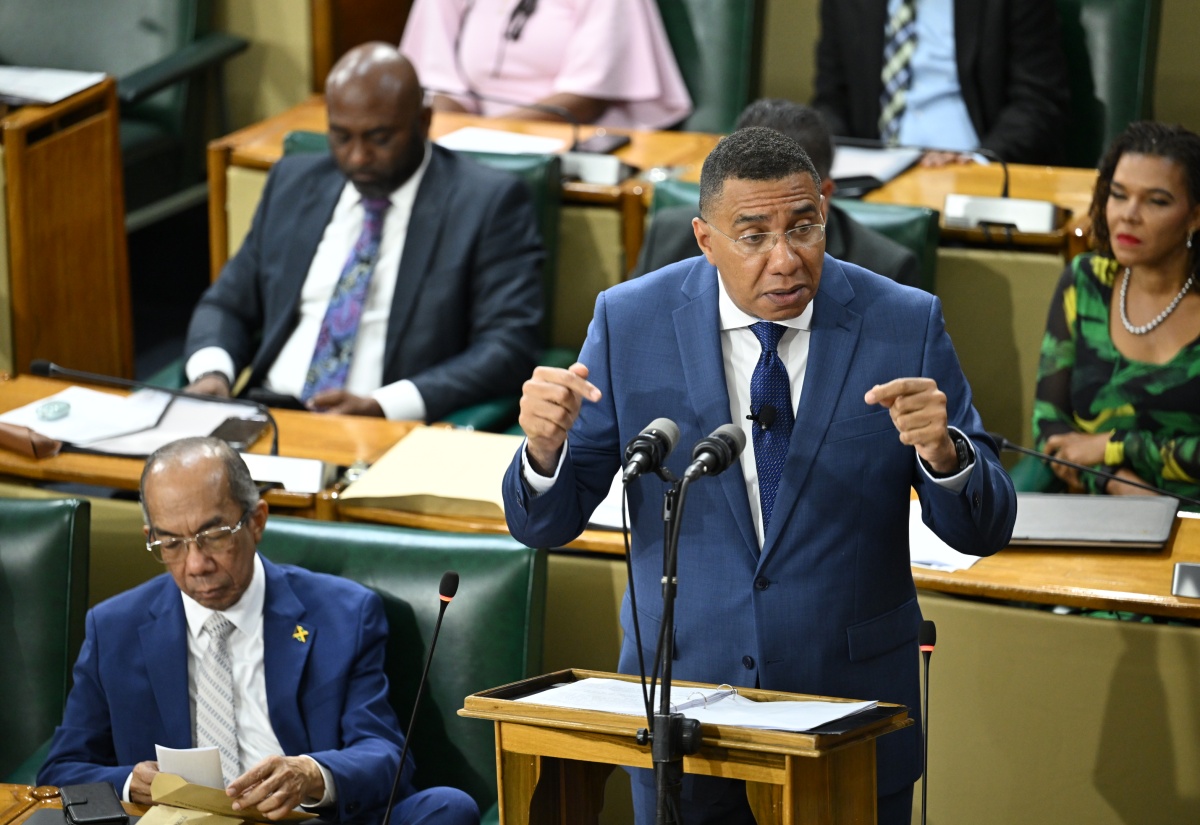
Photo: Adrian Walker
Prime Minister, Dr. the Most Hon. Andrew Holness, delivers his 2026/2027 Budget Debate presentation in the House of Representatives on Thursday (March 19).The Full Story
Prime Minister, Dr. the Most Hon. Andrew Holness, has announced a national strategy to redefine Jamaica’s approach to development in the wake of Hurricane Melissa.
Using the redevelopment of Black River, St. Elizabeth, as a template, the Prime Minister outlined four foundational principles designed to transition the nation from a state of climate fragility to resilience.
During his 2026/27 Budget Debate presentation in the House of Representatives on Thursday (March 19), Dr. Holness provided plans to redevelop the coastal town, using climate-smart strategies that can withstand the impact of major hurricanes.
“The same questions that Hurricane Melissa forced on Black River must now be confronted everywhere, and the answers must be guided by the same logic, applied consistently, deliberately, and at national scale,” Dr. Holness maintained.
The first pillar, he outlined, is the need for strategic spatial planning and risk-informed development.
He noted that the devastation in Black River was a direct result of decades of development made without regard for hazard mapping, flood risk or climate projections, emphasising that this needs to change.
“Critical national infrastructure must progressively be relocated away from high-risk coastal zones. Hospitals, schools, utilities, highways, and logistic facilities must be positioned with full regard to storm surge, flooding, and sea-level rise. Where we build is as important as what we build,” he said.
Furthermore, the Prime Minister introduced the principle of building redundancy into distributed systems across critical infrastructure.
He noted that the concentration of Black River’s civic core in a single exposed corridor allowed Hurricane Melissa to compromise the entire system simultaneously.
To prevent such failure in the future, Dr. Holness stressed that the country’s transportation corridor, power systems, water supply, telecommunications network, and logistic systems must be engineered with back-up capacity.
“[This ensures that] when one part of the system is struck, the rest keeps functioning. Resilience is incompatible with single points of failure,” Dr. Holness said.
The third principle of the national strategy is the integration of regional development and resilient economic clusters.
Using the Black River plan as a model, the Prime Minister explained that resilience cannot be built in isolation or on a project-by-project basis.
“It has to be built by a network. Connectivity, roads, hospitals, schools, housing, energy systems, and government services must be planned together to create a self-sustaining regional ecosystem,” he emphasised.
Finally, the Prime Minister highlighted the necessity of economic diversification and production resilience.
He argued that a resilient nation must be physically strong as well as economically adaptable.
Dr. Holness noted that the redevelopment of the Black River waterfront will serve as a blueprint for this, anchoring not only tourism but also wellness, marine recreation, and culinary offerings rooted in the agricultural identity of St. Elizabeth.
“That diversification, away from dependence on a single sector, any single market, any single source of economic activity, is the model for Jamaica as a whole. We must broaden our productive base,” he said.
As the country seeks to rebuild stronger, Dr. Holness gave the Government’s commitment to use the redevelopment of Black River as the blueprint of the lessons learnt from Hurricane Melissa, which will be applied to other parishes and communities that face similar challenges to the coastal town.