


Parliament to Establish Joint Select Committee to Review Jury Act
By: , January 14, 2026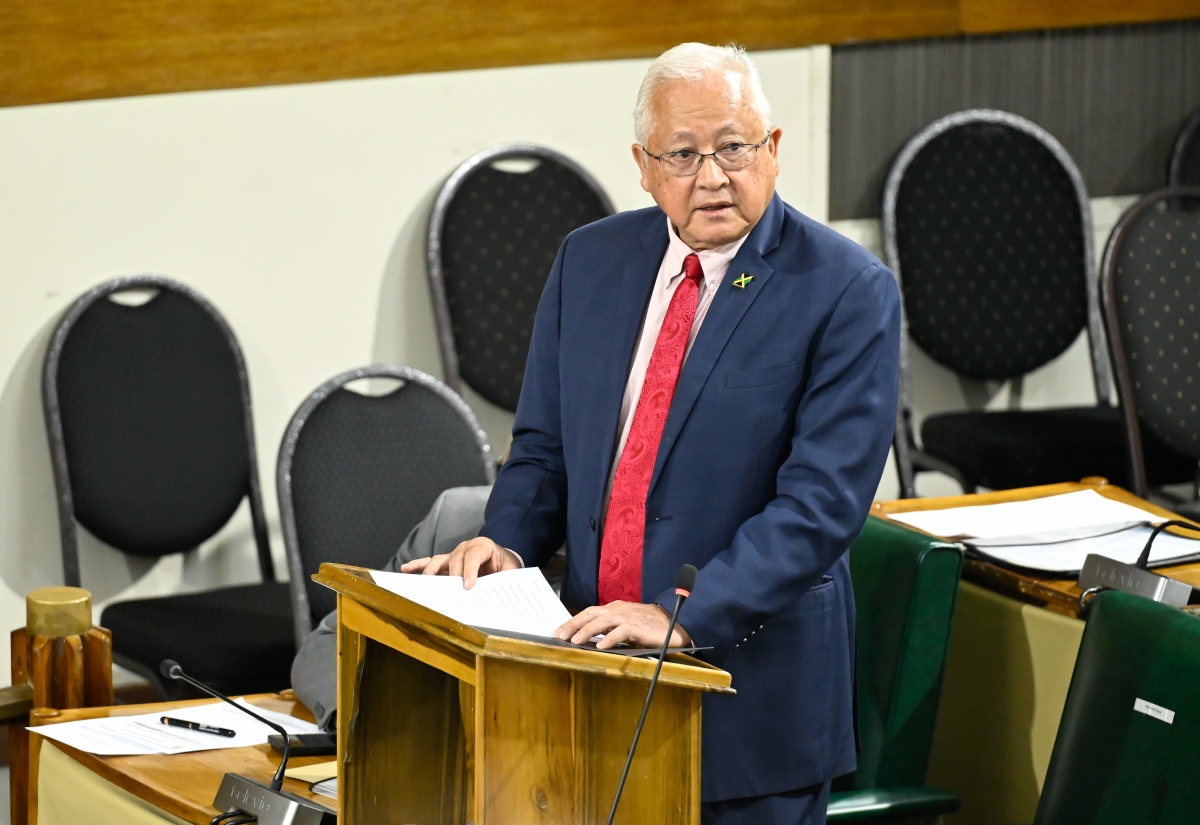
Photo: Donald De La Haye
Minister of Justice and Constitutional Affairs, Hon. Delroy Chuck, makes a statement to the House of Representatives on Tuesday (January 13).The Full Story
A Joint Select Committee of Parliament is to be established to examine matters relating to the Jury Act.
This was disclosed by Minister of Justice and Constitutional Affairs, Hon. Delroy Chuck, during a statement to the House of Representatives on Tuesday (January 13).
He noted that the Committee will, in particular, examine and receive recommendations from stakeholders in the justice sector as well as the wider public on whether jury trials should continue to be a feature of the court system.
The deliberations will also consider which cases are most appropriate for jury or bench trials, and whether Jamaica should contemplate abolishing jury trials altogether in favour of bench trials only.
Mr. Chuck explained that the matter of jury trials versus bench trials has been in the public domain for some time, with Chief Justice, Hon. Bryan Sykes, publicly encouraging defence lawyers to make greater use of the latter as one solution to reducing the case backlog in the criminal courts.
“Recognising that jury trials have been a hallmark of our justice system, this is a matter that Parliament should decide on, taking into account the suggestions and recommendations from all stakeholders within the justice system and the wider public. Following that process, the House will be in a better position to make a final and well-informed decision,” the Minister said.
He further noted that the Chief Justice recently highlighted that more than 3,000 criminal matters are currently awaiting trial in the Supreme and Circuit Courts.
“My understanding is that most of the Court rooms remain available for trial, in particular the Supreme Court. As such, any delay in commencing or completing a trial could not be attributed to a lack of court space. Over the last 10 years we have increased the number of Judges in the Supreme Court, as well as in the Parish Courts, who can be utilised to act, if necessary, in Circuit Court trials,” Mr. Chuck said.
“We were also successful in doubling the number of prosecutors as we continue to provide the necessary resources towards, among other things, reducing the backlog and ensuring a first-class justice system that is comparable to international standards. As suggested by the Chief Justice and reiterated by me – we cannot try all cases within a reasonable time. That is why I pushed for the passage of the far-reaching Plea Negotiations and Agreements Act, 2017,” he added.
The objective of the Act is to establish a formal legal framework for plea negotiations and agreements in criminal proceedings.
It seeks to promote the efficient disposition of cases, reduce delays and case backlogs, ensure transparency and fairness in the plea‑bargaining process, safeguard the rights of accused persons, and preserve judicial oversight in both the public interest and the interest of justice.
Mr. Chuck explained that the legislation provides a framework whereby the accused and the prosecution may negotiate a reduced sentence in exchange for a voluntary guilty plea, adding that “great urgency on my part was expressed for it to be fully utilised”.
The Minister pointed out that it is widely acknowledged in the United States (US) that plea bargaining plays a major role in determining the outcome of criminal cases.
“As it now stands, more than 90 per cent of criminal cases in the US are resolved through plea bargains, with some estimates placing the figure at 97 to 98 per cent in the Federal Courts, making trials the rare exception.
Unfortunately, the reverse seems to be the case in Jamaica, where the majority of matters go to trial,” Mr. Chuck stated.
“We need not rely solely on the accused pleading guilty under the Criminal Justice Administration Act to benefit from a sentence reduction. In keeping with the protocol in other progressive justice systems, it is my view that the prosecution can, in more cases, proceed differently by more proactively making the offer of plea negotiation where the case file is completed, rather than waiting on the defence or the accused to make the request,” he added.
Mr. Chuck is also imploring members of the Defence Bar, where appropriate, to encourage their clients to pursue plea bargaining.
“I recognise that there have been instances where the prosecution has made a plea-bargaining offer and the retort by the accused is ‘I will take my chances in court’. The process must be different. Not every case needs to go to trial. I have no doubt that if the Plea Negotiation legislation is suitably utilised, we could have many more cases expeditiously completed with all parties involved feeling that justice is served,” the Minister stated.