

National Recovery Strategy for Hurricane Melissa Well Advanced
By: , October 15, 2026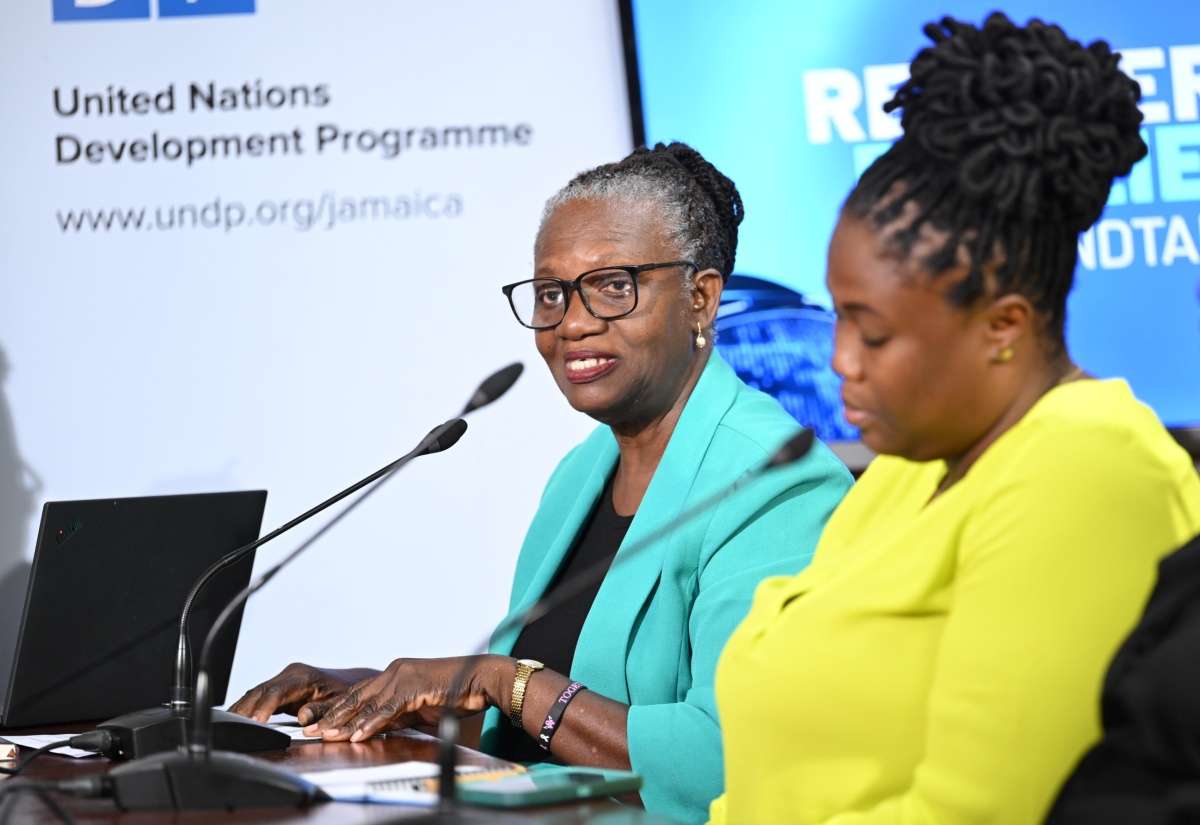
Photo: Adrian Walker
Deputy Director General for Sustainable Development and Social Planning at the Planning Institute of Jamaica (PIOJ), Claire Bernard (left), addresses the ‘Recovery to Resilience Round Table’ held on Tuesday (October 13) at the United Nations Development Programme (UNDP) office in St. Andrew. Listening attentively is Moya Walker of the Jamaica Network of Rural Women Producers' Happy Grove Cluster.The Full Story
Deputy Director General for Sustainable Development and Social Planning at the Planning Institute of Jamaica (PIOJ), Claire Bernard, says work on a National Recovery Strategy to guide the country’s recovery in the aftermath of Hurricane Melissa is well advanced.
“We are undertaking that work in collaboration with the World Bank, the Inter-American Development Bank (IDB) and the United Nations Development Programme (UNDP),” she said while speaking during Wednesday’s ((October 14) ‘Recovery to Resilience Round Table’, which highlighted success stories from communities on the front lines of Hurricane Melissa.
The forum was convened at the UNDP office in St. Andrew to commemorate the International Day for Disaster Risk Reduction, under the theme ‘Resilience Starts at Home’.
Providing an update on Hurricane Melissa recovery planning, Ms. Bernard noted that several guiding principles have been established, including the use of spatial planning to ensure that future development does not exacerbate existing vulnerabilities.
She further outlined that the plan takes into consideration issues such as the protection of marine life.
“We are trying to ensure that our attitudes and the structures that we put in place are not contributing to the degradation of the reef systems that is impairing our fish catch and, therefore, our protein intake… and the kind of multiplier effect that the fishing industry has in the community,” the Deputy Director General explained.
Ms. Bernard noted that the National Recovery Strategy also considers areas in which diversification can be facilitated.
Meanwhile, she advised that the Institute has been working with the Office of Disaster Preparedness and Emergency Management (ODPEM) to develop a national recovery framework.
“Not only have we done the national recovery framework [but] we’ve developed a pilot recovery plan… working with ODPEM… and the intention is that we’re going to be building that out. We have also worked on developing some community disaster risk management plans… . I think we’ve completed about 15 but many more need to be done,” Ms. Bernard detailed.
She emphasised that the plans are evidence-based and informed by data on Jamaica’s climate.
“We’re working with the University of the West Indies and we’ve also developed in the PIOJ – working with other partners – a Jamaica systemic risk assessment tool which we’re using to ensure that, before you put any investment in infrastructure in the country, there’s a thorough analysis done so that it’s informed by the best data to reduce risk,” the Deputy Director General informed.