


Multi-Agency Partnership Boosting JCF Helmet Enforcement Thrust
By: , March 26, 2026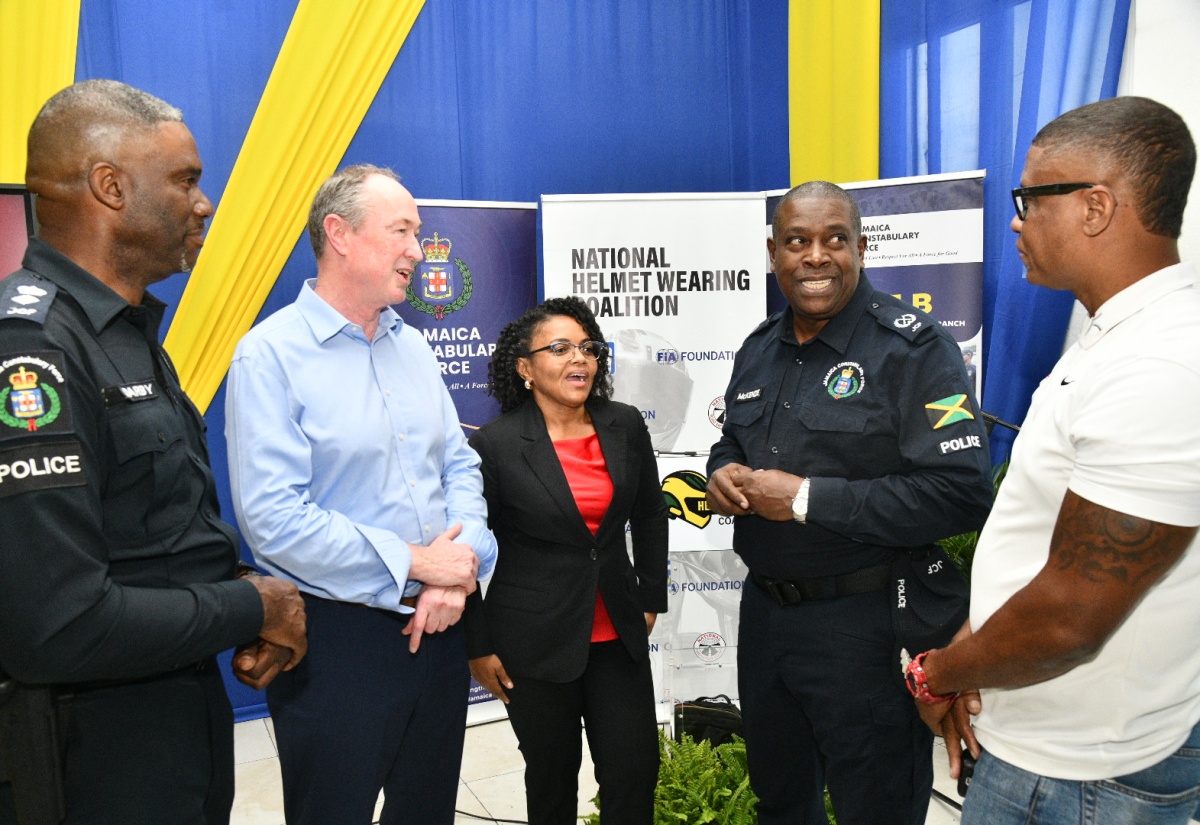
Photo: Michael Sloley
Assistant Commissioner of Police (ACP), Dr. Gary McKenzie (second right), converses with (from left) Commanding Officer, Public Safety and Traffic Enforcement Branch (P-STEB), Senior Superintendent of Police, Lloyd Darby; Chief Executive Officer, Global Road Safety Partnership (GRSP), Dave Cliff; Jamaica National (JN) Foundation General Manager, Claudine Allen; and President, Jamaica Motorcyclist Association (JMA) and Community Engagement National Helmet Wearing Coalition Lead, Marlon Fletcher. The occasion was the Jamaica Constabulary Force (JCF) Helmet Enforcement Training at the Jamaica Defence Force (JDF) Area Four Headquarters (Harman Barracks) on South Camp Road in Kingston on Wednesday (March 25).The Full Story
Efforts to strengthen motorcycle helmet enforcement are being advanced through a multi-agency training programme for members of the Jamaica Constabulary Force (JCF), aimed at improving how the organisation enforces helmet safety on the nation’s roads.
The initiative, led by the JN Foundation under the National Helmet Wearing Coalition, targets personnel within the JCF’s Public Safety and Traffic Enforcement Branch (P-STEB).
Designed as a capacity-building intervention, the programme combines theory with practical exercises, equipping officers with updated enforcement techniques and a deeper understanding of the behavioural risk factors associated with motorcycle use.
This first phase of training targets 25 potential trainers within the JCF and incorporates both classroom instruction and practical outdoor components. The programme will be rolled out across several phases.
It forms part of a broader partnership with local and international road-safety organisations and is designed to strengthen enforcement, improve helmet compliance, and reduce motorcycle-related deaths and injuries on Jamaica’s roads.
Speaking at the JCF Helmet Enforcement Training on Wednesday (March 25) at the JDF Area Four Headquarters, Harman Barracks, South Camp Road in Kingston, Assistant Commissioner of Police (ACP) Dr. Gary McKenzie, on behalf of Commissioner of Police Dr. Kevin Blake, stated that the initiative forms part of the Force’s broader strategic priority to enhance public safety and road safety outcomes.
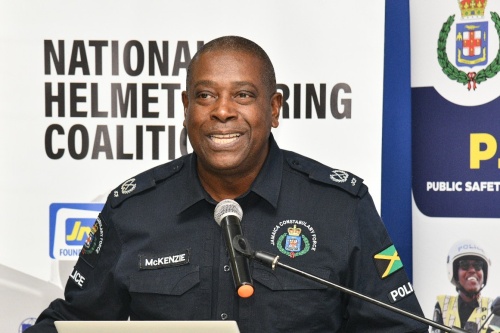
He reaffirmed the importance of incorporating new strategies and perspectives, emphasising that adopting innovative approaches is critical to achieving improved outcomes.
“It is a fact that no matter what we know before and what we have been doing before, certainly to have an appreciation of new perspectives, new ideas, new strategies will always be very important to our success,” the senior officer stated.
ACP McKenzie noted that motorcycle fatalities continue to represent a significant portion of road deaths in Jamaica.
“Motorcycle deaths and injuries have been a very sad part of what we have had to contend with as a nation and certainly as a police force. Approximately 30 to 33 per cent of those persons who have been killed on our roadways have been persons who have been travelling on motorcycles,” he explained.
ACP McKenzie emphasised that addressing the issue requires a strategic, intelligence-driven approach, including targeted interventions in high-risk areas and among high-risk groups.
“We have discussed from a strategic level, that just like how we have the focus deterrence strategy in relation to crime… we also have to look at the people that are driving motorcycles [in terms of] what are their behaviours,” he noted.
The senior officer added that greater emphasis is being placed on identifying high-risk groups and locations.
He advised that targeted strategies are already being implemented in several parishes, particularly Westmoreland, Hanover, St Elizabeth and Manchester,“Those have been recipients of the kind of focus deterrence strategy that has, so far, been taking place,” ACP McKenzie added.
He further indicated that community engagement will remain a central component of the approach.
“Policing is not just about enforcing. It is an infusion of several different initiatives… which may include interfacing, training, educating, doing a lot of community intervention,” ACP McKenzie said.
Commanding Officer for P-STEB, Senior Superintendent of Police (SSP) Lloyd Darby, presented background data underscoring the scale of the problem and highlighting the need for targeted enforcement and greater helmet compliance.
“Jamaica’s road collision and fatal hit problem has been a societal concern for a number of years. From 1974 to 2025, 18,941 persons have died from road collisions,” he said.
SSP Darby noted that the figures over the past 11 years remain deeply concerning.
“If you look at the last 11 years… 4,484 persons die from road collisions. Of that number, 1,256 were motorcyclists, and another 159 were pillion passengers. This represents a combined 33 per cent,” he stated.
SSP Darby highlighted non-compliance with the Road Traffic Act, particularly helmet use, as a major contributor to motorcycle fatalities.
“The non-conformity with the Road Traffic Act is also evident… [specifically] the absence of helmets for both drivers and pillion passengers,” he noted.
The senior officer added that enforcement has been intensified as part of the strategy to improve compliance and reduce motorcycle fatalities.
“So this strategy of zero-tolerance enforcement of all motorcycle offences, coupled with public education, was launched in February; 786 motorcycles have been seized, compared to 336 for the corresponding [period last] year,” SSP Darby added.
Jamaica National (JN) Foundation General Manager, Claudine Allen, explained that the partnership emerged from discussions on how best to sustainably support the JCF in reducing road fatalities through capacity development and stronger enforcement.
“We explored the ways where we could practically and sustainably help the JCF to tame this trend of spiraling and increasing road-safety fatalities… and that conversation included capacity development,” she said.
Mrs. Allen noted that the initiative seeks to strengthen enforcement while bridging the gap between legislation and road-user behaviour.
She added that the programme is ultimately focused on saving lives by strengthening enforcement and driving behaviour change.
“We can turn enforcement into prevention and training into transformation. Success is going to be measured by the number of lives you save,” Mrs. Allen declared.
The training forms part of a broader partnership with local and international road-safety organisations and is designed to strengthen enforcement, improve helmet compliance, and reduce motorcycle-related deaths and injuries on Jamaica’s roads.
The three-day programme, being held from March 25 to 27, builds on a June 2025 Memorandum of Understanding aimed at strengthening the JCF’s enforcement capabilities.