


Monetary Policy Tools Will Be Used to Deal with Expected Spike in Inflation – BOJ
By: , April 2, 2026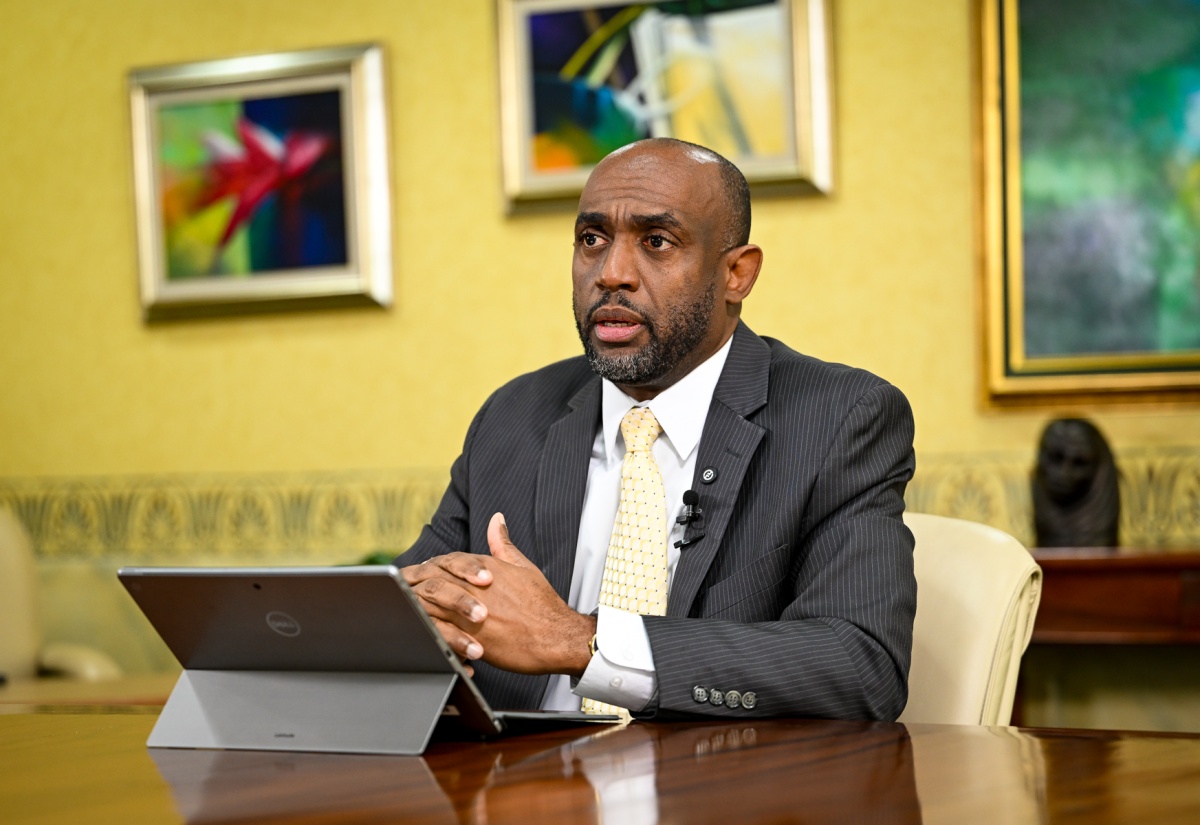
Photo: Adrian Walker
Senior Deputy Governor, Bank of Jamaica, Dr. Wayne Robinson, emphasises a point during an interview with JIS News on April 1.The Full Story
The Bank of Jamaica (BOJ) is assuring Jamaicans that it will utilise monetary policy tools to deal with the spike in inflation or the general level of price increases that is expected to result from the conflict in the Middle East.
This assurance came from Senior Deputy Governor, Dr. Wayne Robinson, during an interview with JIS News on April 1.
He noted that the conflict has created a high level of uncertainty in Jamaica and around the world about where price levels will be over the next several months.
Dr. Robinson said that, already, the conflict in the Middle East has led to significant increases in key international commodity prices, particularly the prices of energy-related products such as oil and liquefied natural gas (LNG).
“We remain focused on ensuring that inflation can come back to the target range as quickly as possible, and we will utilise all the tools at our disposal, whether it’s interest rate adjustments or direct liquidity (cash) management tools, but we are not yet at that point,” he explained.
“As we had indicated, at this point we are holding the policy rate as is, and we stand ready to intervene in the foreign exchange market where and when necessary, to support orderly conditions in a context where exchange rate movements will have an impact on domestic prices,” he said.
In its latest monetary policy announcement on March 31, BOJ’s Monetary Policy Committee (MPC), which is responsible for monitoring inflation, kept the policy rate (the interest the Central Bank pays on current accounts of commercial banks at the Central Bank) unchanged at 5.50 per cent per year.
The policy rate, one of the main monetary policy tools, serves as a signal from the BOJ of what the level of interest rates on loans and bank deposits should be in the economy.
“So, what we’re saying, in the near term we want interest rates to hold steady at the current level. We’re not saying that this is going to be the permanent state, but for now, we want interest rates in the economy, whether savings, mortgages, mortgage rates, lending rates, to hold steady,” he pointed out.
The Senior Deputy Governor said the Central Bank will continue to pay close attention to what is happening around the world and will respond appropriately to ensure that the higher inflation expected later this year can return to the target range of between four per cent and six per cent in the shortest possible time.
At March 2026, the inflation rate, as measured by the Statistical Institute of Jamaica, was 3.9 per cent.
“What is important to note is that, essentially, what we are facing is a supply shock, which in the first round there’s not much we can do about it. So, what we have to do is really focus on the extent to which you have second-round effects or ripple effects,” Dr. Robinson said.
“So, we will continue to monitor and watch the incoming data to see the extent to which inflation is going well beyond the levels of which we’re comfortable, and if necessary, we will respond. And importantly, we will continue to communicate our policy positions and our policy intentions, so that the public can get a better sense as to where we are going,” he added.
In its decision, which followed two days of meetings on March 27 and March 30, the MPC noted that the shock to commodity prices poses a risk of higher inflation in Jamaica as well as lower levels of GDP growth.
In the context of increased uncertainty, the MPC determined that the current monetary policy stance is the most appropriate to support inflation settling within the target range over time.
Meanwhile, Dr. Robinson pointed out that the economic effects of the conflict in the Middle East will be significant.
“The price of Brent (oil) on the world market has gone up since the war by approximately 63 per cent. WTI (West Texas Intermediate oil) also went up by about 52 per cent. We also import LNG, but while the prices of LNG have fluctuated, it has remained pretty steady, but crude oil prices have gone up significantly. So, we have been seeing increases in prices at the pump here. We expect to see increases in the price of cooking gas, and JPS (Jamaica Public Service) has signalled that we should brace for increase in electricity rates,” he said.
Dr. Robinson pointed out that this will cause a sharp rise in the country’s import bill.
“Because we import all our fuel, we are going to see an increase in the country’s import bill, primarily related to fuel. We estimate that… every US$1 increase in the price of a barrel of oil adds about US$20 million to our import bill. So, we’re going to be seeing a worsening in the current account of our balance of payments,” he said.
He added that the war is also going to affect other commodities, such as petrochemicals, fertiliser, airfares, grains, shipping, and manufactured products. He explained that Jamaica imports a lot of consumer products, and the prices of those consumer products are going to be increased globally.
Despite the outlook for higher prices later this year and the general uncertainty in the global economy, the Senior Deputy Governor said the Bank remains focused on its primary mandate of managing inflation, ensuring that it remains stable and low and predictable.
“We are experiencing yet another unprecedented shock but as before, we will manage this. We had COVID, then we had the Ukraine war, then we had [Hurricane] Beryl, then we had [Hurricane] Melissa. But the Bank was successful in managing inflation throughout these shocks and we can reassure the public that we will remain focused on this objective of ensuring that inflation remains low, stable and predictable,” he noted.
“The challenge we face now is that the duration and magnitude of this impact is highly uncertain. As you will appreciate, a lot is going to depend on how long the conflict lasts, and that, in and of itself, is a big question,” Dr. Robinson said.