



Minister Charles Jr. Calls for Multi-Sector Collaboration
By: , February 12, 2026
Photo: Adrian Walker
Minister of Labour and Social Security, Hon. Pearnel Charles Jr., delivers the keynote address at the National Policy-Level Workshop on 'Stronger and Greener Productive Capacities for a Just Transition in Jamaica' on Wednesday (February 11), held at S Hotel in New Kingston. The workshop, held in collaboration with Jamaica Productivity Centre (JPC) and United Nations Conference on Trade and Development (UNCTAD), aims to utilise evidence-based data to examine Jamaica’s opportunities to strengthen productivity, resilience, and sustainable growth.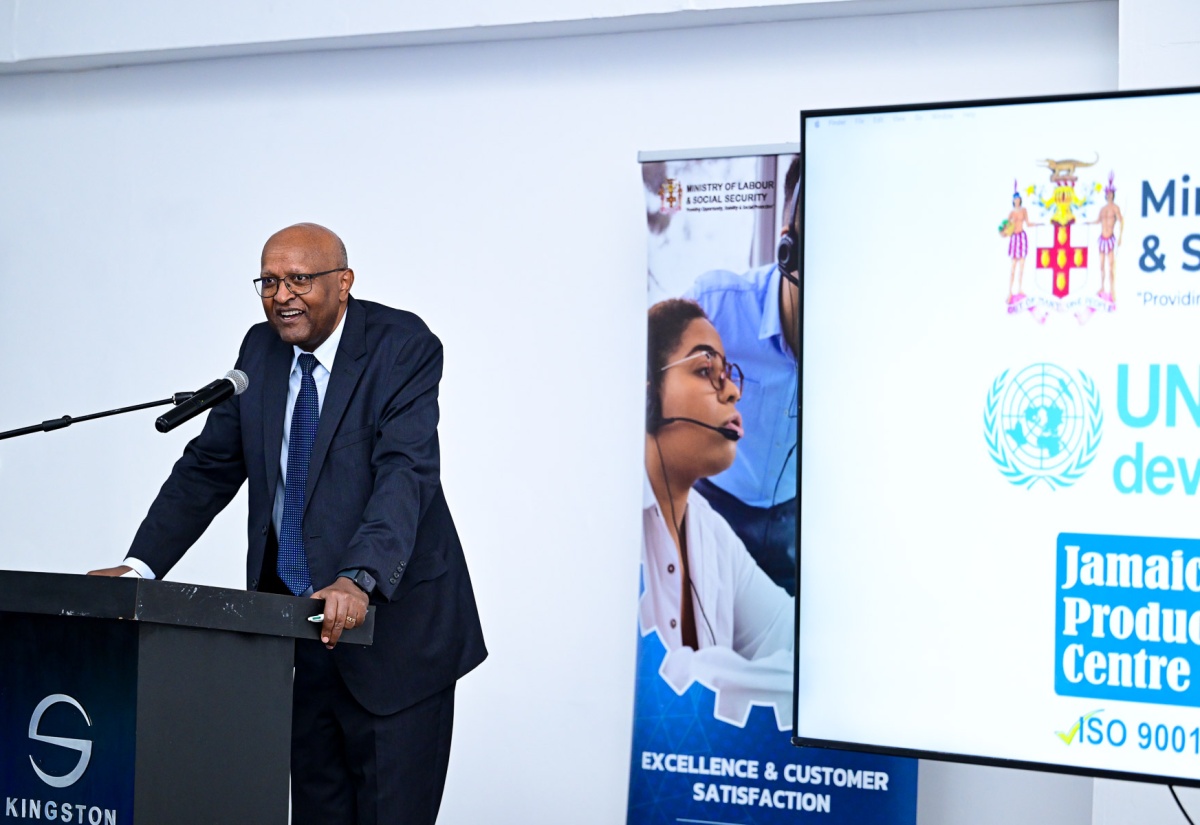
Photo: Adrian Walker
Head of the Productive Capacities and Sustainable Development Branch, Division for Africa, Least Developed Countries (LDCs) and Special Programmes at UNCTAD, Mussie Delelegn brings remarks at the National Policy-Level Workshop on 'Stronger and Greener Productive Capacities for a Just Transition in Jamaica' on Wednesday (February 11) held at S Hotel in New Kingston. The workshop, held in collaboration with Jamaica Productivity Centre (JPC) and United Nations Conference on Trade and Development (UNCTAD), aims to utilise evidence-based data to examine Jamaica’s opportunities to strengthen productivity, resilience, and sustainable growth.
Photo: Adrian Walker
Minister of Labour and Social Security, Hon. Pearnel Charles Jr. (second right), converses with key stakeholders at the National Policy-Level Workshop on 'Stronger and Greener Productive Capacities for a Just Transition in Jamaica' on Wednesday (February 11) held at S Hotel in New Kingston. Also present are (from left) Head of the Productive Capacities and Sustainable Development Branch, Division for Africa, Least Developed Countries (LDCs) and Special Programmes at UNCTAD, Mussie Delelegn; Development Coordination Officer/Economist at the UN Resident Coordinator Office, Stuart Davies; Jamaica Productivity Centre Chief Technical Director, Tamar Nelson; Acting Permanent Secretary in the Ministry of Labour and Social Security, Dione Jennings, and the Ministry’s State Minister, Hon. Donovan Williams.The Full Story
Minister of Labour and Social Security, Hon. Pearnel Charles Jr., is urging greater collaboration across all sectors to build Jamaica’s economic resilience through increased and sustained productivity.
He was speaking at the National Policy-Level Workshop on ‘Stronger and Greener Productive Capacities for a Just Transition in Jamaica’ on Wednesday (February 11), held at the S Hotel in New Kingston.
The workshop, hosted in collaboration with Jamaica Productivity Centre (JPC) and United Nations Conference on Trade and Development (UNCTAD), aims to utilise evidence-based data to examine Jamaica’s opportunities to strengthen productivity, resilience, and sustainable growth.
Minister Charles noted that productivity is the cornerstone of Jamaica’s “pathway to prosperity” and the best way is to identify gaps, find solutions to the problems and make them sustainable.
He maintained that Jamaica, as a Small Island Developing State (SIDS), has done well with identifying the issues that tend to halt our economic growth and ascertain the solutions; however, the shortfall happens at the implementation stage.
“Getting now to move the data that we receive from the Productivity Capacity Index (PCI) and integrate it into the various sectors so that it can help us in terms of how we treat with human capital, with physical infrastructure, with our institutions, with the private-sector capabilities, with structural change, all of those things now require us to take further steps,” Minister Charles Jr. said.
The PCI combines a range of factors that reflect the resources a country has available to build its economy. In 2024, Jamaica’s PCI was estimated at 46.9, ranking 109th of 194 countries measured.
Minister Charles stated that he looks forward to the National Productive Capacities Gap Assessment, which will be provided by UNCTAD, as it will give a clear picture of the country’s standing.
“The real work begins when we translate those findings into concrete actions, and that is the challenge to us all. Policy reforms must also be implemented to remove the regulatory barriers and to strengthen the institution so that those findings can move into action,” Minister Charles said.
He also pointed out that strategic investments in critical infrastructure and human capital, as well as public-private partnership, are necessary to leverage the country’s resources.
Meanwhile, Head of the Productive Capacities and Sustainable Development Branch, Division for Africa, Least Developed Countries (LDCs) and Special Programmes at UNCTAD, Mussie Delelegn stated that from the workshop, a targeted list of priority areas will be created for Jamaica to focus on over the next 10 to 15 years.
He added that a detailed National Productive Capacity Gap Assessment will also be provided and is expected to be finalised by September 2026.
“Now, based on the gaps, we will be developing what we call the holistic programme to address the gaps. That is an actionable programme which is long-term in nature. We can’t fix productive capacities in one day, one year, through one workshop, but we envisage for Jamaica between seven and 10 years maximum,” Mr. Delelegn noted.
The programme is set to be completed by the end of the year, following feedback from the gap assessment.