

Jamaica Moves to Strengthen Disaster Early Warning Capacity
By: , August 28, 2026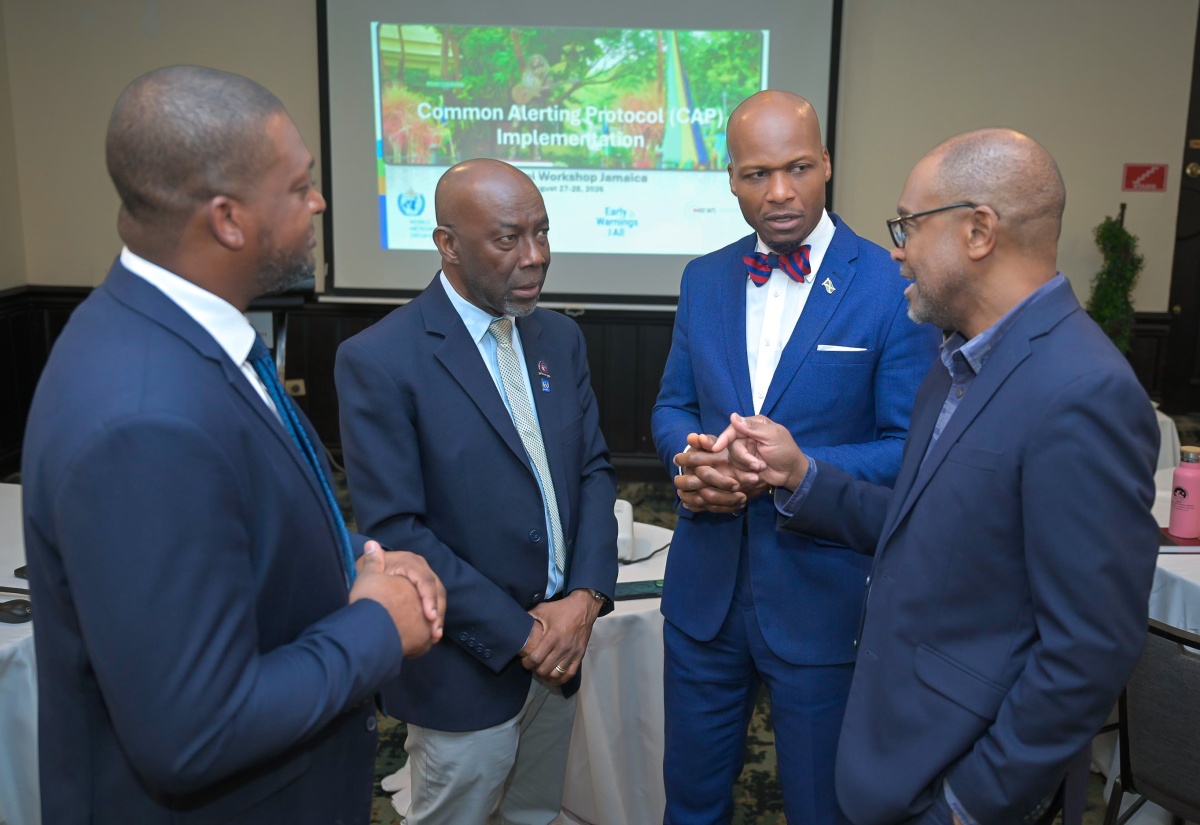
Photo: Donald De La Haye
Principal Director of the Meteorological Service of Jamaica, Evan Thompson (right), makes a point during a discussion with (from left) Director General of the Office of Disaster Preparedness and Emergency Management (ODPEM), Commander Alvin Gayle; Science and Technology Officer at the Caribbean Meteorological Organization (CMO), Kenneth Kerr; and Permanent Secretary in the Ministry of Water, Environment and Climate Change, Wayne Robertson. The occasion was the Common Alerting Protocol (CAP) Workshop, held at the Courtleigh Hotel and Suites in New Kingston on Thursday (August 27).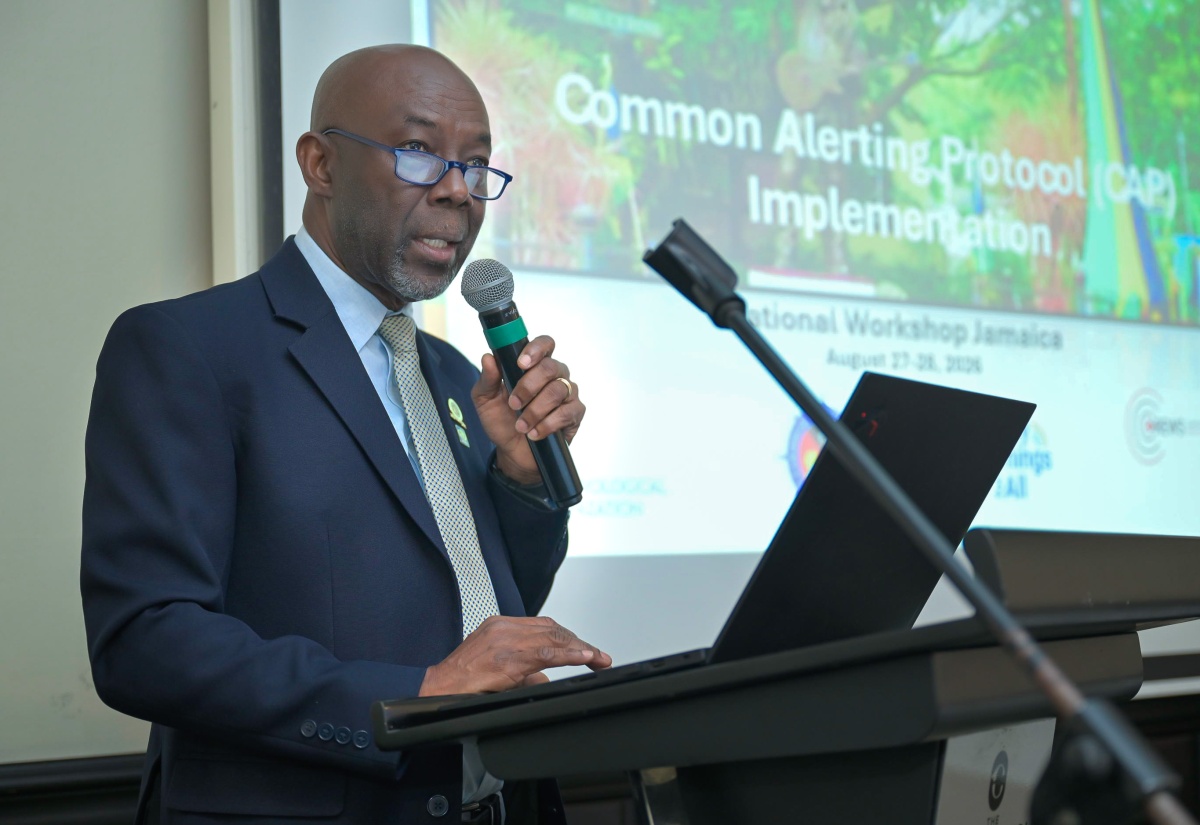
Photo: Donald De La Haye
Science and Technology Officer at the Caribbean Meteorological Organization (CMO), Kenneth Kerr, delivers greetings as he chairs the opening ceremony of the Common Alerting Protocol (CAP) Workshop at the Courtleigh Hotel and Suites in New Kingston on Thursday (August 27).The Full Story
The Ministry of Water, Environment and Climate Change has reaffirmed its commitment to protecting citizens through the enhancement of multi-hazard early warning systems.
Permanent Secretary in the Ministry, Wayne Robertson, reaffirmed the commitment during the Common Alerting Protocol (CAP) Workshop, held at the Courtleigh Hotel and Suites in New Kingston on Thursday (August 27).
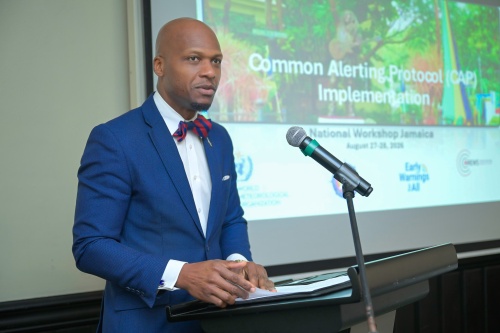
He emphasised that the warning systems are designed to protect residents and save lives in times of disaster.
“In the Caribbean, a warning delayed is a life put at risk. A warning misunderstood is a family unprepared… and a warning that never reaches the right person is a failure of the system we are all sworn to protect,” Mr. Robertson said.
The two-day workshop forms part of ongoing regional efforts to strengthen early warning systems and support the effective implementation of the Common Alerting Protocol (CAP) across the Caribbean, while enhancing stakeholders’ capacity to develop and disseminate timely, trusted alerts using a common standard.
The initiative is being held in partnership with the World Meteorological Organization (WMO) and the Caribbean Meteorological Organization (CMO), and brings together representatives from the Meteorological Service of Jamaica, the Office of Disaster Preparedness and Emergency Management (ODPEM), disaster risk management agencies, and other key stakeholders.
The initiative aligns with the United Nations Early Warnings For All mandate, which aims to ensure universal protection by the end of 2027.
Citing severe weather events such as Hurricane Beryl in 2024 and Hurricane Melissa in 2025, the Permanent Secretary highlighted that extreme heat, flash flooding and bush fires are becoming an increasingly frequent reality.
To address these challenges, Mr. Robertson emphasised the need to build an effective, people-centred multi-hazard early warning system.
“By strengthening our capacity to communicate timely, clear and actionable alerts through the Common Alerting Protocol, we are directly advancing our goals of reducing disaster risks, safeguarding vulnerable communities, and supporting national climate adaptation and sustainable development,” he said.
The Permanent Secretary noted that the Meteorological Service of Jamaica is central to the national early warning system, with enhanced technological capabilities enabling the provision of 24-hour weather forecasting and monitoring services.
Mr. Robertson argued, however, that effective communication is the equally critical component of the process.
“The CAP gives us one standard message that can go out once and can be received everywhere on radio, TV, cell phones, sirens, social media, and emergency dashboards. It removes ambiguity, which is very important, and also delays,” he highlighted.
“It ensures that the warnings issued by the Met Service is the same warning received by OPM (Office of the Prime Minister), the Ministry of Health and Wellness, various schools across Jamaica, the utility companies, and citizens in parishes such as St. Thomas or Hanover,” the Permanent Secretary added.
Mr. Robertson pledged the Ministry’s commitment to strengthening Jamaica’s CAP framework through continued investment in training and interoperability, to ensure that warnings are clearer, faster and more actionable.
Science and Technology Officer at the CMO, Kenneth Kerr, highlighted the significance of the CAP workshop in Jamaica, noting that strengthening disaster coordination is a key objective of the Government.
“This workshop provides an important platform for coordinating amongst the Meteorological Service, ODPEM, emergency services, health, the media, and other key stakeholders, including water,” he said.
Mr. Kerr highlighted the well-established CAP system within the Meteorological Service of Jamaica, noting that the workshop “will also serve as a foundation to further advance the agency’s impact-based forecasting efforts and strengthen Jamaica’s Early Warnings for All initiative”.
CAP workshops have already been held in St. Vincent and the Grenadines, St. Kitts and Nevis, and Antigua and Barbuda.