


Issues Contributing to Multidimensional Poverty Need to Be Addressed – PIOJ
By: , January 19, 2026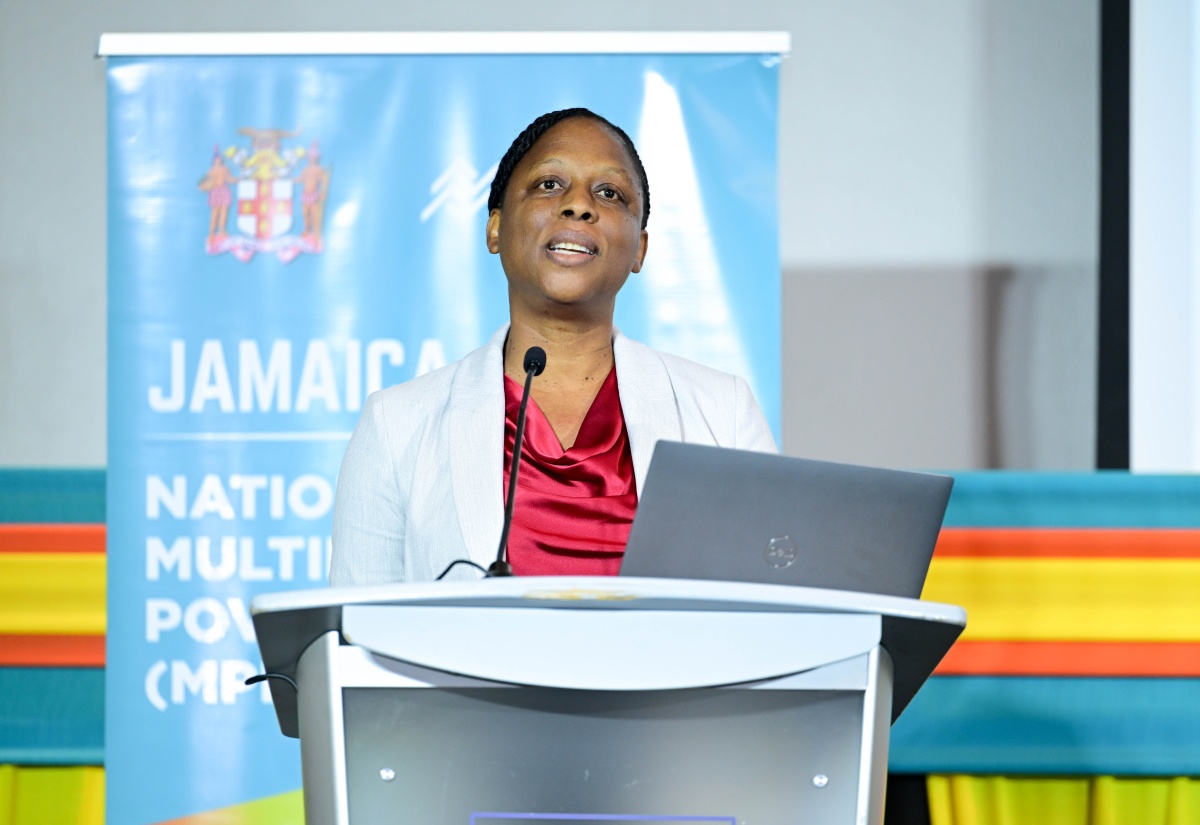
Photo: Adrian Walker
Director of Policy Research at the Planning Institute of Jamaica (PIOJ), Suzette Johnson, speaks at the official launch of the Jamaica National Multidimensional Poverty Index (MPI), at the AC Marriott Hotel in Kingston on Friday (January 16). The MPI will guide the Government’s development of policies and programmes aimed at poverty reduction.The Full Story
Director of Policy Research at the Planning Institute of Jamaica (PIOJ), Suzette Johnson, says priority action is needed to address issues of income security, insurance, basic infrastructure and building resilience, the major determinants of poverty across Jamaica.
She was speaking at the recent release of Jamaica’s first national Multidimensional Poverty Index (MPI) report at the AC Marriott Hotel in Kingston, on January 16.
Revealing the findings of the MPI, which were calculated using data from the 2018 Jamaica Survey of Living Conditions (JSLC) as the baseline, Mrs. Johnson noted that in 2018 the largest contributors to national multidimensional poverty were lack of contributions to the National Insurance Scheme (NIS), followed by inadequate sanitation and unemployment.
“In 2019, contribution to the NIS, and sanitation, remained the main contributors [to multidimensional poverty], but unemployment was surpassed by water,” she said.
The Director pointed out that by geographical region, rural areas had the highest incidence of multidimensional poverty at 18.1 per cent in 2018.
This means rural areas accounted for 71 per cent of all the country’s multi-dimensionally poor, despite only accounting for 46.6 per cent of the overall population.
By comparison, other urban centres and the greater Kingston Metropolitan Area had a lower incidence at 9.5 per cent and 2.9 per cent, respectively.
“Other disaggregation showed a higher incidence of MPI poverty in female-headed households than in male-headed households and among children age 0 to 14 years than among older persons. Multidimensional poverty was also higher in households with at least one child present than those without children and in large-sized households,” Mrs. Johnson shared.
She pointed out that in 2019, the incidence of MPI poverty was also higher among individuals living in a household with at least one member that had a disability.
The Director emphasised that the MPI provides a more inclusive perspective on the dynamic nature of poverty in Jamaica and adds valuable information for public policy and programme interventions.
Addressing the cause of multidimensional poverty, she noted that “the largest contributors were the lack of paying to the NIS that provides a minimum guarantee against income loss, inadequate sanitation, unemployment and inadequate access to clean drinking water”.
Mrs. Johnson said accelerated interventions must be implemented in sectors, regions, and population subgroups that face the most significant challenges.
“Rural areas have the highest incidence of both multidimensional poverty and monetary poverty, hence there is pressing need for targeted policies and programmes, especially in the areas of access to safe drinking water, proper sanitation, garbage disposal, provisions for income security, and completing secondary-level education,” she outlined.
The Director said that additional research is needed in the areas of culture, socialisation, aspirations around well-being, and other qualitative factors that give further insight into the perspectives on multidimensional poverty in Jamaica.