


Inflows from US$6.7 Billion in Development Financing Will Be Channelled Through NARRA
By: , January 30, 2026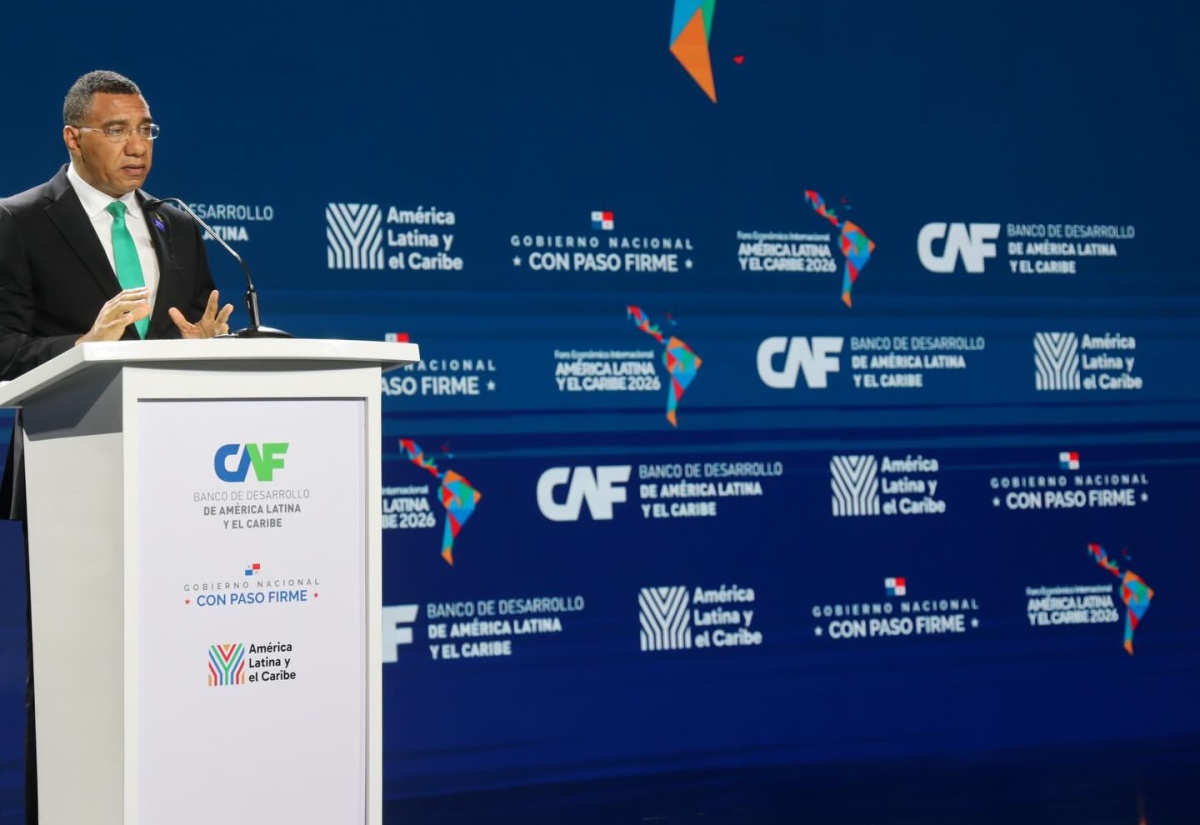
Photo: Contributed
Prime Minister, Dr. the Most Hon. Andrew Holness, addresses the International Economic Forum, Latin America and the Caribbean 2026, in Panama, on January 28.The Full Story
Prime Minister, Dr. the Most Hon. Andrew Holness, has informed that inflows from the US$6.7 billion in development financing, designed to support Jamaica’s recovery from Hurricane Melissa, will be channelled through the National Reconstruction and Resilience Authority (NaRRA).
The US$6.7 billion is being provided through CAF – Development Bank of Latin America and the Caribbean, Caribbean Development Bank (CDB), Inter-American Development Bank (IDB) Group, International Monetary Fund (IMF), and the World Bank Group.
“This is the largest and fastest mobilisation of financing in Jamaica’s history. The bulk of these inflows will be channelled through the National Reconstruction and Resilience Authority, which will serve as a centre of technical excellence for project development, a single point of national coordination, and a platform for public-private partnerships,” Dr. Holness said.
“The National Reconstruction and Resilience Authority will enable Jamaica to execute resilient infrastructure projects at scale and speed,” he continued.
Dr. Holness was speaking at the International Economic Forum, Latin America and the Caribbean 2026, in Panama, on January 28.
Three months ago, Jamaica faced one of the most severe natural disasters in modern history, the third most powerful hurricane ever recorded in the world.
Dr. Holness said Hurricane Melissa, a Category Five storm, tested the country’s institutions, infrastructure, and people.
“Yet, I stand before you with a simple but powerful message: Jamaica has endured, Jamaica is recovering and strongly recovering, and Jamaica is moving forward,” he said.
He noted that Jamaica’s debt-to-gross domestic product (GDP) was on track to be below 60 per cent before the hurricane, while unemployment is at a historic low of 3.3 per cent.
“Our net international reserves now exceed US$6 billion, and we’re proud to say that for the last 10 budgets presented to the people of Jamaica, we have not exacted any new taxes. We have a freely floating currency with no foreign exchange controls, no capital controls. We are further reinforcing this strong macroeconomic framework through productivity reforms to reduce delays, cut bureaucracy, and accelerate investment,” the Prime Minister stated.
“We are reinforcing it through the energy sector reforms, through low energy costs, expanding renewable energy capacity, and strengthening the resilience of our grid. And importantly, we are reinforcing it through improved public safety. Jamaica recorded a 42 per cent reduction in homicides last year, and in January, to date, we have reduced homicides by a further 54 per cent, comparing it to January last year,” he added.
Meanwhile, Dr. Holness stressed the importance of keeping an eye on the poor in societies, noting that Jamaica has cut absolute poverty in half, from 16 per cent to eight per cent.
However, he pointed out that the hurricane will have some impact on the baseline poverty rate.
“But the lesson that we have learned in the last decade is that the best way to address poverty, the best way to lift people out of poverty, is through good governance and good fiscal management of the economy. Jamaica today is like a ship that has not only reinforced its hull but redesigned its navigation systems. We are not merely seaworthy; we are voyage ready. We can withstand shocks, but more importantly, we can chart a longer and more ambitious course. That journey has already begun,” he said.