


Gov’t Strengthens Digital Economy Measurement Capacity
By: , March 26, 2026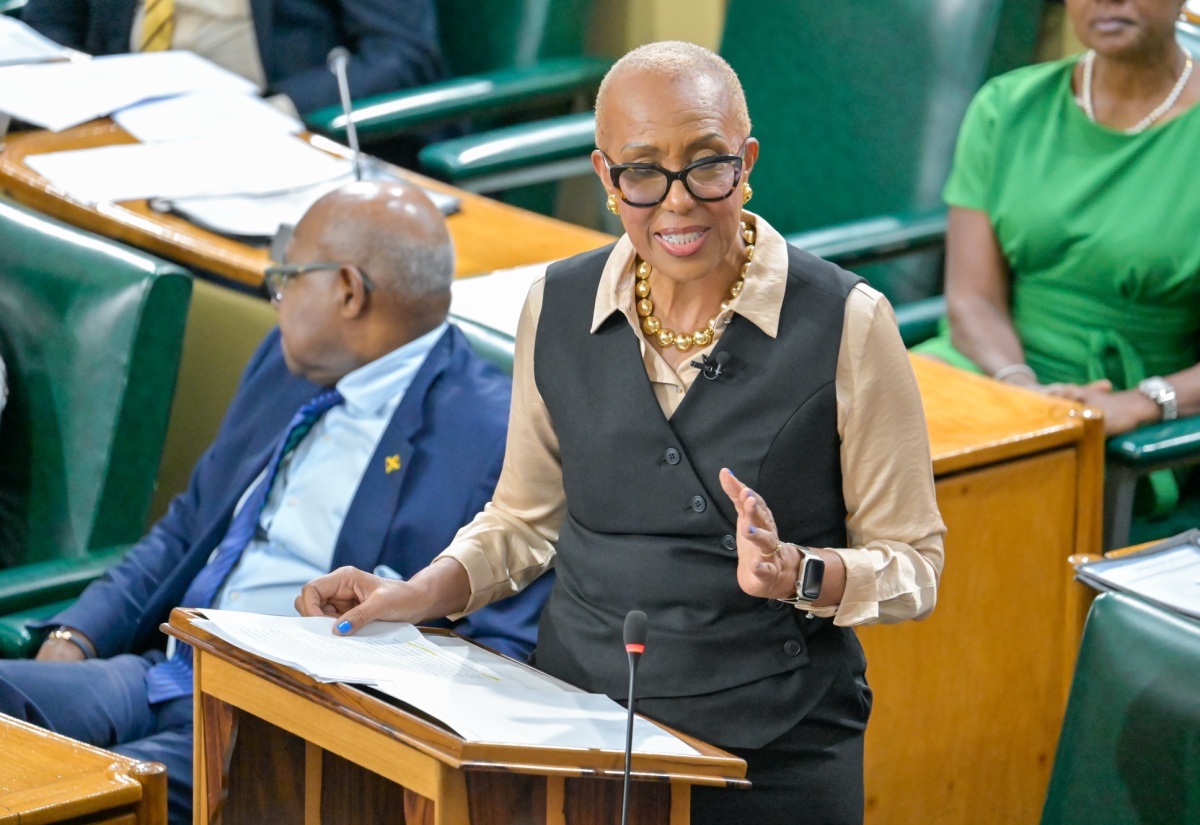
Photo: Danielle Myers
Minister of Finance and the Public Service, Hon. Fayval Williams, closes the 2026/27 Budget Debate in the House of Representatives on Tuesday (March 24).The Full Story
The Government continues to strengthen the nation’s capacity to measure and interpret digital economic activity, ensuring that policies remain fair, balanced, and grounded in accurate data.
“As the global economy becomes increasingly digital, countries must adapt how they understand and respond to new forms of economic activity. Services already account for a substantial share of Jamaica’s GDP (gross domestic product), and an increasing portion of this activity is taking place through digital and cross-border channels.
“This is not simply a matter of getting revenues but of ensuring that our economic systems are properly equipped to understand these developments. Jamaica has provided global leadership on measuring digital economic activity,” Minister of Finance and the Public Service, Hon. Fayval Williams, said.
She noted that Jamaica currently serves as Chair of the United Nations (UN) Task Team on Digitalisation, under the UN Committee of Experts on Business and Trade Statistics.
“This means the Committee provides guidance, coordinates and standardises business and trade statistics, focuses on areas like globalisation, digitalisation, and statistical capacity-building in Member States. This work is being led by one of our very own Jamaicans through the Bank of Jamaica,” the Minister said.
She further noted that the country was featured in the 2023 edition of the UN/World Trade Organization (WTO)/Organisation for Economic Co-operation and Development (OECD) ‘Handbook on Measuring Digital Trade’, which included a case study on digital trade measurement involving Jamaica.
“The team’s work looked at issues such as digital trade, e-commerce and cross-border digital services. Much of the work the group is doing internationally focuses on the measurement issues governments around the world face when designing policies on digital trade and digital taxation,” Minister Williams said as she closed the 2026/27 Budget Debate in the House of Representatives on Tuesday (March 24).
Explaining that the definition of digital trade has evolved, she pointed out that it is now categorised in three ways: digitally ordered and digitally delivered; digitally ordered and physically delivered; and physically ordered and digitally delivered.
Mrs. Williams explained that the second definition, which focuses on digitally ordered and physically delivered goods, refers to items entering Jamaica through the country’s ports that are already subject to taxes and duties.
“Obviously, these will not be subject to any further taxes and duties as a result
of the revenue measures. Let me say it clearly, digitally ordered and physically delivered trade was not included in our revenue measures.
“However, for measurement purposes, that is, when measuring digital trade in order to know how large Jamaica’s digital economy is, definition #2 is included. So the size of Jamaica’s digital economy is larger than the portion on which the revenue measures will be calculated. This definition that includes #1, 2 and 3 is used by many countries, including Jamaica,” she stated.
Meanwhile, Mrs. Williams further explained that shoppers have found creative ways to avoid taxes and duties on goods imported under the De Minimis Policy, including practices such as ‘splitting up orders’.
As of April 1, 2024, the De Minimis threshold in Jamaica was increased from US$50 to US$100.
Goods imported for personal or commercial use with a Free on Board (FOB) value of US$100 or less are exempt from customs duty and related taxes. If the value exceeds US$100, duties apply to the total Cost, Insurance and Freight (CIF).
“By ‘splitting up’, I mean the instances in which, if you are ordering from the same vendor, instead of making one order, you make multiple orders. Take a scenario in which you are ordering two items and they cost US$100 each, that’s a total of US$200.
“Packaged and shipped in one package of US$200, there would be tax on the CIF. Instead, what we are seeing is a splitting of the orders to fall within the US$100 De Minimis allotment and an increase, sometimes I can characterise it as a deluge, in the number of US$100 and undervalued packages,” Mrs. Williams said.
The Minister noted that the unforeseen consequence is that no revenues flow into the Treasury.
“This is quite regrettable and was simply not the intent of the De Minimis Policy. Forgive me if I am being pedantic, but it is imperative that everyone understands what I have to share. When I draw a reference to our local retailers, it is because they are feeling the impact of untaxed goods coming in,” Mrs. Williams said.