

Gov’t Signs CDB Loan Agreement for Rural Water Programme
By: , September 17, 2026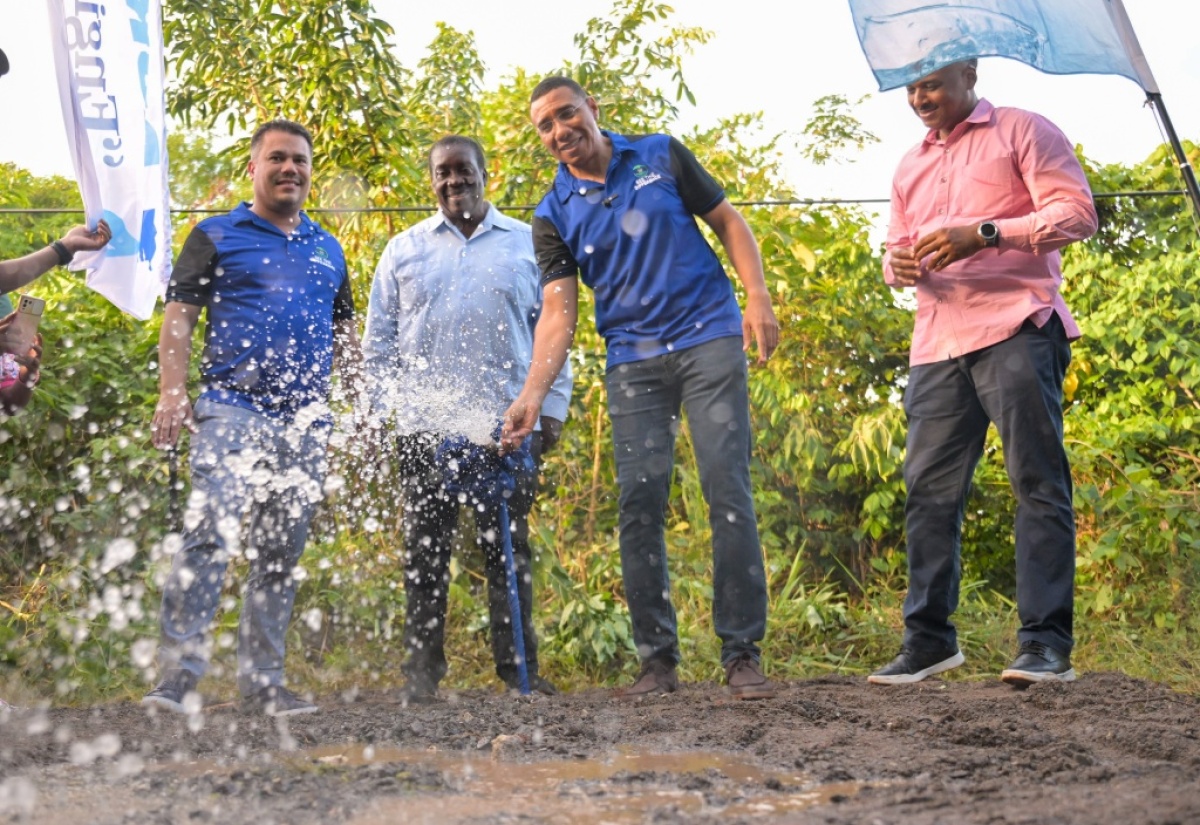
Photo: Yhomo Hutchinson
Prime Minister, Dr. the Most Hon. Andrew Holness (second right), commissions a water supply system during a recent ceremony in St. Mary Western. Joining him are (from left) Minister of Water, Environment and Climate Change, Hon. Matthew Samuda; Minister without Portfolio in the Ministry of Economic Growth and Infrastructure Development with responsibility for Land Titling and Settlements and Member of Parliament for St. Mary Western, Hon. Robert Montague; and Chairman of Rural Water Supply Limited, Omar Sweeney.The Full Story
The Government has signed a loan agreement with the Caribbean Development Bank (CDB) to support the Jamaica Rural Water Supply Programme.
The US$36-million (approximately J$5.7 billion) project, financed largely by the Caribbean Development Bank (CDB), is expected to enhance access to potable water for more than 40,000 residents through six water supply schemes spanning five parishes.
The programme will support water-supply improvements in Agualta Vale, Jordan Run, and Mason Hall in St. Mary; Albert Town and Ulster Spring in Trelawny; Union and Balaclava in St. Elizabeth; Port Morant and Airy Castle in St. Thomas; and Green Park Bamboo in St. Ann.
Prime Minister, Dr. the Most Hon. Andrew Holness, says the financing represents continued progress in the Government’s efforts to expand access to reliable, utility-grade water, particularly amid increasing pressure on the nation’s water resources.
Speaking during Wednesday’s (September 16) signing ceremony at the Consulate General of Jamaica in Miami, Dr. Holness noted that Jamaica is experiencing prolonged drought conditions caused by the El Niño weather phenomenon, with below-average rainfall leading to water restrictions in several communities across the island.
As a result, he said the initiative will help expand access to piped, centrally managed water supplies, noting that it represents continued progress in the Government’s efforts to provide utility-grade water to Jamaicans.
The Prime Minister indicated that utility-grade water currently reaches between 75 and 80 per cent of the population, with the National Water Commission (NWC) serving more than two million Jamaicans through over 400,000 customer accounts.
He explained that persons outside the NWC’s utility-grade network are not necessarily without water, as they may be served by municipal, private or other systems, pointing out that the goal is to expand the reach of centrally managed water services across the island.
As such, Dr. Holness said the systems, which will be handed over to the NWC upon completion, must be built to the Commission’s standards for operation and maintenance.
He reaffirmed the Government’s commitment to achieving universal access to utility-grade water, noting that the decision to partner with the CDB was driven by the institution’s development mandate, technical support and financing capabilities.
“We are edging closer to achieving universal utility-grade water access in Jamaica. Every year, we are making investments of this nature,” the Prime Minister said.
Additionally, Dr. Holness said the loan forms part of the Government’s fiscal envelope and is not anticipated to create any fiscal risk.
Meanwhile, Minister of Water, Environment and Climate Change, Hon. Matthew Samuda, described the project as a critical investment in Jamaica’s water resilience, particularly in the face of increasingly severe weather events.
He noted that many of the targeted communities have outgrown the capacity of their existing water infrastructure and require systems that can support their continued growth and development.
“This investment gives them, not just a chance to survive the changing climate, but a genuine chance to economically thrive,” the Minister maintained.
Mr. Samuda noted that Jamaica’s approach to water access prioritises reliability and quality of service, rather than merely the availability of a water source within a specified distance.
He assured that the project will improve the reliability of water service for residents already connected to the utility network, while extending utility-grade water access to additional persons.
Mr. Samuda advised that the programme will include upgrades to existing treatment facilities, transmission and distribution lines, the construction of three large community tanks with a combined capacity of approximately 800,000 gallons, and several lift stations, noting that “these are large-scale rural water projects.”
Meanwhile, CDB President, Daniel Best, underscored the importance of reliable water access, noting that safe and affordable water is essential for social well-being, economic opportunity and sustainable development.
He pointed out that many rural communities across the Caribbean continue to grapple with water shortages, service disruptions, ageing infrastructure, inadequate storage capacity and weak distribution systems, challenges that are being exacerbated by the impacts of climate change.
“The Jamaica Rural Water Supply Project is about far more than pipes, pumps and reservoirs… it is about improving lives,” Mr. Best declared.
He noted that improved water services will benefit households, schools, health facilities, farmers and businesses, while strengthening communities’ resilience to climate-related challenges.
Mr. Best said the CDB is supporting the project through concessional financing from its Special Development Fund, in keeping with the Bank’s commitment to investing in resilient infrastructure and improving livelihoods.
In his remarks, Chairman of Rural Water Supply Limited, Omar Sweeney, said the agency will provide the technical expertise and implementation capacity needed to successfully execute the project.
He explained that the project will encompass land acquisition, engineering consultancy services, design development, supervision and certification of works, as well as the preparation of tender and bid documents.
Mr. Sweeney further noted that the project will support the acquisition of vehicles and enhancements to geographic information systems and other information technology infrastructure needed by the project management unit, with implementation and overall programme management expected to continue over the next five years.
The Chairman pointed out that once the systems are handed over to the NWC for operation and maintenance, annual reporting will be required under the terms of the agreement.
“I can assure you that we are committed to executing this project at the highest standards of technical excellence, efficiency, transparency and accountability,” Mr. Sweeney stated.