


Gov’t Launches $880m REDI-II Greenhouse Project to Strengthen Climate-Resilient Agriculture
By: , February 25, 2026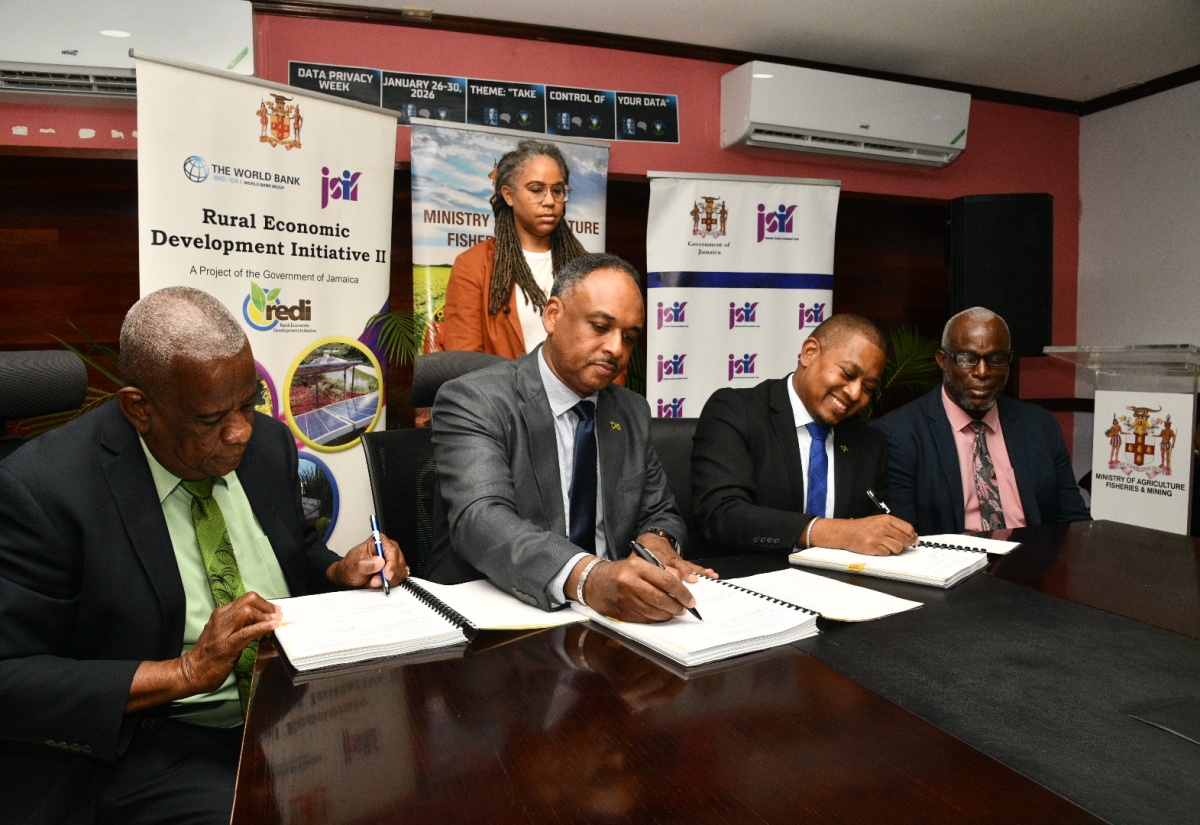
Photo: Michael Sloley
Minister of Agriculture, Fisheries and Mining, Hon. Floyd Green (second right), signs a contract for the Greenhouse Clusters and Cooperative Infrastructure Upgrade Project during the official signing ceremony held on Tuesday, February 24, at the Ministry’s Hope Gardens headquarters in St. Andrew. Also participating are (from left) State Minister, Hon. Franklin Witter; Jamaica Social Investment Fund (JSIF) Managing Director, Omar Sweeney; Chairman of the Mocho Community Council Benevolent Society, Leon Clair; and (standing) World Bank Senior Agriculture Specialist, Kilara Suit, who represented World Bank Caribbean Country Director, Lilia Burunciuc. The project, being implemented under the Second Rural Economic Development Initiative (REDI-II) with an investment of $880.4 million, aims to strengthen year-round agriculture production by supporting climate-resilient practices in rural farming communities.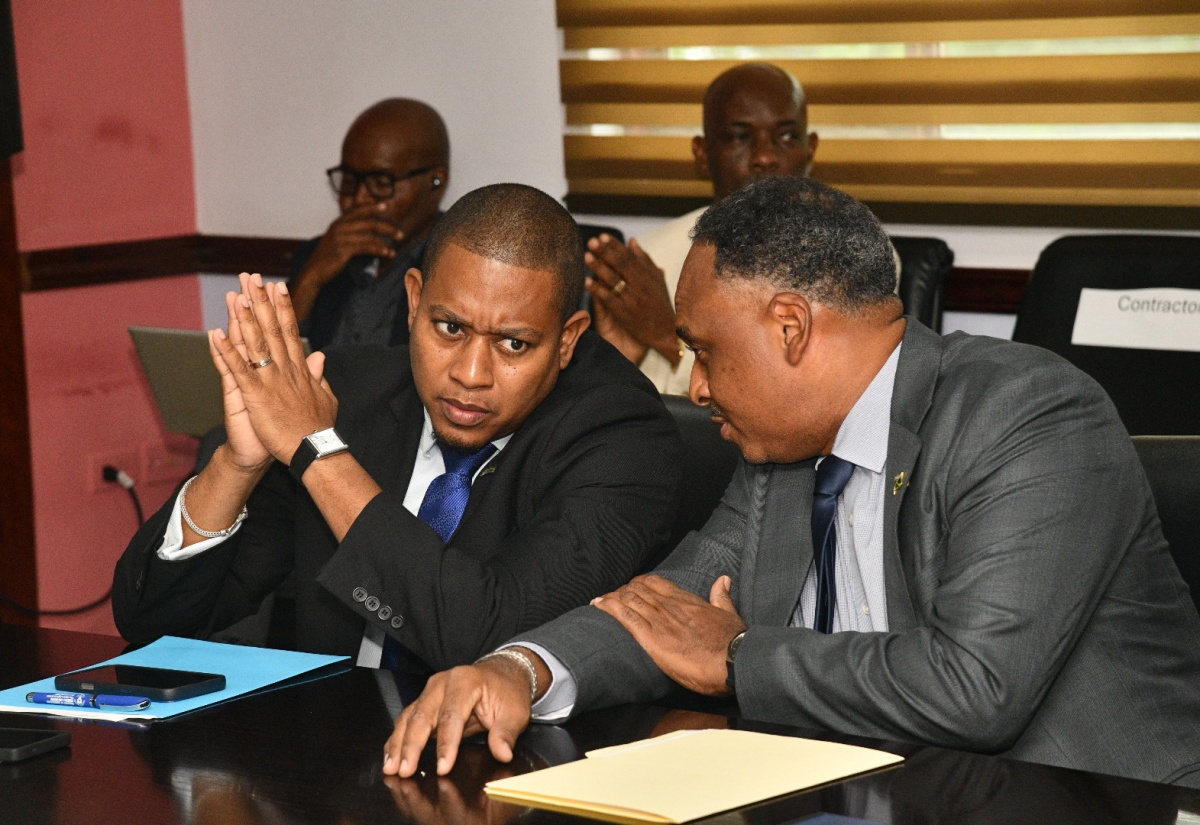
Photo: Michael Sloley
Minister of Agriculture, Fisheries and Mining, Hon. Floyd Green (left), converses with Jamaica Social Investment Fund (JSIF) Managing Director, Omar Sweeney, during the Official Contract Signing Ceremony for the Greenhouse Clusters and Cooperative Infrastructure Upgrade Project, held on Tuesday (February 24) at the Ministry’s Hope Gardens headquarters in St. Andrew. The project, being implemented under the Second Rural Economic Development Initiative (REDI-II) with an investment of $880.4 million, aims to strengthen year-round agriculture production by supporting climate-resilient practices in rural farming communities.The Full Story
The Government, through the Ministry of Agriculture, Fisheries and Mining, has officially launched the Greenhouse Clusters and Cooperative Infrastructure Upgrade Project to strengthen year-round agricultural production by investing in climate-resilient practices in rural farming communities.
The project, funded with an investment of $880.4 million under the Second Rural Economic Development Initiative (REDI-II), will deliver 95 greenhouses in community clusters across Clarendon, Manchester, St. Ann, and St. Catherine, while upgrading infrastructure at the Mafoota Agriculture Cooperative in St. James.
Ten greenhouses will be built in eight clusters on former bauxite mining lands, equipped with drip irrigation and fertigation systems, water-harvesting and storage facilities, sanitary and changing rooms, pesticide and fertiliser storage, and packing areas to support post-harvest handling and distribution.
Meanwhile, the Blackstonedge Community Greenhouse Cluster in St. Ann will receive 15 greenhouses equipped with irrigation, water-harvesting systems, and a 20-foot storage container for produce.
The programme is expected to benefit approximately 848 families, including farmers, purveyors, and retailers in the participating communities.
Speaking during the project’s Official Contract Signing Ceremony on Tuesday (February 24) at the Agriculture Ministry’s Hope Gardens office in St. Andrew, Portfolio Minister Hon. Floyd Green championed the initiative, noting that it is expected to improve farmers’ livelihoods while advancing climate-resilient farming in the sector.
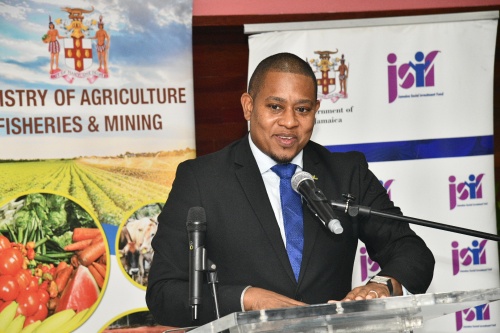
“This will improve productivity in the areas. It will strengthen income stability. More importantly, it will enhance climate resilience. All of us as farmers, we have seen that the climate has changed. We’re seeing higher temperatures; we’re seeing extended periods of drought. But in facing that reality, we have to do things differently,” he stated.
Mr. Green added that for clusters without produce storage, the Ministry and the Rural Agricultural Development Authority (RADA) will instal renewable energy-powered containers in high-production zones, ensuring that excess produce can be stored to maintain a consistent supply.
“If it is now not a part of their buildout to have storage, we’re going to put storage in them. Because we do not want to, now, produce so much that it becomes a disincentive if you don’t have the storage,” the Minister maintained.
The Ministry will provide training and input materials, while RADA will ensure farmer engagement and extension services are accessible to beneficiaries.
Additionally, the bauxite companies involved in the project will undertake land preparation activities necessary for establishing the greenhouse clusters.
They will also address land reclamation issues, carry out earthworks, and facilitate the leasing of lands to community benevolent societies, while providing the required documentation.
The REDI-II Greenhouse Clusters and Cooperative Infrastructure Upgrade Project is being executed in partnership with the Jamaica Social Investment Fund (JSIF), the World Bank, the Jamaica Bauxite Institute (JBI), RADA, and bauxite companies – namely Jamalco, Windalco, and Discover Bauxite.
JSIF Managing Director, Omar Sweeney, highlighted that the REDI-II initiative builds on the success of REDI-I, during which 160 greenhouses were constructed in eight communities across Manchester, St. Elizabeth, and St. Ann, producing approximately 762 tons of vegetables annually.
Describing the aim of the REDI-II project, he noted, “We’re doing things that will enable persons to take the shock of what may come with climate risk, absorb it, and recover quickly.”
Work is expected to begin in March 2026 and be completed within six months, followed by a six-month liability period.