


Gov’t Building Out Irrigation Infrastructure to Bolster Climate Resilience, Food Security
By: , March 2, 2026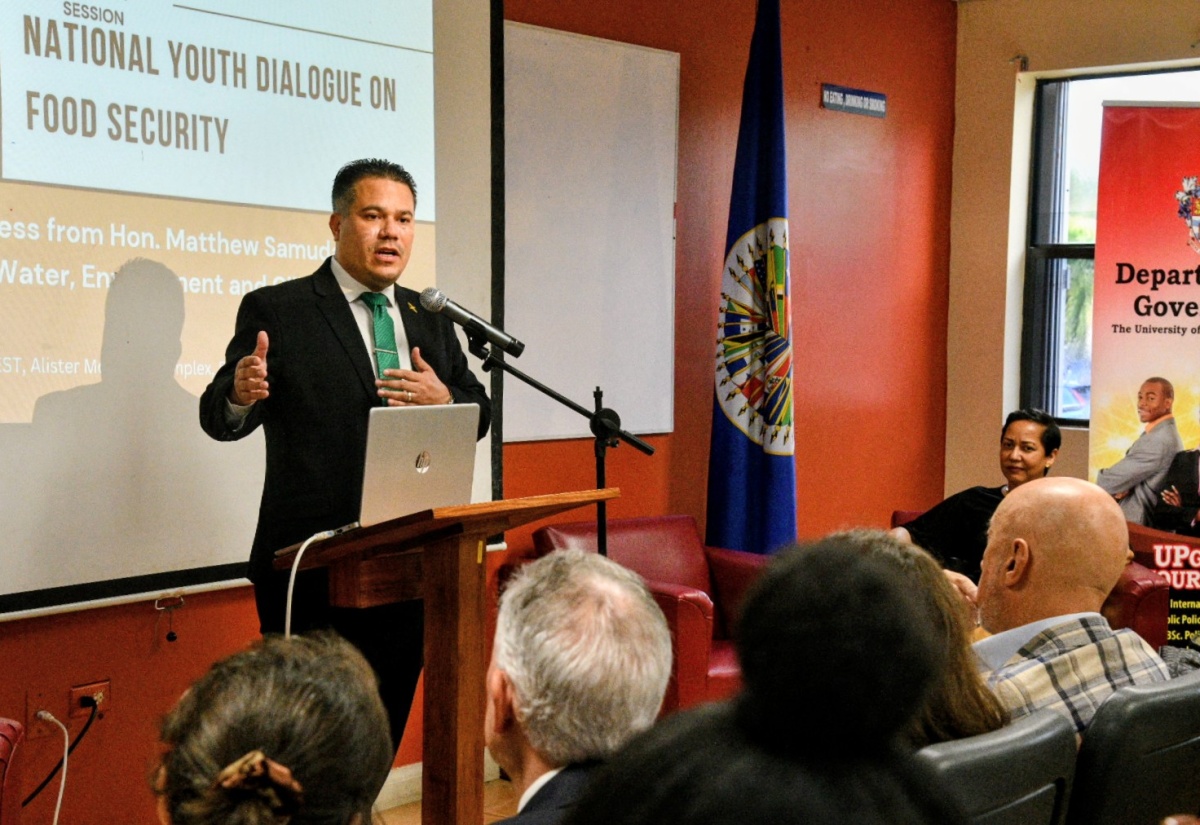
Photo: Michael Sloley
Minister of Water, Environment and Climate Change, Hon. Matthew Samuda, delivers the keynote address at the national youth dialogue on food security held at the University of the West Indies' Mona campus in St. Andrew on Friday (Feb. 27). The event was held under the Organization of American States (OAS) Youth Partnership Programme.The Full Story
Minister of Water, Environment and Climate Change, Hon. Matthew Samuda, says the Government is focused on building out the country’s irrigation infrastructure as a climate adaptation strategy and to contribute to the nation’s food security.
“We’re actively doing so in Essex Valley, we’re actively doing so in St. Elizabeth, and we have major irrigation plans for St. Mary and the plains of Yallahs,” he outlined during a national youth dialogue on food security on Friday (Feb.27).
He further cited the Pedro Plains Irrigation Project in St. Elizabeth, noting that upon completion of the five-year undertaking “we will be able to say that we are food secure in particular vegetables with just this single investment.”
Addressing students and faculty at the event held on the University of the West Indies’ Mona campus, Minister Samuda pointed out that climate change is already having an impact on the island’s food supply chains.
“Over the last five years, Jamaica would have experienced a category 4 hurricane, a category 5 hurricane, tropical storm, three of our five worst droughts in the last 120 years. We have experienced our hottest day on record. We have also experienced our wettest day on record. So, for us, we are living the impact of shifting weather patterns,” he pointed out.
Minister Samuda noted that the unpredictability of weather now being experienced has negatively affected the island’s food security.
“What has it led to? Deteriorating soil quality [and] lower pollination rates. So, ultimately, we are, through no doing of our own, less food secure today than we were 10 or 20 years ago…and that is a reality that we have to confront,” he said.
He stated that the Government is committed to making the investments needed to support the necessary adaptations in agriculture.
“The first reality has to be the provision of water. Ultimately irrigation is the basis of food production,” he said.
He informed that the Ministry completed the National Water Resource Management Plan last year, which confirmed that Jamaica has 500 per cent of what is needed for potable water and irrigation needs.
The plan assessed the state of the island’s water resources such as aquifers, rivers and underground water sources.
Minister Samuda pointed out that food security is not only about access to irrigation but adequate cold storage.
“We also need to institute the standards for food storage that reduce wastage, that reduce spoilage. So, Jamaicans will have to get used to the fact that some of your food will indeed be stored in solar-powered chillers,” he said.
“So, on food security we must significantly increase our irrigation. We must make sure that we have cold storage. We must connect our farmers much faster to markets so that there is far less spoilage,” he added.
The youth dialogue was held under the Organization of American States (OAS) Youth Partnership Programme.