

UTech Students Pioneer Agri-Tech Venture to Boost Food Security
By: , March 30, 2026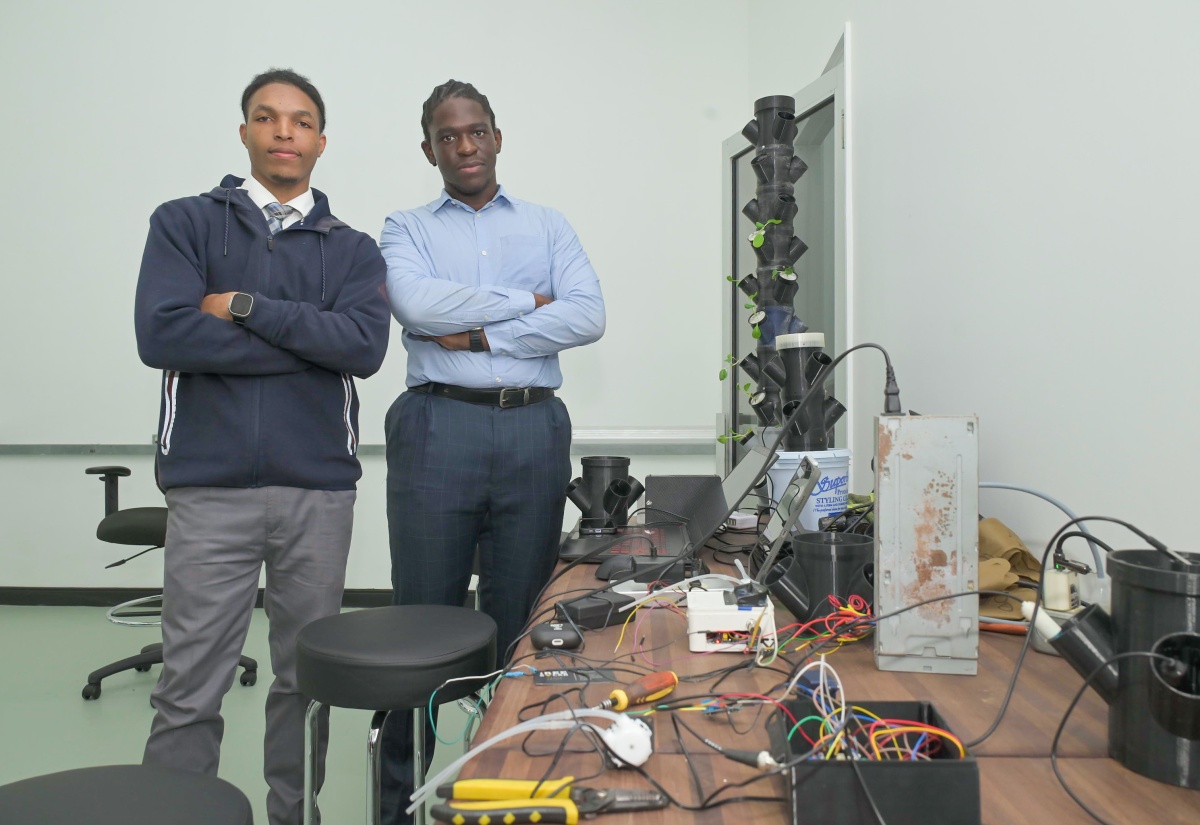
Photo: Donald De Lay Haye
Co-owners of Agrosphere Enterprise Limited and third year engineering students at the University of Technology, Jamaica (UTech), Jehohan Phillips (right) and Brian East, display prototypes of the aeroponic towers used in their farming operation at the institution. The occasion was the recent launch of the UTech Lloyd Carney Foundation IMEK Laboratory.The Full Story
What began in February 2025 as a collaborative project among three engineering students at the University of Technology, Jamaica (UTech), has quickly evolved into a business focused on advancing food security at the institution and in the nearby market.
The student-led venture, drawing on expertise from both engineering and agriculture, was officially registered as Agrosphere Enterprise Limited in November 2025 by founders Jehohan Phillips, Deandra Simmonds, and Brian East.
The team, all third-year students, operates with the precision of a well-oiled machine, skillfully leveraging their diverse engineering expertise.

Mr. East, who studies Electrical Engineering, oversees the ‘brain’ of the operation, managing its automation, sensors, and control systems.
Meanwhile, the two Mechanical Engineering students share the remaining responsibilities: Mr. Phillips focuses on systems design and manufacturing, while Ms. Simmonds specialises in project management, strategy, and overall operations.
The team departs from traditional soil farming by applying data-driven engineering to build a predictive model.
This model analyses key variables, including nutrient levels, temperature, plant size, growth length, and lighting conditions, to determine the optimal environment for crop cultivation.
“As we move forward, we constantly test, we constantly iterate, we go back. As we grow, the model grows. So we’re able to supply [produce] consistently and we’re able to have a high yield,” Mr. Phillips explains.
The team cultivates their crops using a range of methods, including aeroponics, hydroponics, and a hybrid of the two – chosen for both the types of produce they aim to grow and the flexibility these systems provide.
“The goal is for excellent space utilisation, as well as not using a lot of water. So there’s water efficiency compared to traditional methods. Using the different mixtures, we’re able to grow even healthier… stronger plants to give us a higher yield, because of how we grow them,” Mr. Phillips says.
Their manufacturing process is equally innovative – to keep costs low, they use 3D printing to produce farm towers made from Polyethylene Terephthalate Glycol (PETG) plastic.
This food-grade, chemically stable plastic – commonly used in water bottles – is recycled into filament for the 3D printer.
“There will be no moisture resistance, so there will be no mould buildup… it’s chemically stable. So even when it’s out in the sun, it won’t start to breakdown and leach into the water or our reservoir; additionally, it’s non-toxic,” Ms. Simmonds states, highlighting the benefits of using PETG plastic in their operation.
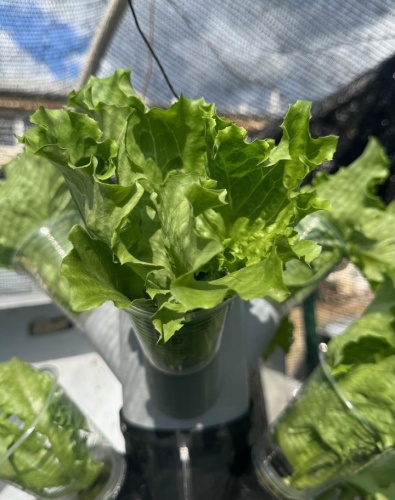
From their impressive operation, the team has harvested high-quality leafy greens, including lettuce, kale, and Pak choi, which are sold to restaurants on the UTech campus.
Mr. Phillips notes that the team plans to design a system for cultivating strawberries, while also expanding their market reach to Papine in St. Andrew, and eventually to the wider Jamaican community.
“Our aim is to be able to give a consistent amount at a consistent price across a period of time. It sounds like a grand vision but we’re trying to act as a buffer between supply and demand as well as the price. So whether there’s a glut or scarcity, we’re able to still supply that same amount at that same level at that same price. That’s our vision… and yes, it still remains profitable,” he further shares.
Mr. Phillips adds that the venture has been highly successful, with Agrosphere Enterprise producing A grade crops in size, colour, and texture. During a test run at market, their produce sold out within an hour.
The team also addresses misconceptions, clarifying that food grown through hydroponic and aeroponic methods is not artificial or non-organic, but rather cultivated using natural processes supported by advanced engineering.
“So the misconception is that we’re adding chemicals and we’re adding additives to the nutrient mix… and that’s not so. It’s literally the nutrients from the soil that are dried and packaged differently. Agrosphere is fully organic. We don’t want to do anything to harm the crops or harm the people consuming them,” Ms. Simmonds emphasises.

The team expresses gratitude for the immense support it has received from individuals, customers, and the University, which approved the use of a rooftop for their farming operation and provided access to power and other resources.
The students are also granted access to the UTech Lloyd Carney Foundation IMEK Laboratory, where they test and print the towers according to specifications designed to optimise crop growth and quality.
Mr. Phillips tells JIS News that, following the success of their tried-and-proven methods, the team is now seeking funding to expand their operations, including their market reach and the range of crops they produce.
He explains that funding is being sought through grants from the Development Bank of Jamaica (DBJ), the Ministry of Agriculture, Fisheries and Mining, and the Ministry of Industry, Investment and Commerce.
“We’re trying to reach out to the different channels. We aim to, by the next two to three years, supply fresh produce to all of UTech and, hopefully, to other markets in Papine, and then we expand accordingly,” Mr. Phillips says.
“Food production isn’t just agriculture, it’s more national resilience… how we’re able to feed our people, how we’re able to support and provide for our people or our country. That’s what we’re trying to do,” he adds.