



USF Utilising Hybrid Approach In Restoring Wi-Fi Sites
By: , February 25, 2026
The Full Story
The Universal Service Fund (USF) is employing a hybrid approach, utilising both traditional as well as satellite and solar technology solutions, to restore community and public Wi-Fi sites that were damaged or destroyed during Hurricane Melissa.
Chief Executive Officer of the USF, Charlton McFarlane, tells JIS News that the objective is to make the USF’s Wi-Fi infrastructure more resilient to future extreme weather events.
He notes that the October 2025 hurricane “exposed a lot of vulnerabilities” in the system.
“The hurricane disaster really impacted essentially all of our sites. We are talking about over 400 sites in total, comprising community Wi-Fi, and also the larger Wi-Fi for towns what we refer to as public Wi-Fi. We had damage to all our network as it relates to Wi-Fi connections,” he says.
Mr. McFarlane noted that the most severely impacted sites are in the western parishes of Hanover, Westmoreland, St. James, Trelawny and St. Elizabeth, which sustained the brunt of the category-five storm.
“We would have encountered total destruction of our infrastructure – equipment, enclosures of equipment and the fibre-optic network. Much of that would have been above ground on the poles,” he points out.
“We also would have been impacted by damage to the Jamaica Public Service (JPS) grid. Those would have impacted our ability to restore,” he adds.
With the power grid down and Wi-Fi sites severely damaged and destroyed, the USF deployed Starlink satellite-based internet systems to provide immediate broadband coverage in key communities in western Jamaica.
“With Melissa, there are many things that we realised quickly within days of the passage. Persons needed connectivity to get in touch with loved ones… we needed a solution that was quick and was relatively ready-made for implementation and so we pivoted to the use of satellite technology,” he says.
“In addition to that, we had to pivot to employ solar solutions to power the satellite technology solutions,” he says.
“It is a solution that we believe is a good one. Certainly, we have seen where we would want to expand that further,” Mr. McFarlane tells JIS News.
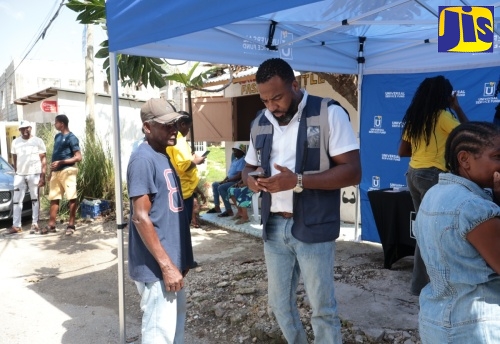
As at February 11, a total of 140 sites have been restored using a mix of traditional and satellite/solar solutions.
Mr. McFarlane notes that as the agency goes into full restoration, the intention is to employ a hybrid approach where appropriate.
“We will employ the use of satellite technology and where appropriate… we will employ the use of the existing technology that we had prior to Hurricane Melissa,” he says.
Mr. McFarlane maintains that the use of satellite technology is a restoration methodology that is resilient.
“It does not rely on terrestrial infrastructure, meaning the fibre cables. A satellite could be taken down in the event of an adverse weather event and put back up afterwards. In addition, we are also employing the use of solar technology, which means that if the traditional power grid goes down, we are able to restore power in a short amount of time.
“That is where the resilience comes in – our ability to bounce back faster. I am not saying this approach will be disaster-proof. What it will certainly do is reduce the time it takes to restore the service we are providing, because the infrastructure we are relying on as we move forward, post Hurricane Melissa is infrastructure that is not as vulnerable to the impacts of a natural disaster,” he explains.
The community and public Wi-Fi programmes are part of the Government’s thrust to transition to a digital society. They are designed to increase access to the internet across Jamaica’s 63 constituencies.
Turning to the Community Access Points (CAPs), Mr. McFarlane tells JIS News that work is under way to repair 49 facilities that sustained damage.
There are 360 CAPs islandwide. These are computer labs located in underserved communities that provide free or low-cost internet, digital training, and services like printing and scanning.
“These are essentially community centres that the USF would have, over the years, equipped with computers, internet and furniture. Those community access points, especially in western Jamaica, would have been significantly impacted. We have started to restore these access points,” he informs.
He notes that the Youth Innovation Centre in Savanna-la-Mar will act as a prototype for utilising the hybrid approach in the restoration of CAP facilities.
“That entity is fully powered by a solar solution, and they are also using satellite technology. This solution was tested… the proof of concept worked, and we are planning to roll out that solution across several Community Access Points right across Jamaica as part of our restoration efforts,” Mr. McFarlane says.