


Study Calls for Digital Literacy to Help Teens Manage Screen Time
By: , March 31, 2026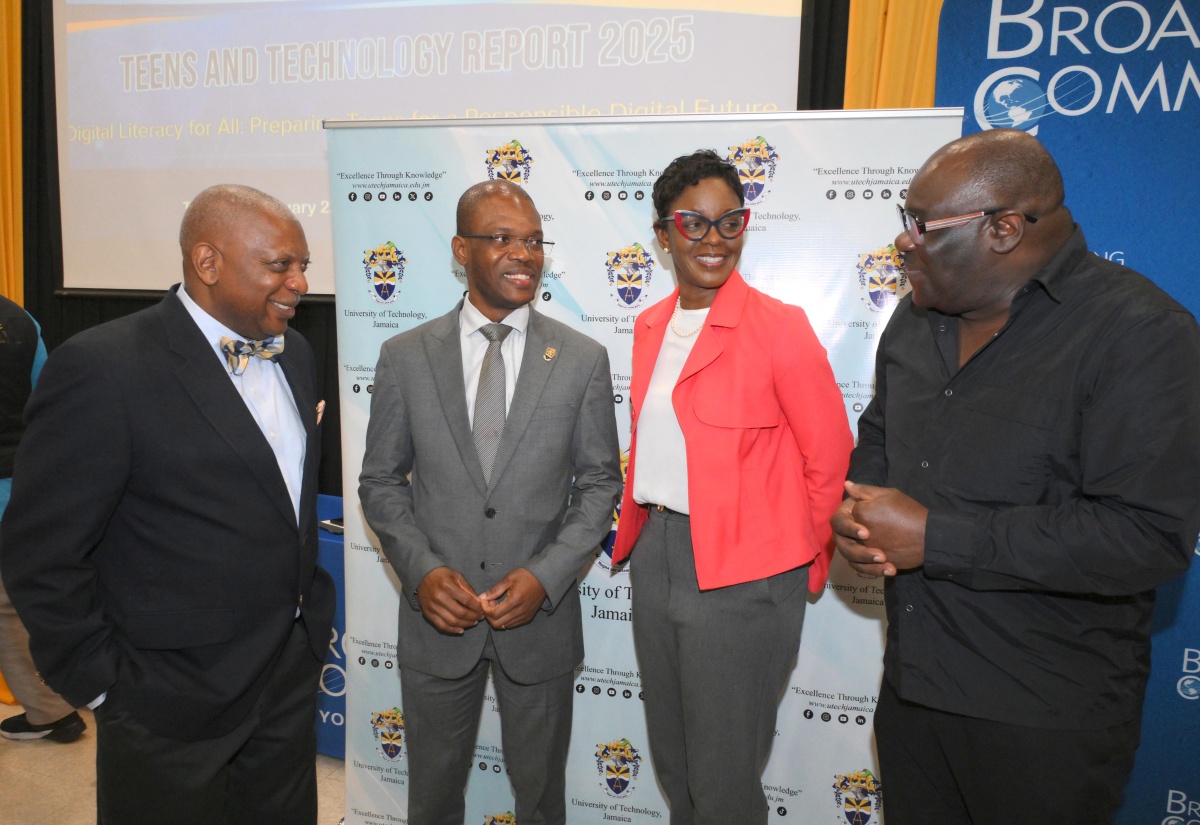
Photo: Rudranath Fraser
Executive Director of the Broadcasting Commission of Jamaica, Cordel Green (right), is in conversation with (from left) Lead Researcher and Professor of Information Systems at the College of Business and Management (COBAM), University of Technology (UTech), Jamaica, Professor Paul Golding; President of UTech, Dr. Kevin Brown; Lecturer at the COBAM, Camille Jackson. Occasion was the recent launch of the 2025 Teen and Tech Report, at the UTech campus in St. Andrew.The Full Story
A new study has highlighted the urgent need for robust digital literacy to better enable teens to navigate the rapidly evolving technological environment, including responsible use of artificial intelligence (AI).
Digital literacy is the ability to appropriately use information and communications technology (ICT) to utilise digital resources and communicate with others.
The research, titled ‘Teens and Technology Report 2025: Digital Literacy for All – Preparing Teens for a Responsible Digital Future’, is a collaborative initiative involving the University of Technology (UTech), Jamaica and the Broadcasting Commission of Jamaica.
Launched earlier this year at the UTech campus in St. Andrew, the study found that teenagers are hyper-connected, with 95 per cent of students having daily access to a device regardless of their ability. Teenagers rarely read the physical newspaper or watch television.
Among the major challenges identified were the impact of online platforms on students’ attention span and learning, the use of AI in schoolwork and addiction to technology.
Executive Director of the Broadcasting Commission, Cordel Green, in addressing the issue of digital addiction during a panel discussion, said that children are naturally drawn to games and devices, and the real issue is big tech intentionally designing technology to be addictive.

He noted the need for collective action to hold big technology companies accountable for profiting from the exploitation of children.
“It is time we think about civil and criminal sanctions for anyone intentionally creating a device which is harmful to children or negligent in allowing devices and platforms to be used in ways that harm children,” he said.
Mr. Green disagreed with banning technology as a resolution and instead, endorsed embedding digital literacy in the curriculum from kindergarten.
“We have to require safety by design. If you are creating a device, across the world we should say, if it is going to be used by children or there is a risk children are going to use it, incorporate child-safety filters,” he proposed.
He noted that “children enjoy a fundamental right to create and to receive information, and restrictions must be justified, proportionate and evidence-based, which is why the research is critical”.
Lead Researcher and Professor of Information Systems at the UTech’s College of Business and Management (COBAM), Professor Paul Golding, in his contribution, said that this research was unprecedented, because of its inclusion of data on deaf and blind students.

“We have not seen any other study in which there is comparison made among deaf students, blind students and persons without any known disability. We have seen other studies on race and gender, [and] what we have done is to look at a wider spectrum than you would normally see in traditional studies,” he pointed out.
“We are hopeful that… the findings that we have will help to determine policy for our students,” he added.
Education Officer for Braille Operations in the Special Educations Unit of the Ministry of Education, Skills, Youth and Information, Vivian Blake, noted that the Ministry is integrating digital literacy into the new curriculum of students.
“The Ministry is moving to incorporate more character education, social and emotional learning. Embedded in this is some of the digital literacy skills and etiquette as it relates to the use of social media,” said Mr. Blake.
Pro-Registrar and Deputy Chief Executive Officer (CEO) of the Caribbean Examinations Council (CXC), Dr Eduardo Ali, noted that during the pandemic there was a shift to online classrooms and an increase in exposure to social media platforms.

This change has contributed to decrease in the attention span of students.
“Most of the content is packaged in bite size, and young people are engaging with that constantly and so their attention span is shifting from 10 minutes to five minutes, to three minutes, to 30 seconds. What they want is content packaged to cater to that,” said Dr. Ali.
CXC has begun integrating AI into its offerings and continues to issue guidelines to ensure its ethical use.
Group CEO from RJRGLEANER Communications Group, Gary Allen, for his part, said that the research revealed the importance of providing easy access to teens where there is a demand.
“We are seeing the decline in the consumption of the hard-copy newspaper and that is why we have to make access available on multiple platforms,” Mr. Allen noted.
This study was a follow up on a similar study done in 2018. Camille Jackson, Lecturer at COBAM was the co-researcher.
Digital literacy and artificial intelligence directly tie to national outcome two of Vision 2030 that emphasises ‘World-Class Education and Training’.
This also aligns with the United Nations Sustainable Development Goal (SDG 4), which aims to ensure inclusive and equitable quality education for all.