

Students and Schools Benefiting from Post-Hurricane ‘Educational Re-Start’
By: , March 1, 2026
Photo: Donald De La Haye
Project STAR, Coordinator, Myshka Allen, receives a cheque from High Commissioner of Canada to Jamaica, His Excellency Mark Berman, during a Canada Fund for Local Initiatives (CFLI) Spotlight Event held at the Terra Nova All-Suite Hotel in St. Andrew in January.
Photo: Donald De La Haye
Project STAR Coordinator, Myshka Allen, provides an overview of the organisation’s activities during a Canada Fund for Local Initiatives (CFLI) Spotlight Event held at the Terra Nova All-Suite Hotel in St. Andrew in January.The Full Story
When Hurricane Melissa struck Jamaica in October 2025, Project STAR (Social Transformation and Renewal) teams were actively implementing social and economic transformation initiatives across several under-resourced communities in the western region.
Like many other non-governmental organisations (NGOs), Project STAR’s initiatives were disrupted by the large-scale devastation of the Category 5 hurricane.
Yet, while other entities withdrew from the affected communities, Project STAR seized the moment to pivot and adapt its approach.
In response, the organisation launched the Hurricane Melissa Educational Re-Start Initiative—a comprehensive recovery programme designed not only to repair infrastructure, but to restore the emotional and operational core of community schooling.
The initiative stands out as one of 11 projects recently awarded grants by the Canada Fund for Local Initiatives (CFLI), securing CAD $50,000.
It currently supports three educational institutions – Sir Clifford Campbell Primary in Westmoreland, and Salt Spring Primary and Infant, and Hartfield Basic School in St. James.
Through this programme, the schools are receiving trucked water, new furniture, including chalkboards and teaching aids, specialised capacity-building sessions for community volunteers, as well as structured art, journaling, and narrative-based activities to provide emotional support.
Project Coordinator, Myshka Allen, explains that the initiative forms part of a broader, coordinated recovery effort in Savanna-la-Mar, Westmoreland, and Salt Spring, St. James.
“When Hurricane Melissa struck, schools were left without water, electricity, safe sanitation and, in some cases, classrooms. For children, the disruption went far beyond physical infrastructure. It meant loss of routine, loss of safety, and deep emotional uncertainty,” she states.
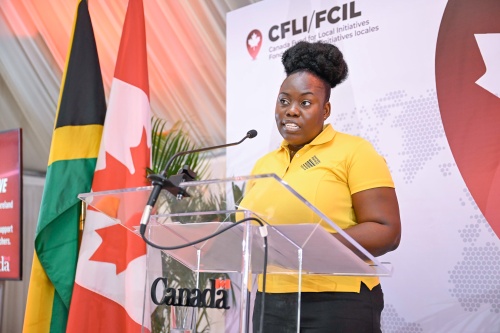
Ms. Allen affirms that, through this CFLI-supported project, Project STAR is addressing both the immediate and long-term dimensions of the crisis.
“We are providing critical equipment, materials [and] resources that allow schools to open safely and function day-to-day. Just as important, we are training community volunteers to deliver psychosocial support to primary-aged children… helping them process trauma, regain a sense of stability, and re-engage with learning,” the Project Coordinator outlines.
She emphasises that by equipping volunteers from within the communities, Project STAR is ensuring that the support network remains strong and continues well beyond the lifespan of the initiative.
“The impact is tangible. It’s more than 600 students. Dozens of teachers and staff will benefit directly, with families and communities supported indirectly as schools once again becomes safe, functioning spaces for learning and care,” Ms. Allen states.
She expresses gratitude for CFLI’s support, noting that the partnership underscores a shared understanding that recovery is not only about rebuilding structures, but also about restoring hope, dignity, and opportunity—especially for the nation’s children.
“CFLI’s support is not only financial, but also a signal that [they] trust our leadership… [they] trust community-rooted solutions,” Ms. Allen affirms.
The initiative is expected to enhance health and safety in beneficiary schools by mitigating hygiene risks through a consistent water supply, while also supporting trauma recovery by strengthening emotional regulation and reducing disaster-related anxiety.
It is also expected to strengthen community resilience by establishing a sustainable, locally rooted support system through trained volunteers, thereby ensuring long-term mental health capacity within the schools.
The Educational Re-Start Initiative has been warmly welcomed by both the beneficiary schools and the surrounding communities.
Teacher at Hartfield Basic School, Salene Murray, expresses deep gratitude to both CFLI and Project STAR for the intervention, noting that it was urgently needed in the hurricane’s aftermath.
“The Hartfield Basic School went through some infrastructural damage during Melissa, that destroyed our resources… learning materials and, overall, the school. Project STAR came in, saw the need, and they basically adopted us at a time that we needed them most,” she shares.
Ms. Murray points out that while other entities and individuals have assisted the institution by addressing physical needs such as resources and infrastructure, Project STAR recognised the importance of going further—focusing on the psychosocial needs of the beneficiaries.
“We have students from two to five years old. They [experienced Hurricane] Melissa [and] had to deal with the challenge of reintegrating and going back into the school system after dealing with the damage and [related occurrences]. [So for] offering this service… [in terms of] looking at the emotional side of things, we are truly grateful, because this will help our students as it relates to getting back on track in their learning and development, and just their overall operation on a daily basis as students,” the teacher explains.
Ms. Murray notes that the programme has also brought significant benefits to the staff at the institution.
“The psychosocial programme is helping and will be helping the staff as well, to be better able to understand the needs of the students and help them where necessary. So we are truly grateful for the help offered… where they came in and they assisted with resources needed,” she adds.