


Small Farmers in Kitson Town Benefit from IRL Project
By: , April 9, 2026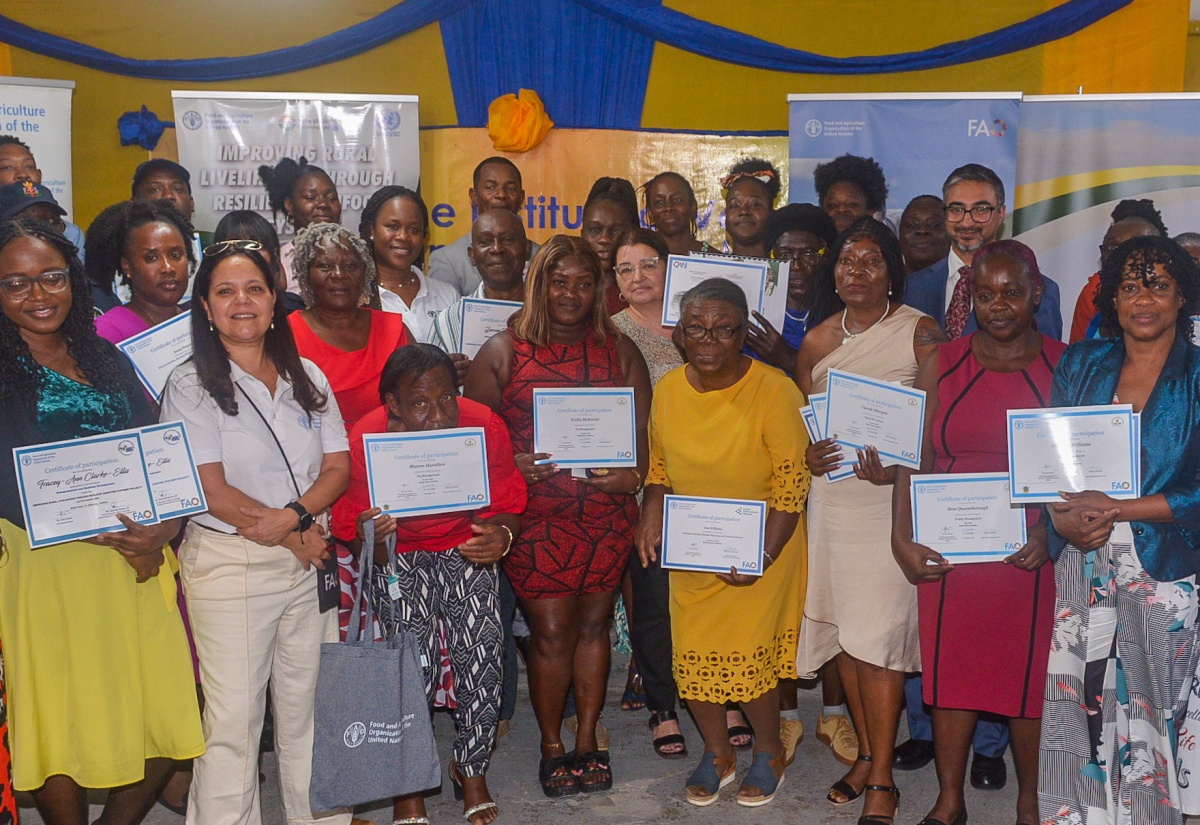
Photo: Dave Reid
Participants in the Improving Rural Livelihoods through Resilient Agri-food Systems (IRL) Project, in the company of officials, display their certificates during the certification ceremony, held recently at the Spring Village Community Centre in St. Catherine.The Full Story
Scores of small farmers in Kitson Town, St. Catherine, say they are benefiting from an agricultural transformation in the community that is improving livelihoods, redefining community, and reimagining the future of rural enterprises.
The small farmers tell a story of empowerment, innovation, and renewed hope, and are crediting the Improving Rural Livelihoods through Resilient Agri-food Systems (IRL) Project for the change.
Valued at US$1 million, the project represents a strategic investment, not just in agriculture but in people.
It is funded under a South-South Cooperation Initiative by the Government of India, through the India-United Nations Development Partnership Fund, and implemented by the Food and Agriculture Organization of the United Nations (FAO), in collaboration with the Government of Jamaica.
The project was designed to strengthen rural economies by equipping small farmers with the skills and tools needed to thrive in an increasingly complex and climate-sensitive agricultural landscape.
At the heart of the initiative is a simple, yet transformative idea that small farmers, when given access to knowledge, resources, and opportunity, can become powerful agents of change within their communities.
For Carole Morgan, a long-time resident of Kitson Town, the programme has been nothing short of life-changing. Once a modest poultry farmer, Miss Morgan describes how the training expanded her understanding of animal husbandry in ways she had never imagined.
“I was a farmer rearing my chickens,” she shared, during the certification ceremony held recently at the Spring Village Community Centre in the parish. “But I got more experience how to do my animals, which I did not know before. So, I am very proud… and I am really truly happy,” she said.
Miss Morgan’s story is echoed by many in the community, particularly women, who make up the majority of the programme’s 200 beneficiaries. Through structured training sessions, participants were introduced to a range of agricultural disciplines, including goat and pig rearing, poultry production, beekeeping, diversifying income streams and reducing vulnerability to market or environmental shocks.
But the impact of the IRL Project extends beyond farming techniques. It is also bridging social divides and strengthening community bonds in unexpected ways.
Constable Ralston McCalla of the Guanaboa Vale Police Station is one such example.
He credits the programme with giving him hands-on skills in goat care, including assisting with births.
“It amazes me to see the things that I learned from this programme. Now my colleagues are calling me ‘Dr. McCalla’, because of how I deliver kids,” he says.
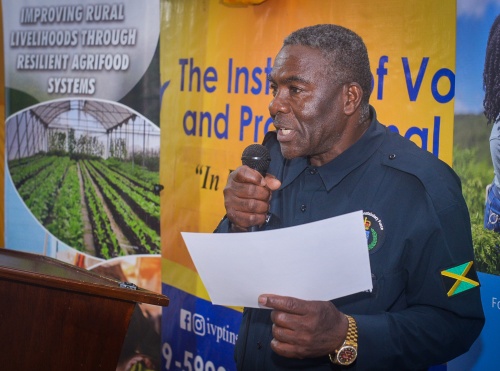
More importantly, Mr. McCalla points out that the initiative has helped to narrow the gap between law enforcement and citizens. In a community where trust can sometimes be fragile, shared participation in agricultural training has fostered new relationships grounded in cooperation and mutual respect.
This blending of social development with economic empowerment is a hallmark of the project’s design, according to FAO Project Manager, Inessa Salomão.
She explains that participants were not only trained in technical agricultural practices but also in entrepreneurship, food safety, and climate-smart farming methods.
“They have been equipped with technologies in livestock… and also other techniques in agriculture for water harvesting and protected agriculture,” she notes.
“Even though they went through a process of entrepreneurship and best practices, this is about building sustainable livelihood,” she adds.
Sustainability lies at the core of the initiative, with Climate Change posing an ever-present threat to Caribbean agriculture. The adoption of resilient practices, such as water harvesting systems and protected farming structures, ensure that farmers are better prepared to withstand droughts, storms, and shifting weather patterns.
The programme’s emphasis on entrepreneurship is equally critical. By teaching farmers how to manage finances, market their products, and adhere to food-safety standards, the initiative is helping to transform subsistence farming into viable small businesses capable of contributing to local and national economies.
For Devon Thompson, President of the Kitson Town Community Development Committee (CDC), the graduation ceremony marked not an end but a beginning.
“This is an opportune moment… the beginning of a transformative development programme in the life of many women and a few men in the Kitson Town community. All of the participants… came in as students. So, it is a beginning,” he told the audience.
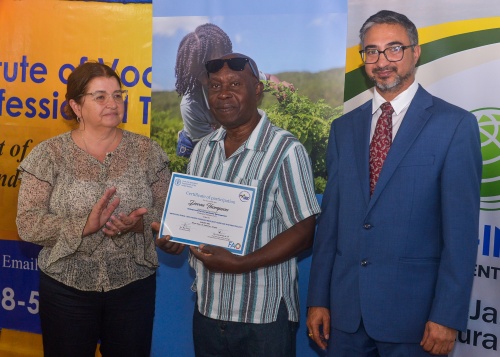
Mr. Thompson’s words capture the essence of the project, as a continuous journey rather than a final destination. The knowledge gained, he emphasised, would ripple outwards, benefiting not just individual participants but the wider community for years to come.
The ripple effect is intentional. According to FAO Representative, Ana Touza, the project is guided by the organisation’s ‘Four Betters’ framework: better production, better nutrition, a better environment, and ultimately, a better life.
“The results are real and measurable. Better production means adopting Climate-resilient farming… better nutrition was advanced by strengthening food-safety practices… better environment is reflected in climate-smart technologies… and all this contributes to a better life,” Dr. Touza tells JIS News.
Her remarks highlight the holistic nature of the initiative. It is not merely about increasing yields but about improving quality of life, ensuring that families have access to safe, nutritious food, while also generating sustainable income.
The international dimension of the project also underscores the growing importance of South-South cooperation in addressing global development challenges.
Representing the Government of India, High Commissioner, Mayank Joshi, praised the programme’s success and reaffirmed his country’s commitment to supporting similar initiatives across the Caribbean.
“This livelihood programme is helping communities sustain themselves. The majority of the beneficiaries here are women. And when women participate in agricultural or economic activities, there is a very strong hope for sustainable development,” he told the audience.
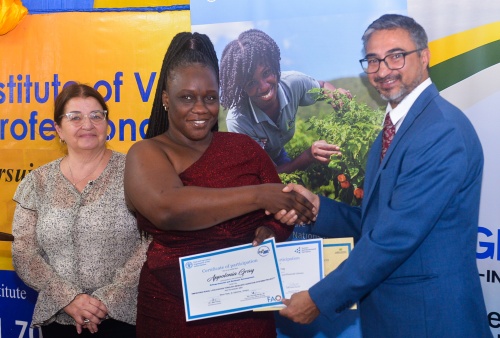
His comments reflect a broader recognition that empowering women is central to rural development.
In Kitson Town, that empowerment is already visible – in the confidence of graduates, in the expansion of small enterprises, and in the strengthening of community networks.
Encouragingly, extension officers and farmer leaders have been trained as part of the initiative, ensuring that knowledge continues to circulate long after the formal programme concludes.
Plans for introducing additional tools, post-harvest facilities, and advanced agricultural technologies, including hydroponics, signal that this is only the beginning of a longer-term transformation.