

Poet Laureate Competition Celebrates Jamaica’s Creative Talent
By: , January 21, 2026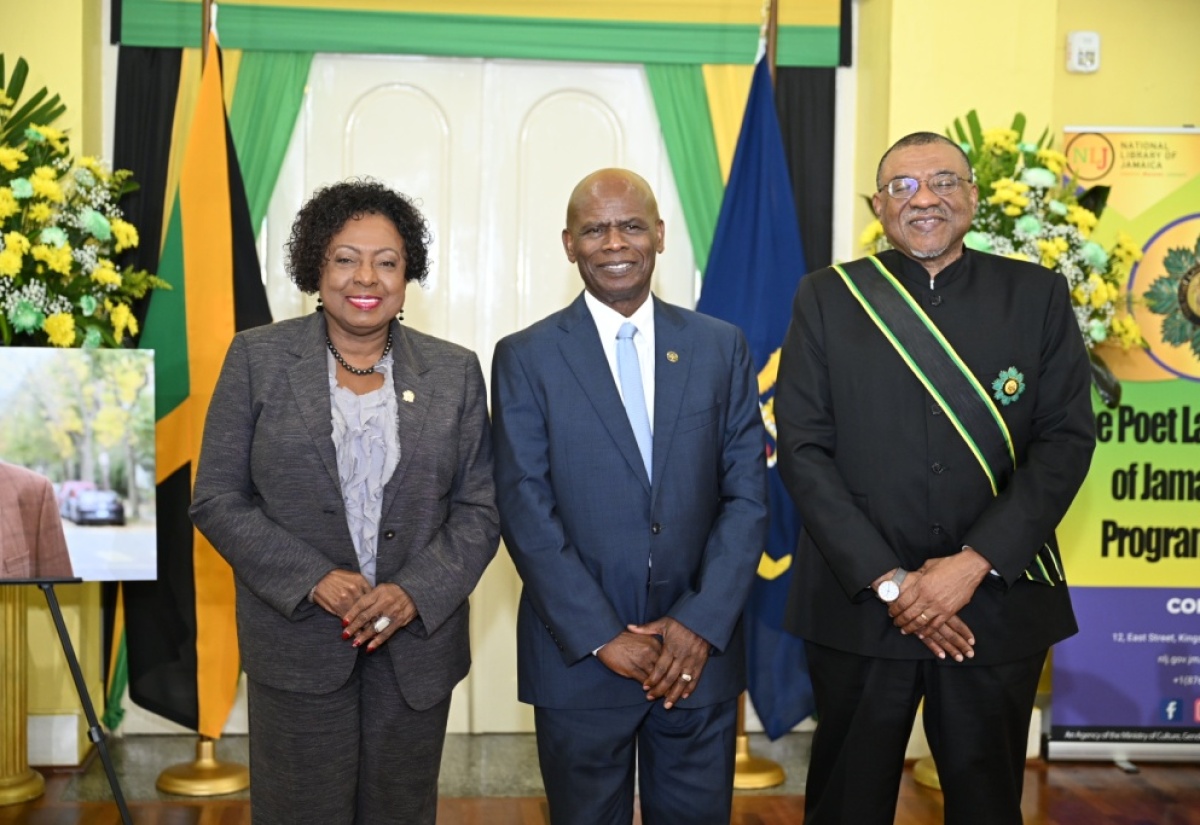
Photo: JIS File
Deputy Governor-General, Hon. Steadman Fuller (centre), and Minister of Culture, Gender, Entertainment and Sport, Hon. Olivia Grange (left), share a photo opportunity with Poet Laureate of Jamaica for 2025 to 2028, Professor Kwame Dawes, at the ceremony of investiture at King’s House in January 2025.The Full Story
Since 2017, the National Library of Jamaica (NLJ) has hosted the Poet Laureate of Jamaica Prizes for Poetry competition, inviting poets from across the country to submit their work for recognition at the national level.
For 2026, the competition continues its tradition of celebrating and highlighting Jamaican literary talent and cultural expression, under the leadership of Poet Laureate of Jamaica for 2025 to 2028, Professor Kwame Dawes.
Speaking with JIS News about the history of the competition, Dr. Dawes, who is a widely acclaimed poet, notes that it began as one of the initiatives of the first Poet Laureate, Professor Mervyn Morris.
“It’s consistent with his own ideas about the importance of a national engagement with poetry writing and so a poetry contest seemed to make sense, and through the National Library it has been repeated with each Poet Laureate each year,” he explains.
“So, I have inherited something that I think is incredibly necessary. I think it’s an exciting project,” Professor Dawes adds.
He emphasises the cultural value of the competition, noting Jamaica’s sustained tradition of arts competitions in different creative disciplines.
“Anybody who has been to school in Jamaica knows the excitement of the different art competitions that happen on a national level, related to festival and also in theatre and song, and that has continued for a long time,” he notes.
“I think what the national contest in poetry has done is to create an exciting focus for everybody who is interested in poetry to be part of that conversation and it is also a great sign for a country like ours to have a national poetry contest. This is true in many countries,” Professor Dawes continues.
The role of writers and artists alike is to reflect the times in which they exist, and it is Professor Dawes’ aim, with the 2026 iteration of this competition, to tap into the creative consciousness of the Jamaican people.
“For me as a poet and as the Poet Laureate, I see it as an opportunity to see what people are thinking, what they’re feeling, and how they’re writing those feelings. It is a way to promote part of our culture, that is poetry writing, lyrics, the construction of a way of seeing the world through this creative mechanism,” he says.
“I really consider poets as the chroniclers of the sentiment of our time and the sentiment of our country, where we are in our space, where you are located. Historians will chronicle events, poets will chronicle the way people felt inside those events, the way people lived in those events. That’s what the poet does,” Professor Dawes adds.
The categories for the competition are the Edward Baugh Prize for adult writers from Portland, St. Thomas, Kingston and St Andrew; the Louise Bennett-Coverley Prize for adult writers from St. Catherine, Clarendon, Manchester, Trelawny, St. Ann and St. Mary; and the Michael Cooke Prize for adult writers from Hanover, St. James, Westmoreland and St. Elizabeth.
These categories welcome entries on any topic of the writer’s choosing and attract cash prizes of US$600, $250, and $150 for first, second and third place, respectively.
“Typically, we open it to anything that anybody wants to be writing about. In some parts of the contest, we might come up with a particular theme, and this has varied from Poet Laureate to Poet Laureate, and I think from year to year,” says Professor Dawes.
Another category is the Poet Laureate of Jamaica Young Writer prize for poets aged 18 to 25.
Following the devastating damage to Western Jamaica caused by the passage of Hurricane Melissa in October 2025, the decision was taken to use this category specifically to highlight work based on images taken in some of the most affected areas.
“When we started discussing the final plans for the contest, we were visited by a very unwelcome visitor named Melissa that really turned things over in Jamaica and it seemed to make sense to acknowledge that this is something that is pressing on the hearts of Jamaicans, their lives and their experience,” Professor Dawes says.
Poets are provided with three (3) photographs from which they are to compose three (3) pieces of poetry.
“The contestants who are going to enter [are] to respond to photographs that reflect the damage and the effect of Melissa in creating their poems. That’s really one of the special qualities that we have for this year,” he informs.
Professor Dawes says the subjectivity of poetry should not be seen as a barrier to access but rather a driving force for its appreciation.
“It’s like music; we have a style of music that we know to be Jamaican music. People say poetry is subjective and it’s in the eye of the beholder, but the truth is, we don’t put that limit when we’re talking about music. We say there’s a hit song everybody likes. It means that there’s a lot of beholders, who are beholding something that is of a certain quality and I think it’s the same with poetry,” he says.
“I don’t approach poetry as something that is inaccessible because it’s subjective. I think its value as a subjective thing is that it moves the emotions of people. It moves our hearts, and we can collectively be moved by poetry, and that’s the best poetry that is generated. So, we’re looking forward to seeing a range of work,” Professor Dawes adds.
Beyond themes and appreciation for poetry, Professor Dawes highlights the importance of authenticity and craft to the competition, encouraging writers to be true to their creative voices.
“I always say to poets, your value as an individual, as who you are, is important. Your sight, what you see is important…. be true to your voice, be true to your language, be true to your reading, what has made you who you are, and create poetry that does that,” he says.
“The last thing I’d say to poets is you didn’t invent poetry. Poets have been there forever so the better you know what has been there, the better you are as a poet. Be true to yourself, but also understand that this is a long, complex and rich tradition that you’re entering and treat it with reverence and respect and learn from it, and then join in the conversation,” Professor Dawes adds.
The deadline for entries to the 2026 Poet Laureate of Jamaica Prizes for Poetry competition is Monday, March 2.
Further details of the competition are available at nlj.gov.jm.