


New Cocoa Farmer Eager to Help Manage the Frosty Pod Rot Disease
By: , April 8, 2026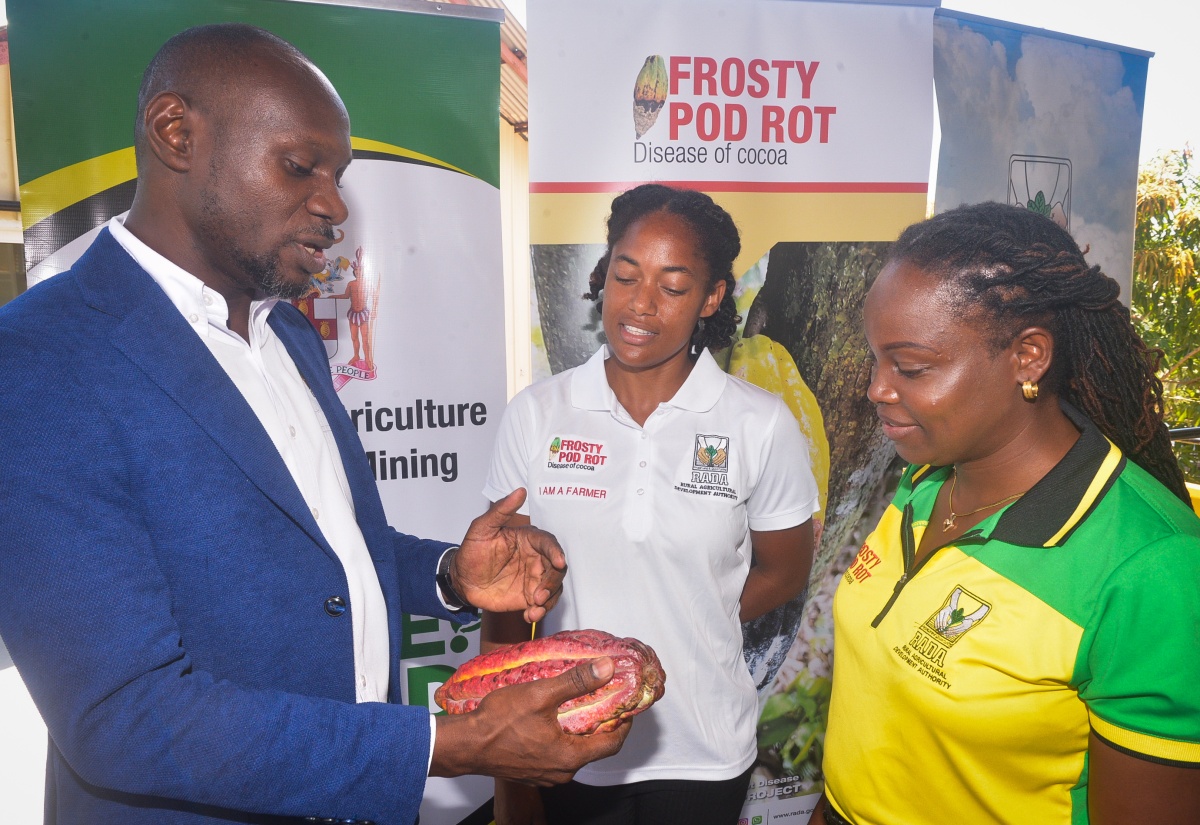
Photo: Dave Reid
Director of Project Management and Coordination at the Rural Agricultural Development Authority (RADA), Dwayne Henry (left), in discussion with female cocoa farmer, Bennesa DeCambre-Hayden (centre), and Marketing Officer at RADA, Tassia Francis, during the recent graduation ceremony for 50 cocoa farmers who successfully completed training in Cocoa Frosty Pod Rot Disease Management, held at the Denbigh Showground in Clarendon.The Full Story
New entrant into the cocoa industry, Bennesa DeCambre-Hayden, graduated from a recent training programme on the Management of the Frosty Pod Rot Disease, at the Denbigh Showground in May Pen, Clarendon.
Mrs. DeCambre-Hayden is not only a relatively new cocoa farmer but a symbol of the sector’s evolving future.
Her journey into cocoa farming was not part of a grand, lifelong plan. Instead, it grew organically out of curiosity, opportunity, and a willingness to learn.
“I’m a new entrant into the cocoa industry. And even after watching 10,000 hours of YouTube, it doesn’t make you an expert,” Mrs. DeCambre-Hayden told the participants at the ceremony.
She emphasised that experience, knowledge, adaptability and dedication are the keys to overcoming one of the cocoa industry’s most persistent threats, the devastating Frosty Pod Rot Disease.
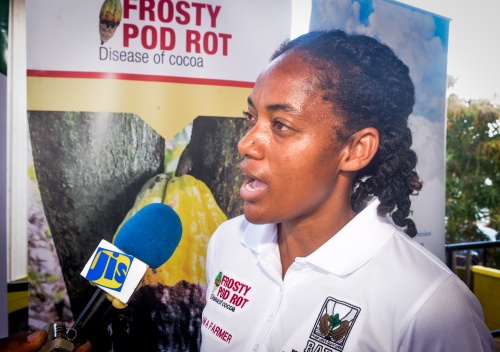
Mrs. DeCambre-Hayden said that the training programme has equipped her and dozens of other farmers with practical tools to confront the fungal disease that has threatened livelihoods across Jamaica.
The training, delivered through a collaborative effort, led by the Rural Agricultural Development Authority (RADA), was not only theoretical. It blended classroom instruction with hands-on fieldwork, ensuring that farmers could immediately translate knowledge into practice.
Mrs. DeCambre-Hayden highlighted Climate Change as one of the most eye-opening topics covered.
“One of the points that stuck out to us was rainfall and how the pattern has changed over the past couple of decades. It is not that we are getting more rain; it is that we are getting more intense rain, falling within a shorter period,” she noted.
The shift, she explained, has significant implications for cocoa farming, particularly in managing the Frosty Pod Rot Disease, which thrives in moist, humid environments.
Understanding these changing patterns allowed farmers to rethink traditional practices and to adopt more climate-smart approaches.
“We discussed how we could modify our cultural practices to adapt to these changes and aid in the elimination of the frosty pod disease,” she noted, underscoring the programme’s emphasis on adaptability and innovation.
Among the most transformative lessons for participants was a shift away from long-held habits towards more precise, science-based techniques.
“We will no longer go out to dash any fertiliser,” Mrs. DeCambre-Hayden said, adding that, “we were literally and figuratively dashing away our fertilisers.”
Instead, farmers are now being taught to apply fertiliser with intention, selecting appropriate distances from trees, digging proper holes, and covering nutrients to prevent waste and maximise absorption.
“It sounds small but when you think about the time it takes and the labour involved, you realise we have to adapt. We have to use different tools and equipment to make it work,” Mrs. DeCambre-Hayden emphasised.
Farmers were not just told what to do; they were shown how to do it.
“We went into the field for hands-on sessions, including disease identification. We did field mapping, looked at drainage, and learned how to create hillside ditches,” she said, adding that farmers eagerly demonstrated their skills during land husbandry exercises.
The exercises have equipped farmers to better manage their land, improve drainage, and reduce the conditions that allow the Frosty Pod Rot Disease to thrive. Participants also engaged in grafting sessions, learning how to propagate disease-resistant and high-yielding cocoa varieties, an essential step in building long-term resilience.
Central to the training was a deep dive into Frosty Pod Rot Disease itself, a fungal infection that targets cocoa pods and can reduce marketable yields by up to 80 per cent if left unmanaged.
Project Management Director at RADA, Dwayne Henry, reinforced this reality during the ceremony, explaining that while infected trees may still bear fruit, much of it becomes unfit for sale.
The solution, he stressed, lies in integrated pest and crop management, an approach that combines cultural practices, chemical treatments, and environmental control.
This change represents a broader cultural shift in Jamaican agriculture, moving from tradition-driven methods to data-informed decision-making.
Mrs. DeCambre-Hayden echoed this understanding, noting how the training demystified the disease and empowered farmers to act decisively.
“We learned how to identify disease-resistant scions, how to care for our tools, and even how the pH of water can affect spraying. These are things you don’t always think about but they make a difference,” she said.
For Mrs. DeCambre-Hayden, farming is not just an occupation; it is a philosophy grounded in adaptability.
“You just have to learn to pivot,” she told JIS News in a subsequent interview. “It’s not about being resilient to the point where you’re wasting your money. You have to look at what’s working, what’s not, and move,” she said.
Her own farming journey reflects this mindset. What began as an interest in goat farming expanded into beekeeping and, eventually, cocoa cultivation, after she and her family acquired land with existing cocoa and coconut trees.
“We wanted a resilient type of farm. The underbrush feeds the goats, the coconuts support the bees, and as a bonus, we have cocoa,” Mrs. DeCambre-Hayden said.
This integrated approach not only diversifies income streams, but also enhances ecological balance, an increasingly important consideration in the face of climate change.
As a relatively young farmer, Mrs. DeCambre-Hayden is part of a new generation redefining agriculture in Jamaica. She is unapologetic in her belief that farming is both viable and vital.
“Whether it’s from being a lawyer, a doctor, a taxi man, or selling food, $1,000 is $1,000.What is more important than food? Nothing,” she said.
Her perspective challenges the outdated notion that farming is a fallback option rather than a strategic, rewarding career.
“There’s something innately fulfilling about watching something grow. You spend time and energy taking care of it, and then you see it produce. That’s a different kind of satisfaction,” Mrs. DeCambre-Hayden said.
She emphasised the value of direct interaction with experts and extension officers, who can provide tailored advice based on local conditions.
Jamaica’s cocoa industry holds a unique place on the global stage. As one of the few producers of fine or flavoured cocoa, the country commands premium prices and international recognition.
RADA’s training programme, supported by a network of partners, represents a strategic investment in the future of the industry, equipping farmers with the tools to combat disease, increase productivity, and sustain livelihoods.
For Mrs. DeCambre-Hayden and her fellow graduates, the responsibility now lies in applying what they have learned.
“On behalf of the cohort, I want to say that farmers will be better for this. We intend to apply all these techniques and bring our farms back into food production,” she said.
Frosty pod rot management focuses on intensive sanitation to reduce spore loads, primarily through weekly removal of infected pods, pruning for airflow, and applying copper-based fungicides.
Infected pods should be buried, covered with leaf litter, or treated with lime to prevent spore dispersal. The disease can reduce yields by up to 80 per cent if unmanaged. Remove all pods showing symptoms (soft spots, white frosting, premature ripening) weekly. This is the most critical control measure, as the fungus produces billions of spores on a single pod.
Prune trees to a height of 10 to 12 feet to reduce shade and allow better light penetration and airflow, reducing the humidity that favours the fungus.