


Jamaica Targets Larger Share of Regional Ship-Repair Market
By: , October 13, 2026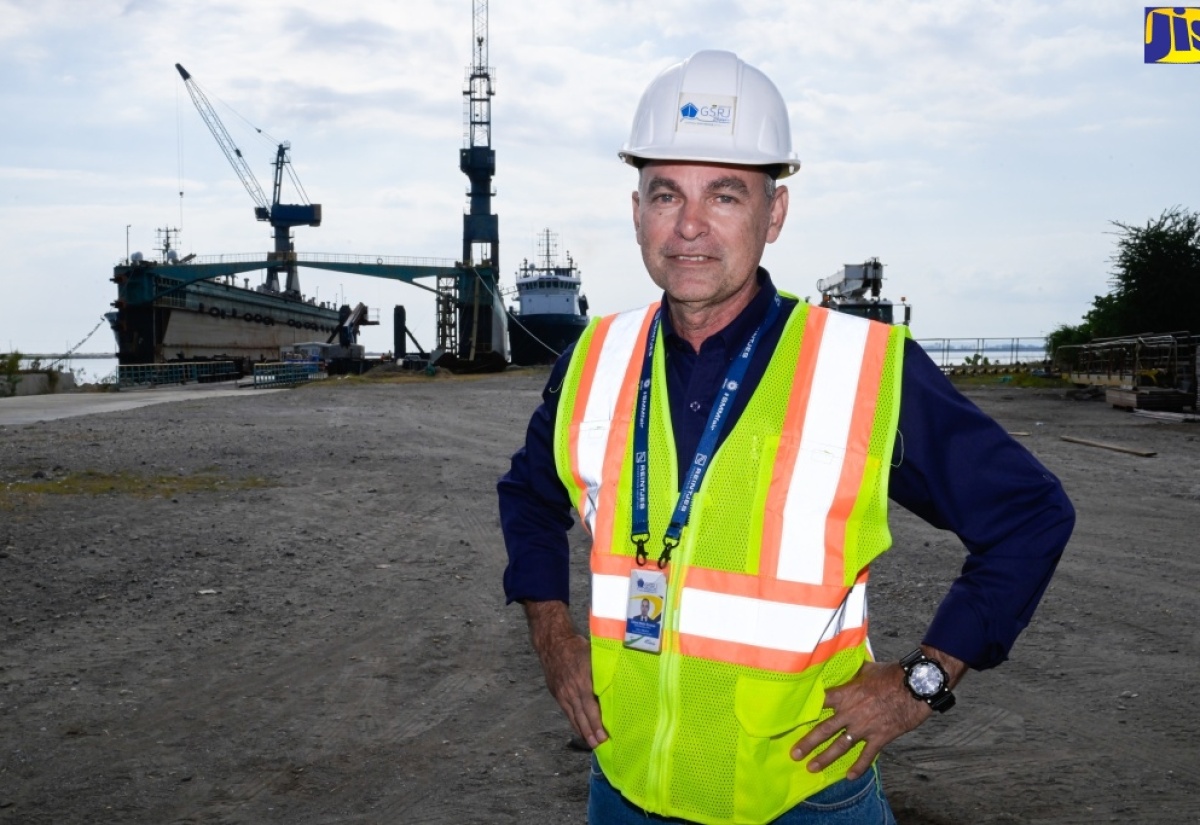
Photo: Donald De La Haye
Chief Executive Officer of German Ship Repair Jamaica Limited (GSRJ), Lieutenant Colonel Martin Rickman.The Full Story
Jamaica is being positioned to capture a larger share of the regional ship-repair market through the specialised services provided by German Ship Repair Jamaica Limited (GSRJ).
Operating within Jamaica’s Special Economic Zone (SEZ) regime, the Kingston Harbour-based company offers repair and maintenance services to commercial vessels operating throughout the Caribbean and the wider region.
GSRJ services Panamax-class vessels, including container ships, fuel tankers and bulk carriers, measuring up to approximately 200 metres in length.
Its range of services includes dry docking, hull treatment, blasting and painting, welding, engine and mechanical repairs, pipe work, valve repairs, and the maintenance of propellers and propeller shafts.
Chief Executive Officer (CEO), Lieutenant Colonel Martin Rickman, notes that before the GSRJ shipyard was established, vessels requiring repairs or maintenance had to seek those services elsewhere.
“By providing these services locally, we are adding value to Jamaica’s logistics sector,” he points out.
According to Colonel Rickman, Jamaica’s strategic location along major shipping routes, coupled with the shipyard’s proximity to the Norman Manley International Airport, gives the country a competitive advantage in delivering value-added maritime services.
“We consider Jamaica to be at the centre of shipping activity in the Caribbean. This is why the country is well-positioned as a [potential] logistics hub and, by extension, to provide the additional services offered by a shipyard,” he says.
Colonel Rickman notes that the presence of a local shipyard significantly benefits vessel owners by reducing the time vessels spend out of service travelling long distances for repairs.
He also highlights the advantages of operating within the SEZ framework, noting that support from entities such as the Jamaica Special Economic Zone Authority (JSEZA) and the Jamaica Customs Agency (JCA) has enabled GSRJ to benefit from efficient importation and clearance processes for service materials.
The arrangement also facilitates the sourcing of specialised tools and equipment required for the company’s operations.
Beyond strengthening Jamaica’s maritime services industry, the shipyard is generating employment opportunities and supporting skills development in specialised trades.
GSRJ currently employs approximately 36 full-time workers, including international specialists, and engages between 50 and 60 contract workers in disciplines such as welding, pipe fitting and electrical work.
Looking ahead, Colonel Rickman says he hopes GSRJ will become a leading example of what can be achieved under Jamaica’s SEZ regime.
“It is certainly my intention for GSRJ to become a leading example of success within Jamaica’s Special Economic Zone framework. I want the company to be a model of what can be achieved through this partnership because it is a mutually beneficial relationship,” he tells JIS News.
That ambition, according to JSEZA CEO, Kelli-Dawn Hamilton, reflects the broader potential of the SEZ regime to attract transformational investment and strengthen Jamaica’s position as a competitive hub for maritime and logistics services.
“GSRJ is an excellent example of how the SEZ regime can support businesses that serve international markets while delivering tangible benefits for Jamaica through investment, job creation, skills transfer, and enhanced economic competitiveness. We look forward to seeing more investors leverage the opportunities available within Jamaica’s SEZs,” she tells JIS News.

The CEO notes that the impact of investments such as GSRJ extends beyond their direct economic contributions, particularly through workforce development and the transfer of specialised skills and knowledge.
“What is especially important about SEZs like GSRJ is the way they expose Jamaican workers to advanced technologies, international standards and specialised industrial processes that are not always widely available locally,” Mrs. Hamilton points out.
“That exposure strengthens our local skills base, enhances workforce development, and better positions Jamaicans to participate in higher-value segments of the global logistics and maritime economy,” she adds.
For JSEZA, the growth of operations such as GSRJ represents more than the success of an individual company.
It illustrates how the SEZ framework can leverage international investment to create opportunities for local talent, facilitate technology transfer, and build the capabilities Jamaica needs to compete more effectively in the global maritime and logistics industries.