



Jamaica Takes Another Decisive Step to Modernise Justice System
By: , March 23, 2026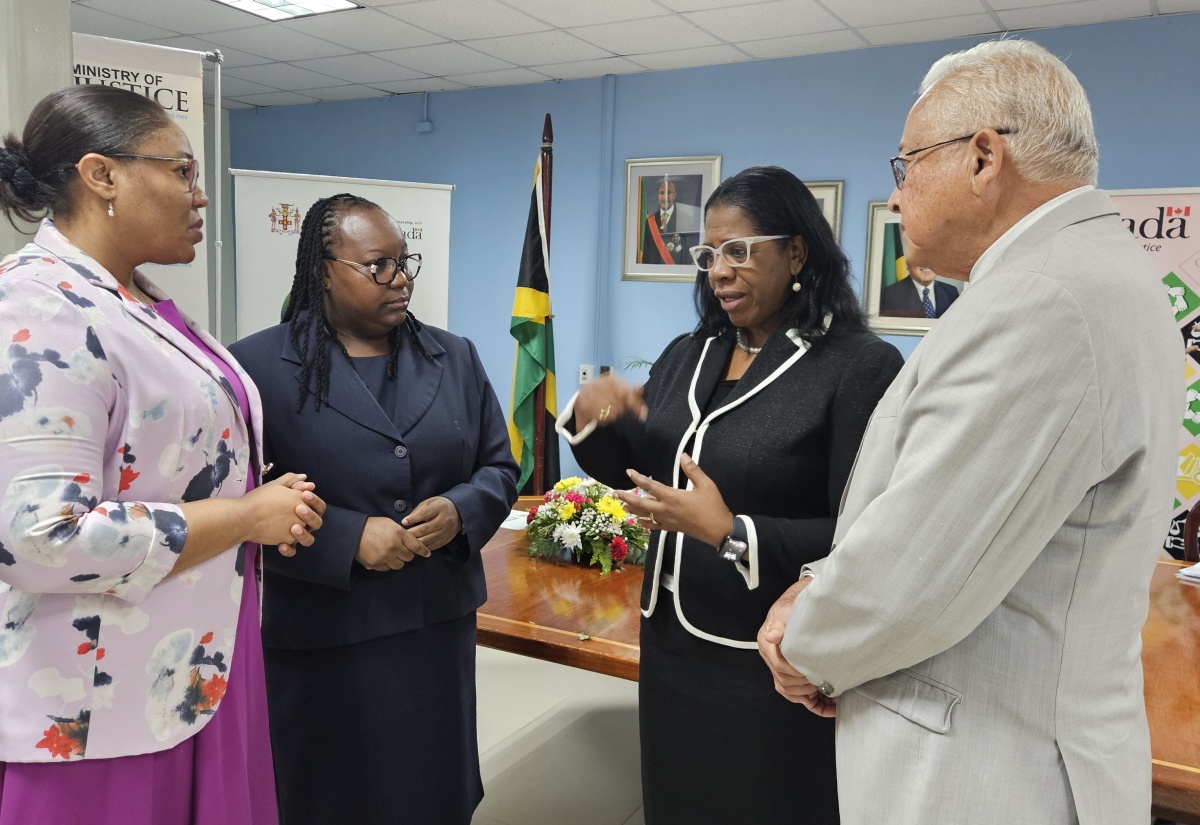
Photo: Michael Sloley
President of the Court of Appeal, Hon. Justice Marva McDonald Bishop (third left), makes a point at the signing of an agreement with Rwanda, for the implementation of an Integrated Electronic Case Management System (IECMS), at the Ministry of Justice and Constitutional Affairs in St. Andrew, recently. Others pictured (from left) are Chief Information Officer at the ICT Authority, Anika Shuttleworth; Director of Public Prosecutions, Claudette Thompson, and Portfolio Minister, Hon. Delroy Chuck.The Full Story
Jamaica has taken another decisive step to modernise its justice system with the recent signing of a landmark agreement with the Government of Rwanda for the design, development and implementation of an Integrated Electronic Case Management System (IECMS).
Valued at approximately US$4.6 million, and slated for a phased rollout over three years, the initiative is being hailed by the Judiciary as a long overdue leap into a digital future, one that will deliver efficiency, transparency, and resilience across the justice sector.
For decades, Jamaica’s courts have grappled with persistent challenges, case backlogs, administrative delays, and the vulnerability of paper-based records to natural disasters, so the introduction of the IECMS represents not just a technological upgrade but a structural overhaul aimed at redefining how justice is administered.
By creating a seamless digital platform linking every stage of the justice chain from investigation to prosecution, adjudication, and corrections, the system is expected to streamline operations and significantly reduce inefficiencies that have long plagued the system.
President of the Court of Appeal, Hon. Justice Marva McDonald Bishop, underscores the magnitude of the development, describing it as a “major stepping stone for the judiciary’.
In an interview with JIS News, she welcomes the development as both relief and optimism within the legal fraternity.
For her and many colleagues, the move towards digitisation is not merely desirable; it is essential. “It is all about getting with the times,” she notes, emphasising that the courts must evolve to meet the demands of a 21st century society.
Justice McDonald Bishop points to the fragility of physical court records in the face of disasters, noting that Jamaica, like many Caribbean nations, is highly susceptible to hurricanes, flooding, and other natural hazards.
She says that in such events, court files are often among the first casualties, leading to significant setbacks and compounding existing case backlogs, and that the IECMS offers a solution by ensuring that critical documentation is securely stored and easily retrievable, even in the aftermath of catastrophic events.
Director of Public Prosecutions (DPP), Claudette Thompson, highlights that the justice sector has already begun its digital transition, as over the past year and a half, the DPP’s office has made significant strides in digitising its records, and the introduction of the IECMS is expected to accelerate the progress.
Miss Thompson illustrates the practical benefits of the system, pointing out that the current process often requires police officers in rural districts to physically transport documents to central registries, from where they are forwarded to Kingston, which not only consumes valuable time and resources but also introduces opportunities for delay and error.
“With the IECMS, such processes will be replaced by instantaneous digital transmission, eliminating unnecessary travel and expediting the flow of information,” she notes.
For Minister of Justice and Constitutional Affairs, Delroy Chuck, the agreement is a visionary partnership.
He emphasises that the IECMS will function as a unified platform connecting all components of the justice system.
“This integration is crucial, as fragmentation has historically hindered coordination among agencies,” he says, while addressing a recent forum at the Ministry.
By linking investigative bodies, prosecutorial offices, courts, and correctional services, the system is expected to foster a more cohesive and responsive justice framework.
The Minister says it is part of a broader objective to position Jamaica as a digital society where public services are efficient, accessible, and citizen-centred.
Endorsement by Chief Justice, Hon. Bryan Sykes, further underscores the significance of the initiative.

He says the IECMS is nothing short of a “game changer”, particularly in expanding remote access to justice.
The project aligns with Jamaica’s recent achievement of ISO certification within the judiciary, signalling a commitment to international standards of quality and efficiency. The IECMS complements this milestone by providing the technological infrastructure necessary to sustain and enhance these standards.
Choosing Rwanda as a partner is both strategic and symbolic. Rwanda has successfully implemented a similar system within its own justice sector, demonstrating its effectiveness in digitising court processes and safeguarding records.
Rwanda’s experience offers a valuable blueprint for Jamaica, particularly in leveraging technology to overcome resource constraints and institutional challenges.
Chief Executive Officer of Rwanda Cooperation, Patrice Uwase, highlights the system’s robust functionality.
Accessible from any location and compatible with multiple devices, “the IECMS is designed to ensure continuity even during power outages, a critical feature in regions prone to infrastructural disruptions,” she says.
“Additionally, built-in notification systems, including SMS and email alerts, enable users to track case progress in real time, enhancing transparency and accountability,” Ms. Uwase adds.
Beyond its technical features, the IECMS represents a shared commitment to innovation and service excellence between Jamaica and Rwanda. This collaboration underscores the growing importance of South-South cooperation in addressing common development challenges.
International partners have also played a pivotal role in advancing the project.
The High Commission of Canada in Jamaica has been instrumental in supporting the Social Justice Programme, which recognises the importance of strengthening institutional capacity and modernising the justice system.
Head of International Cooperation, Shehryar Sarwar, notes that the IECMS will connect courts with key stakeholders, creating a more robust framework for service delivery.
Similarly, the United Nations Development Programme (UNDP) has endorsed the initiative as a critical component of efforts to promote inclusive access to justice.
Resident Representative, Kishan Khoday, emphasises that the system will align Jamaica’s case management processes with international standards, while also ensuring accessibility for persons with disabilities.
Inclusivity is a central pillar of the IECMS. By enabling digital access to court services, the system has the potential to democratise justice, making it more accessible to individuals who may face physical, economic, or geographic barriers. For persons with disabilities, in particular, the ability to engage with the justice system remotely represents a significant advancement.
The financial investment in the IECMS, while substantial, is expected to yield long-term savings. By reducing reliance on paper, minimising administrative overhead, and streamlining processes, the system will enhance productivity and free up resources for other critical areas.
More importantly, it will address the chronic issue of case backlogs, which have undermined public confidence in the justice system.
Transparency is another key benefit. In a digital environment, every action, from the filing of documents to the scheduling of hearings, is recorded and traceable. This not only reduces the potential for errors and misconduct, but also fosters greater accountability among all stakeholders.
The timing of the initiative is particularly significant.
Jamaica’s recent experiences with natural disasters have underscored the urgency of building resilient systems capable of withstanding shocks.
The IECMS, with its emphasis on secure digital storage and remote accessibility, represents a proactive response to these challenges.
Ultimately, the IECMS is more than a technological solution; it is a statement of intent.
It signals Jamaica’s determination to modernise its institutions, embrace innovation, and deliver justice in a manner that is efficient, transparent, and inclusive.
For a system long burdened by delays and vulnerabilities, the promise of a digital future offers not just hope but a tangible path forward.