


IRL Project Transforms Agricultural Practices in Kitson Town
By: , April 21, 2026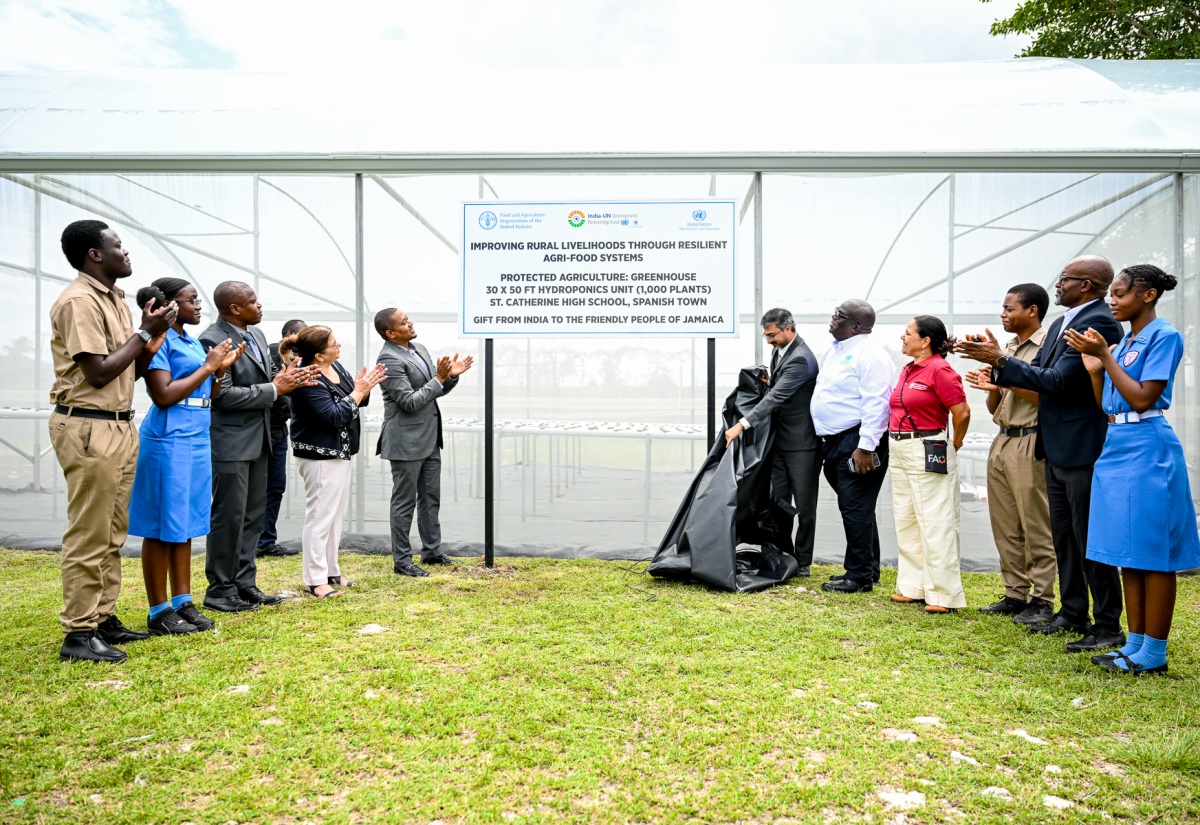
Photo: Adrian Walker
Minister of Agriculture, Fisheries and Mining, Hon. Floyd Green (fifth left), and Indian High Commissioner to Jamaica, His Excellency Mayank Joshi (sixth right), unveil the greenhouse established at the St. Catherine High School under the Improving Rural Livelihoods Through Resilient Agri-Food Systems (IRL) Project. They are joined by stakeholders in the programme, including students at the institution. The infrastructure was handed over on Wednesday (March 25), during the IRL project’s closing ceremony, held at St. Catherine High School.The Full Story
With the recent conclusion of the Improving Rural Livelihoods Through Resilient Agri-Food Systems (IRL) Project, the landscape of Kitson Town in St. Catherine has entered a new era of climate-smart, business-oriented agriculture.
The project, which was launched in 2023, was funded by a US$1-million investment from the Government of India and implemented through a partnership between the Food and Agriculture Organization (FAO) and the Ministry of Agriculture, Fisheries and Mining.
It targeted Kitson Town and included the St. Catherine and Tacius Golding High Schools in St. Catherine, equipping participants with training in climate-smart agriculture, greenhouse-based protected farming, livestock management, food safety, and entrepreneurship.
Beneficiaries also received inputs, including a total of 14 greenhouses, fertilisers, essential farming kits and various tools, which were distributed to farmers.
Now that the programme has been completed, reaching more than 200 beneficiaries, the rhythm of rural agriculture in Kitson Town has shifted from the unpredictability and limitations of traditional farming to sustainability and expansion.
For Shaherah Brown-Lawrence, who has been a poultry farmer for approximately 10 years, her modus operandi when it comes to raising birds has drastically changed.
She tells JIS News that one of the lessons she learnt from the programme is that raising poultry is not to be done on a whim, as this could affect the potential profits and hamper the growth of the business.
“Before [the programme] I normally just go buy some birds, buy a couple of bags of feed and just sell them, get the money, go back again, that’s it,” Mrs. Brown-Lawrence says.
“But since the programme comes in now, I will practise proper documentation. I learn about harvesting, site selection, which is a key aspect of preparing a birdhouse for your birds, and also the foot bath [which] is very important for a birdhouse,” she adds, explaining that the foot bath prevents unwanted bacteria and viruses from entering the birdhouses and contaminating the chickens.
The poultry farmer notes that she now views her venture as a business and not “just a hustle thing”, as she is practising the various skills, including proper budgeting and how to invest to ensure the maximum outcome.
Though the project officially ended in March, Mrs. Brown-Lawrence continues its mission as a ‘trainer of trainers’, visiting poultry farms to encourage the adoption of IRL programme practices.
“I can teach others my knowledge, skills, whatever that I’ve developed and learned at the programme… . And I also started my journey visiting different farms and encouraging mostly young people and women especially in our communities,” Mrs. Brown-Lawrence explains.
Another beneficiary of the IRL Project, livestock and produce farmer Keneil Gray, is pleased with the programme, which provided a lifeline for his 33-acre property, which has long been stifled by a lack of water.
The project equipped him with a 30×50 greenhouse, featuring a fully automated irrigation system, 3,000-gallon freshwater tank, and a 650-gallon nutrient tank.
“So, having this unit that not only minimises our water needs, because it’s in a more controlled environment and we can more precision water to our irrigation and fertigation system, we’re now able to harvest water from the greenhouse,” Mr. Gray tells JIS News.
He shares that he and his business partner have dug out a pond and are sourcing pond liners, so the excess water from the greenhouse can be used to put more of the land into production.
Mr. Gray says that due to the water restrictions, he has never been able to farm more than one acre at a time, but with the input from the project he is able to plan better and put more of his farm land into production.
Having first discovered his passion for agriculture 12 years ago while studying History and Entrepreneurship at the University of the West Indies, Mr. Gray is grateful for the project.
He believes the greenhouses will empower farmers to produce high-quality crops and help reduce the nation’s import bill – a mission he takes personally.
“I am extremely happy and grateful… . It’s a big gift that we hope to multiply because it’s about improving rural livelihoods. And I can see already from persons who have received livestock, the greenhouses, we’ll be able to now support our families in a more sustainable way,” Mr. Gray says.
Meanwhile, at St. Catherine High School, the IRL Project is securing the future of food security by donating a greenhouse to the institution, as well as training students in best farming practices.
Head of the Agricultural Science Department, Sherene Smith, explains that the greenhouse will expose students to the practical aspect of greenhouse farming, aligning with the school’s curriculum.
“They’re used to the traditional way of farming… but because the school curriculum facilitates the use of greenhouse technology as well as soilless culture, the students will get first-hand experience of growing plants with soilless culture,” she says.
Ms. Smith highlights the greenhouse as a key driver for food security for the 2,500 students at the institution.
While the school’s clay soil often prevents traditional farming during periods of excess rainfall, the greenhouse ensures year-round production by bypassing these challenges.
She also hopes that the greenhouse will pique the interest of other students to get involved with agricultural science, as it has also shown the innovation of some students who have developed concepts for portable soil test kits and creating a Cooperative for small farmers in nearby communities.
“We are looking forward to seeing students coming on board. Even as the students reach grade nine, they have the opportunity to choose their vocational area. So, this greenhouse, I hope, will stimulate the minds and pull more students on our side of the discipline,” Ms. Smith says.