



Girl Power: Jamaican Women Holding Their Own on Canadian Farms
By: , October 16, 2022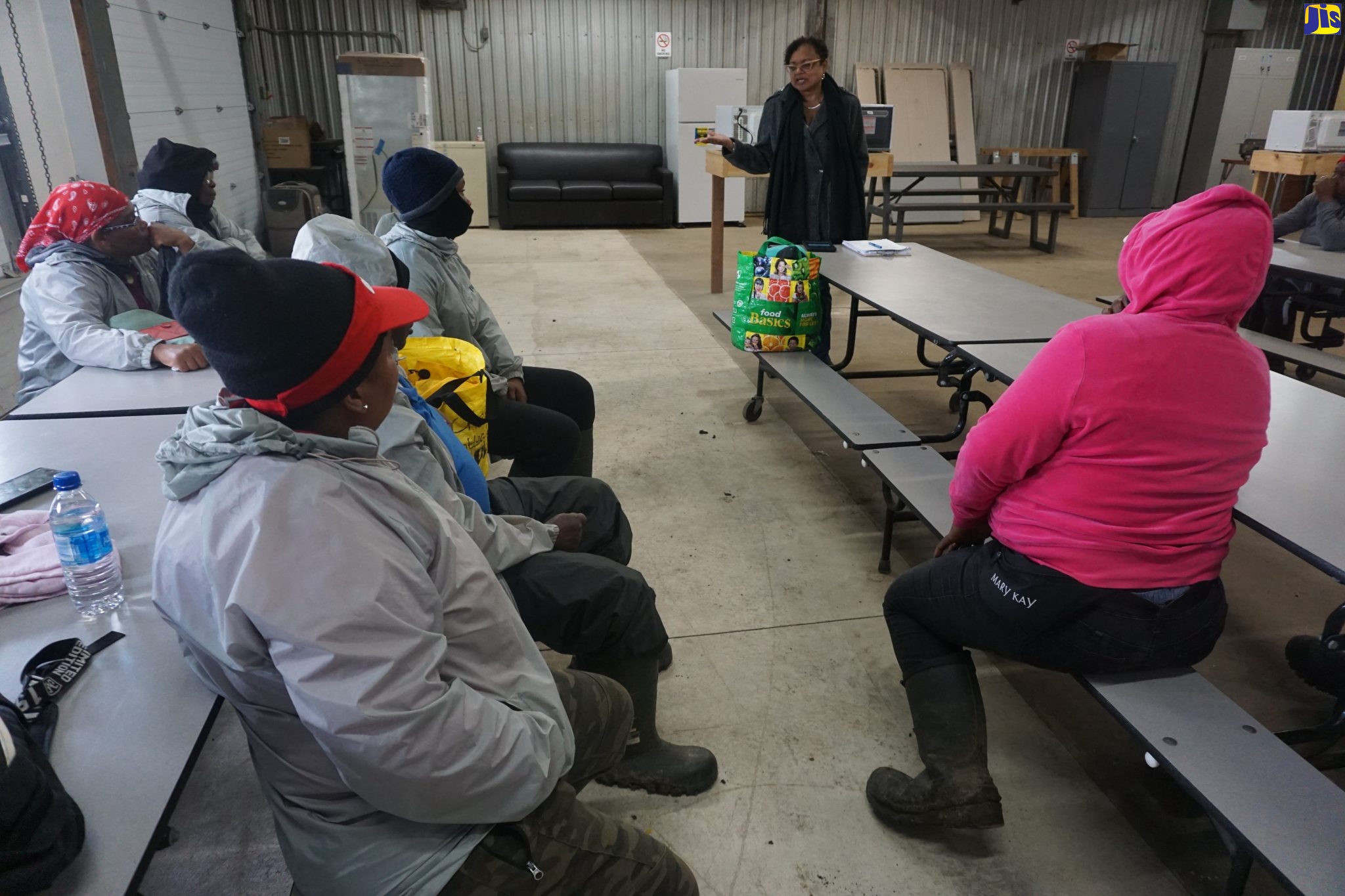
Photo: Mickella Anderson
President of the Jamaica Confederation of Trade Unions (JCTU), Helene Davis-Whyte (standing), speaks to a group of women on a Canadian apple farm on Thursday (October 13). Mrs. Davis-White chairs the factfinding team that is probing the status of Jamaican farm workers in Canada.The Full Story
Among the thousands of Jamaicans, who leave the island every year for Canada to participate in the Seasonal Agricultural Workers’ Programme, is a large group of women, who are holding their own alongside their male counterparts.
They are employed on properties, such as a 2,500-acre apple farm in the Simcoe, Ontario area, where they are picking and packing the fruit.
Cherries, corn, asparagus, peaches and other crops, are also cultivated on the farm at different times throughout the season.
Nearly 400 persons work on the property and around 120 of them are females.
The farm was one of the stops on Thursday (October 13), for the local factfinding team probing the Canadian seasonal agriculture programme.
It was the first time, since starting the interviews on October 10, that the team was encountering a cluster of Jamaican female workers.
Keisha White, who hails from the parish of St. Elizabeth, packs peaches and picks apples and is on the programme for the first time.
Ms. White, who is a mother of two, says that for her, the major difference between the two countries, is the ever-changing weather.
“We’re accustomed to sunshine (in Jamaica) and then we’re accustomed here to all different changes. Today is hot, tomorrow is cold and there’s rain in between,” she notes.
Her colleague, Lisa Kelly* of St. Catherine, is on her second stint with the programme and packs peaches, plums, and nectarines. In Jamaica, she worked at a Chinese restaurant but stopped due to the COVID-19 pandemic.
On working with her Jamaican male counterparts, Ms. Kelly, who is the mother of a seven-year-old girl, says, “When I was learning certain things for the first time, we saw the men do it and then they helped us. They showed us because we didn’t have any experience and it was our first time on the farm.”
Additionally, she points out that the programme has introduced her to other Caribbean nationals, as they work alongside persons from Barbados and Trinidad on the large farm.
“They like our culture and always want to know what we say, and we have to translate to let them understand us and we get to understand them too,” she explains.
While she has not mastered any regional dishes so far, she says she has learned quite a bit about other cuisines.
Measha Black* from St. Thomas has been travelling on the programme for four years. In Jamaica, she operates a farm where she reaps plantain, banana, pepper, and pumpkin and sells them in the markets.
While she’s away, her farm is tended to by her mother and brother. There is a notable difference between her farm activities at home and what she does in Canada.
“At home, I have to go out there in the field (and) take suckers from the roots. When they say farm work here, it doesn’t mean you (always) go out there and dig or plant. I go out there to reap so it’s different from what I do in Jamaica,” the mother of four tells JIS News.
She says that working among her Jamaican male counterparts has been a good experience as the men willingly transfer knowledge.
“If it is not this farm and I go on another farm, I can do what is there or what they (the owners) want me to do because the men show us. They teach us … how to bend to pick the apple so it doesn’t affect our back or anything,” she outlines.
Ms. Black says she maintains her closeness to home by doing things that she would normally do in Jamaica, such as cooking her rice and peas on a Sunday.
Several varieties of apples are farmed on the property such as red delicious, honeycrisp, fuji, gala, empire, and McIntosh.
There is a certain technique to picking the apples to prevent bruising, entailing a gentle grasp of the fruit in one’s palm before turning it gently and then releasing it into the bin (container).
All the females with whom JIS News spoke easily attested to this technique, with Cora Blake* of Clarendon explaining just why a woman excels at this job.
“We are gentle…we handle it (the fruit) like our baby,” she chuckles.
Ms. Blake has been travelling on the programme for 19 years. In Jamaica, she raises chickens, pigs, and goats and plants yams, bananas and plantains. When she is not on her farm, she is being a mother to her three children, two of whom are now in the military.
She says that her years of experience allows her to guide the newer women, who often look to her for advice.
On juggling motherhood with her many years of farm work travels, she says that she has always received the support of family members and while away, she remains in constant contact with her children.
“I call them in the mornings. When they have a break, they will call me or text,” she says.
The Seasonal Agricultural Workers’ Programme has been ongoing since 1966.
The team of factfinders, commissioned by the Ministry of Labour and Social Security to look into the programme, are collecting information to prepare a report on the workers’ status.