


Family’s Gift Keeps Long Bay Beach Access Open for Community
By: , March 3, 2026
Photo: GLENWAYDE BROWN
An image of Long Bay Beach in PortlandThe Full Story
A long-standing tradition of generosity and community spirit continues to shape life in Long Bay, Portland, where the family of the late Annie Neufville has preserved public access to Long Bay Beach in honour of her legacy.
Entrance to the beach was made possible decades ago when Ms. Neufville and fellow landowner Granville Ellis each gave up three feet of their respective properties, creating a six-foot-wide access road for residents.
This access was crucial not only for recreational purposes but to enable residents to fetch seawater, which was historically used in the processing of coconut oil for sale.
Today, that 75-metre passage from the main road to the shoreline remains a vital lifeline for the community.
Affectionately known as “Mommy Seaside”, Ms. Neufville is remembered as a woman of vision and generosity, whose decision to formally donate the land ensured uninterrupted access for generations.
“She was a very giving, community person,” recalls her great-grandson, Chris Richards, while speaking to JIS News.
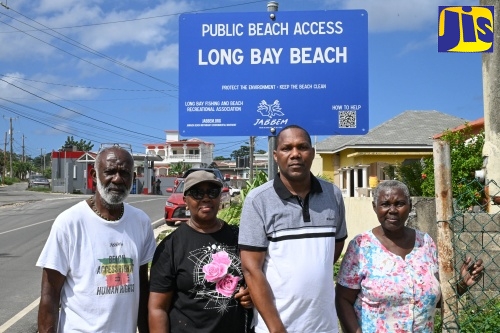
“Originally, people would walk through [the property] to go to the beach and she’d allow them and then she actually went and donated that section so everybody can actually have access,” he points out.
The access way is wide enough to accommodate fishermen with trailers and for persons in wheelchairs to reach the beach with relative ease.
The beach’s value goes beyond just recreation, providing economic and environmental benefits as well. Fishermen depend on it for their livelihood, residents use the beach for exercise and meditation while turtles swim ashore to lay their eggs.
“When I was a kid, I would go to the beach if I had the flu,” Mr. Richards tells JIS News, noting the healing benefits of the salt water.
“We used the beach almost like a medicine to heal. Anything happen, you have a headache, you go to the beach,” he says.
“The kids are down there in the morning and in the evening so you know it’s a benefit to everybody,” he adds.
Ms. Neufville’s granddaughter, Winsome Walker, shares memories of disciplined but joyful childhood visits to the seaside with her grandmother.
She tells JIS News that her grandmother would assign specific days for beach outings, watching from under a coconut tree in the yard as the children played. Failure to obey her rules meant losing beach privileges for a month.
Ms. Walker, who was born in 1957, says the beach was central to everyday life in Long Bay during the 1950s and 1960s.
She recalls that residents from Windsor Forest, Hartford and Commodore would collect the seawater to use in preserving coconut oil during processing.
“We had a little house with a cellar, so on their way to the post office, they would put their pan under the cellar… on their way back [they would retrieve their pans] and go to the seaside and to pick up their seawater,” she says.
Her sister, Phyllis Byfield, fondly remembers being allowed to visit a small pond near the beach, sometimes called the basin or round hole, which “disappears” depending on the tide.
She also remembers schoolchildren from neighbouring communities being asked by their parents to fetch seawater on their way home for coconut oil processing.
Occasional trespassing prompted Ms. Neufville to formalise the arrangement by donating the land, safeguarding the community’s access.
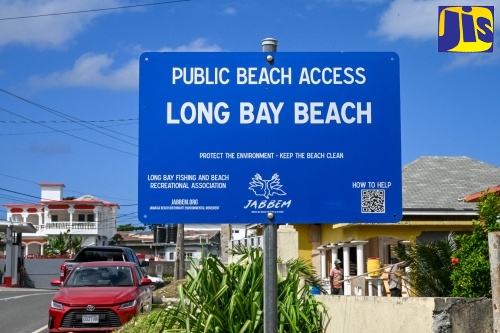
That act of generosity was recognised by the Jamaica Beach Birthright Environmental Movement (JABBEM), which earlier this year, donated a sign marking the entrance.
The organisation installs similar markers islandwide to help preserve public beach access points.
Regional Director, Wilbourn Carr, tells JIS News that JABBEM learned that certain families in Long Bay had donated property to ensure public access and moved to document and protect the sites.
“We decided to come over here, explore, and we found four access points over here in Long Bay,” he says, while hailing Ms. Neufville’s foresight.
“Because she knew that it was important for the people of Windsor Forest and Hartford to access water, to help them to boil the coconut oil, she allowed them to pass through the property and to access the beach and this is back in the ‘60s,” he points out.
“So, here’s a woman who was poor but had vision. She donated that land and she put up a permanent wall that tells her children, the next generation, that, listen, this access is important to the community.
“Now, this woman has passed along many, many years ago and it is her vision that her family now celebrates because here we are today telling this story,” Mr. Carr adds.