



Education Officials in Region 4 Prioritise Continuity in Teaching and Learning
By: , December 24, 2025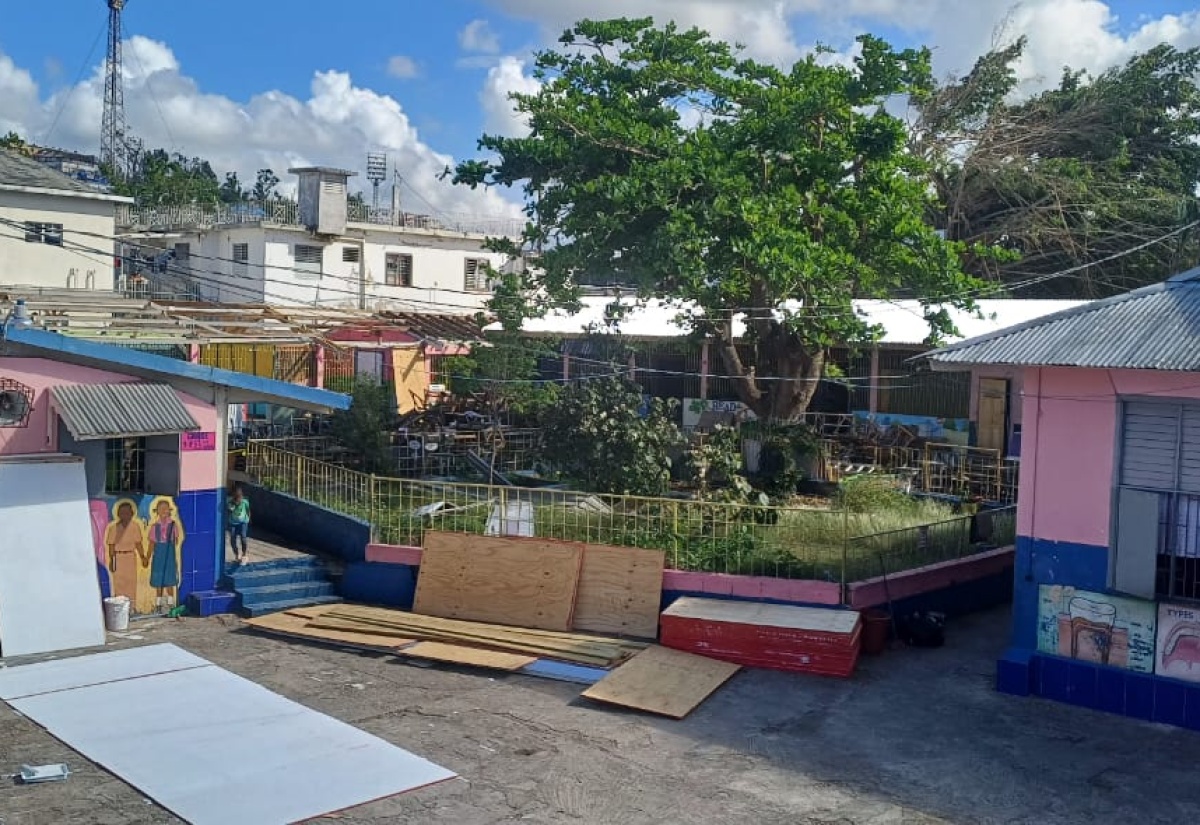
Photo: Serena Grant
Repairs in progress at the Corinaldi Avenue Primary School, in St. James. The school was damaged by Hurricane Melissa on October 28.The Full Story
For education officials in Region 4, ‘Bouncing Back Better’ has become more than a slogan, it is the guiding framework for how schools, parents and communities are responding to learning loss, following the disruption caused by Hurricane Melissa on October 28.
Regional Director for Region 4 (Westmoreland, St. James and Hanover), Dr. Michele Pinnock, told JIS News that the Region’s approach to recovery is deliberate and structured, with a focus on restoring confidence and maintaining continuity in teaching and learning.
At the core of that approach is a framework designed to guide recovery in a comprehensive way, addressing emotional wellbeing, physical rebuilding and academic progress simultaneously.
“As a region, the mantra that we’re using is ‘bouncing back better’,” Dr. Pinnock noted.
She emphasised that recovery efforts are being guided by a set of priorities she refers to as the four Rs, which speak to both healing and learning.
Central to this approach is Renewed hope, aimed at reassuring teachers, parents, boards and students that learning will regain momentum, while deliberately Rebuilding emotional strength through psychosocial support.
Dr. Pinnock said this is being reinforced by a focus on Restored infrastructure, ensuring that schools are rebuilt as safe, resilient spaces where students and educators can return with confidence.
At the heart of the strategy, Dr. Pinnock added, is Reignited education, which places teaching and learning firmly back at the centre, encourages self-directed and independent learning, and equips both teachers and parents to nurture children as they rebuild routines, confidence and academic focus in the aftermath of the disruption.
With some communities still facing electricity challenges, Dr. Pinnock argued that learning continuity requires practical alternatives to digital instruction.
“We recognise that electricity is an issue in some of the places, so we can’t just go digital. We have to get back to the printing of learning kits,” she said.
She explained that these kits were distributed directly into communities to ensure students remained engaged, even when schools were being repaired or used as shelters.
Looking ahead to the January term, Dr. Pinnock said Region Four is prioritising a return to classroom instruction wherever conditions allow. Where infrastructure damage remains a challenge, temporary measures are being implemented to minimise disruption.
“We’re actually putting up tents and looking for alternate spaces so that our children can actually be engaged in the face-to-face environment,” she informed.
Dr. Pinnock stressed that parents remain essential partners in preventing learning loss, beginning with emotional reassurance at home.
“One of the things that I’d love to reach home to our parents to say, listen, it’s important that we check in with our child, especially emotionally,” she said.
She also highlighted the role of stability and structure in helping students to regain focus, emphasising that “consistency is very important.”
Literacy, Dr. Pinnock said, also remains a foundational tool in helping students recover academically and develop independence.
“Reading is extremely important. The skill and art of reading is something that has to be practiced,” she emphasised.
Dr. Pinnock said that when schools, parents and communities operate together under the shared goal of bouncing back better, Region Four is positioned to narrow learning gaps and support students holistically as the recovery continues.