



Education Forum Focuses on Children with Special Needs
By: , May 6, 2024
Photo: Okoye Henry
Special Needs Coordinator in the Ministry of Education and Youth, Region 5, Toween Campbell-Wilson.The Full Story
An Education Forum and Workshop, organised by the Jamaica Teachers’ Association (JTA) St. Elizabeth Special Education Committee, has brought heightened awareness to the requirements of children with special needs.
Held under the theme ‘Improve Your Care By Being Aware’, at the St. Elizabeth Technical High School (STETHS) on May 3, the event, which coincided with National Child Month, focused on the importance of understanding and supporting children with special needs.
The forum also provided information about State services, and opportunities available to children with special needs in St. Elizabeth and across Jamaica.
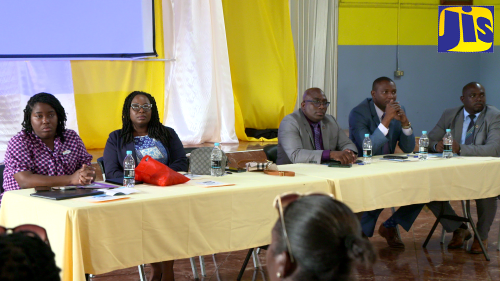
In fact, the Special Education Department of the Ministry of Education and Youth outlined a range of services to include pullout classes in primary schools to support students with special education needs within the mainstream setting.
“At the secondary level, we have what is called the Alternative Pathways to Secondary Education (APSE) approach and that is where we have special education teachers that are placed into high schools to support not only the students with special education needs, but also our teachers as well,” said Special Needs Coordinator in the Ministry of Education and Youth, Region 5, Toween Campbell-Wilson.
“So, our special education teachers in the form of our APSE coaches provide support in helping the teachers to deliver special education methodologies to our students with special education needs,” she added.
Another important service provided by the Ministry is shadow support, which assists students who struggle in the mainstream setting by providing a shadow caregiver who accompanies them to school. This is especially beneficial to those children with physical, severe behavioural and emotional challenges as well as those who are generally hard to control and disruptive.
“For [special needs] students who are sitting the Primary Exit Profile (PEP) examination, there is also accommodation to include extra time, preferential seating, close monitoring, as much breaks as needed, and we also provide support in the form of support personnel who may read or write for a student,” Mrs. Campbell-Wilson outlined.
However, to qualify for these services, students must present a medical report for physical challenges or a psycho-educational assessment report for cognitive challenges.
The Ministry partners with external organisations to further support special education in the country, including collaboration with Digicel Foundation to retrofit an inclusive classroom at Bethabara Infant in Manchester as well as the establishment of the Santa Cruz Special Education Centre in St. Elizabeth.
These are two key partnerships that have aided in advancing support for the growth, development and well-being of special needs children.
Additionally, the Ministry collaborated with the Jamaica Social Investment Fund (JSIF) to construct a special education block at Albion Primary School in Manchester, further emphasising their commitment to special education across all levels of the education system in Region Five.
“We are aware of the need for special education services, and as a region, ministry and unit we continue to champion the cause of special education,” Mrs. Campbell-Wilson indicated.
The St. Elizabeth Parish President of the JTA, Okeshue Bigby, highlighted the importance of special education in achieving inclusive education, along with the need for parents and guardians to be aware of the available support services islandwide.
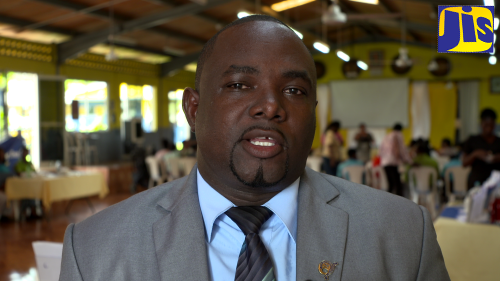
He encouraged them to be strong and to reach out for support from the JTA and government agencies that are available to assist them, because “special education is a big deal”.
Mr. Bigby said St. Elizabeth will continue to actively engage residents in activities designed to promote best practices and offer assistance for the special needs children.
“So, the different stakeholders are here sharing with our parents and guardians, as well as the students, the different services they can access as well as where they can get support for special education and special needs right across the parish,” he said.
“We also want to have them know that the JTA is not just an entity that advocates for teachers, but we also look out for students as well as the total well-being of education, generally,” he added.
Parents, Natalia McIntosh and Kerry Clarke, shared their experiences and expressed gratitude for the information and support received during the forum.
Ms. McIntosh, whose son has autism, OCD (Obsessive Compulsive Disorder) and ADHD (Attention-Deficit/Hyperactivity Disorder), pointed out how essential it is to seek education and support for her child.
She noted the challenges of finding suitable schooling but expressed hope with the possibility of shadow support through the Ministry.
“To the organisers, thank you for putting on this programme. We have received a lot of information that we can use to assist ourselves and our children,” she said.
Ms. Clarke, whose son has an intellectual disability, said being well informed to help her son reach his full potential is her top priority.
She encouraged parents to get involved and support their children with special needs, because “they have gifts and abilities and it’s your responsibility to help them reach their full potential.”