


Farmers Encouraged to Adapt to Climate Realities
By: , August 24, 2026
Photo: Donald De La Haye
Minister of Agriculture, Fisheries and Mining, Hon. Floyd Green, delivers the keynote address during the commissioning ceremony for the $37.8-million Solar Photovoltaic Pump Station in Duff House, Manchester, on August 20.
Photo: Donald De La Haye
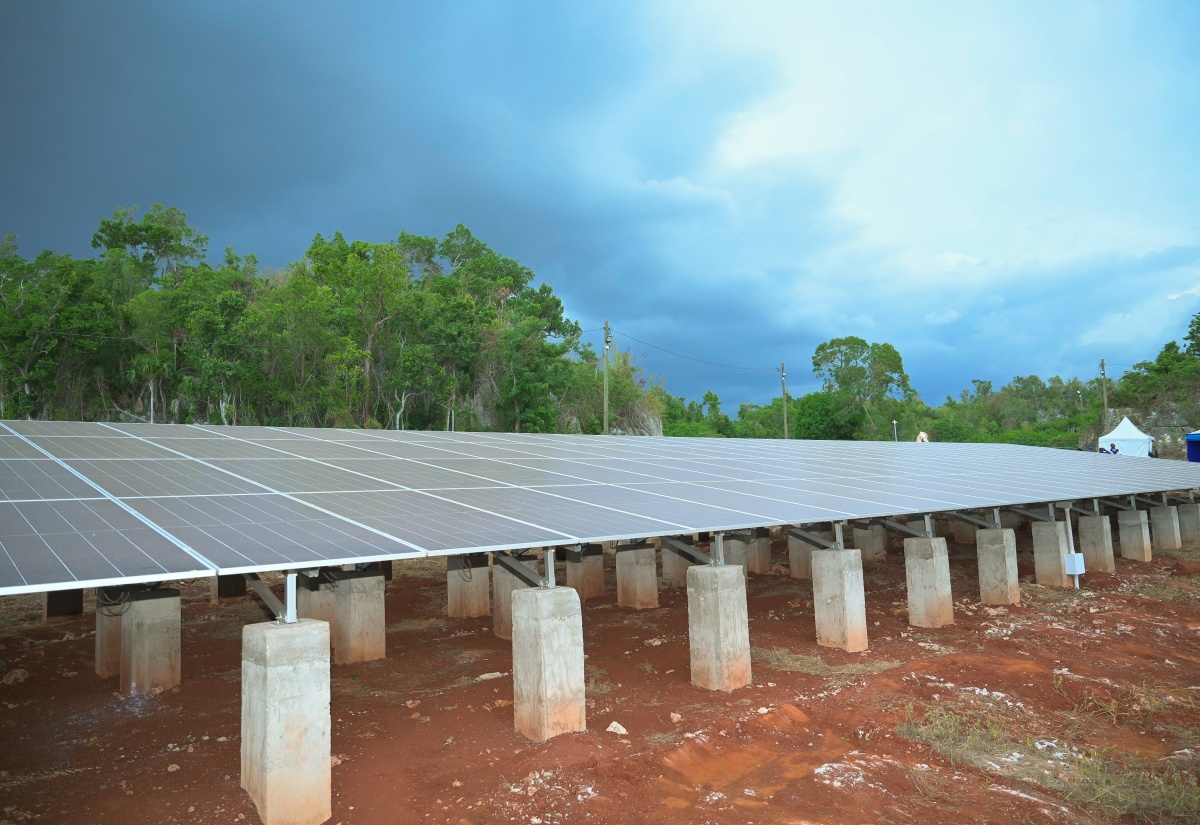
Photo: Donald De La Haye
The Full Story
Minister of Agriculture, Fisheries and Mining, Hon. Floyd Green, is urging farmers to view the changing climate, prolonged drought conditions, and elevated temperatures as challenges that can be turned into opportunities.
He emphasised that, rather than lamenting these realities, farmers should give serious consideration to identifying practical ways to adapt and build resilience.
Speaking during the commissioning ceremony for the $37.8 million, 150-kilowatt Solar Photovoltaic Pump Station in Duff House, Manchester, on August 20, Mr. Green noted that one of the ways to address the challenge is to harness solar energy to help reduce the cost of supplying water during critical periods.
“That is why we are here [at Duff House]… using the changing climate to our benefit, because there is elevated heat and longer periods of sunlight… so let us convert that into energy,” he said.
The Minister acknowledged that the nation was facing a challenging period due to the prolonged drought, which had heightened the urgency of securing irrigation water.
He noted that, under the prevailing conditions, farmers with access to reliable irrigation systems would be best positioned to sustain production.
“One of the best decisions made in agriculture, was to establish the National Irrigation Commission (NIC) … a body that focuses on [providing] water for our farmers. No matter how scarce the commodity, people still have to eat… so farmers must have access to a reliable source of water,” Mr. Green emphasised.
However, he argued that, as the system is expanded and the Government intensifies its efforts to address climate change and strengthen food security, equal emphasis must be placed on ensuring efficiency in implementation.
“This 150 KW solar photovoltaic system will serve about 457 farmers. That [will] cover 437 hectares of agricultural lands in Logwood, Plumwood, Duff House, and New Forest, ensuring that a wide range of crops will be able to be grown, even in times of drought,” Minister Green said.
The pump station is supported by more than 26 kilometres of conveyance pipelines and supplies approximately 6,480 cubic metres of water daily.
However, operating the system requires significant amounts of energy, with the NIC ranking among the country’s largest consumers of electricity.
Over the past five years, the Duff House station has recorded an average annual electricity consumption of 818 megawatt-hours.
“The installation of the system, which has 256 bifocal photovoltaic panels… each with 525 watts… will generate 276 megawatt hours of renewable energy annually, reducing our dependency on the JPS (Jamaica Public Service Company) system by over 30 per cent. This means that, each year, we will save about $14.8 million,” Mr. Green said.
He noted that, with electricity costs continuing to rise, the NIC would also face increased costs in providing water to farmers during critical periods.
The Minister explained that this would compound the challenges already posed by drought, resulting in the dual burden of water scarcity and higher irrigation costs.
As a result, the NIC embarked on an initiative to instal 11 similar systems across the island, which collectively generate 1.2 megawatts of renewable energy.
He noted that another renewable energy system is slated for commissioning by the end of the year and will generate 3.1 megawatts of power to support the Essex Valley Irrigation System.
Mr. Green added that the NIC also plans to construct a 100-kilowatt solar system for the Southern Plains, which will increase its renewable energy-generation capacity to 4.4 megawatts before year-end.
In his remarks, NIC Chief Executive Officer, Joseph Gyles, noted that the organisation had undergone significant transformation over the past four decades, expanding its operations, embracing new technologies and strengthening its contribution to agricultural development.
“Water today… food tomorrow, captures that responsibility very well, because the decisions we make about water today, have consequences that extend far beyond the immediate operation of an irrigation system. They influence whether farmers can plan with confidence and whether Jamaica is building the capacity required to sustain agricultural production over the long term,” Mr. Gyles stated.