


Emergency Housing Must Support Long-Term Community Development – PM Holness
By: , October 6, 2026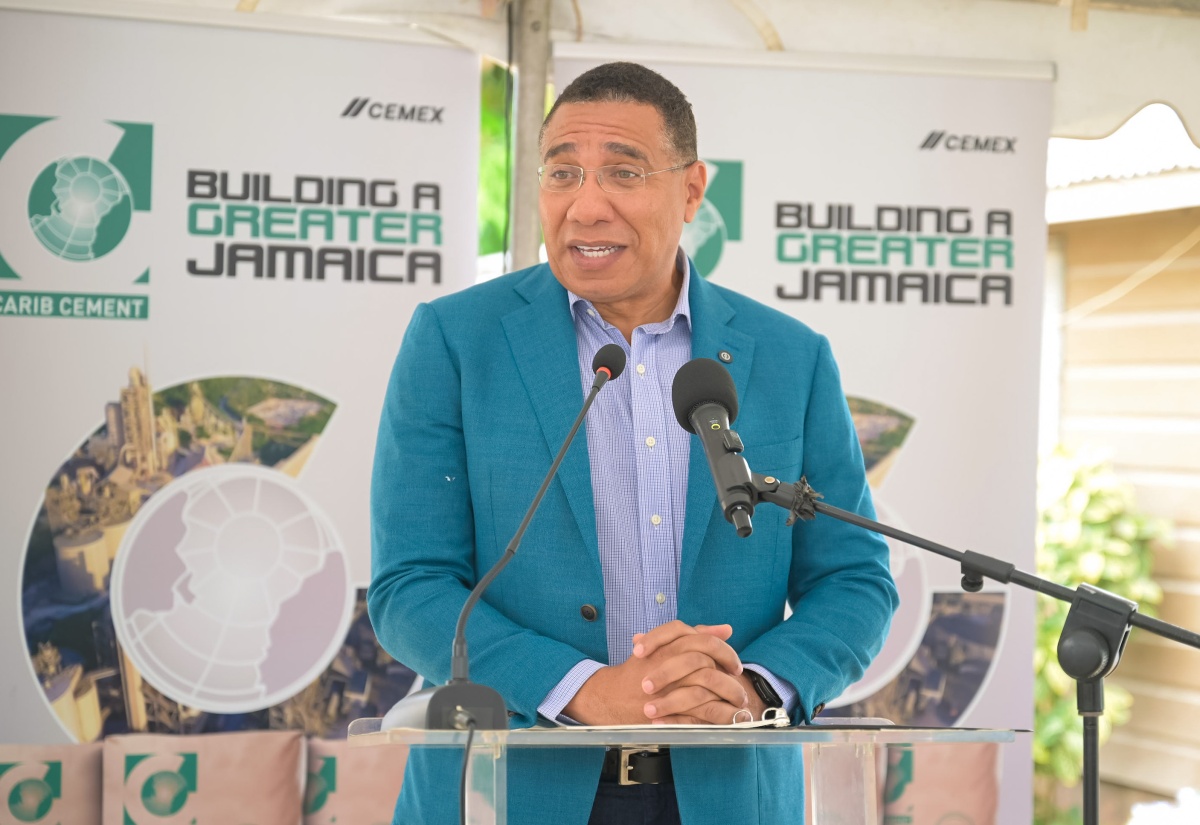
Photo: Donald De La Hay
Prime Minister, Dr. the Most Hon. Andrew Holness, delivers the keynote address during the handover ceremony for the Concrete Pavement and Infrastructure Improvement Project in Bell Rock, Olympic Way, St. Andrew, on October 2.The Full Story
Prime Minister, Dr. the Most Hon. Andrew Holness, has emphasised that short-term emergency housing must serve as a foundation for permanent, long-term community infrastructure development and secure land ownership as the Hurricane Melissa reconstruction effort continues.
Speaking on October 2 during the handover ceremony for the Concrete Pavement and Infrastructure Improvement Project in Bell Rock, Olympic Way, St. Andrew, Dr. Holness highlighted lessons drawn from past emergency housing settlements, noting that these experiences are helping to shape the Government’s current recovery and reconstruction strategy.
The Prime Minister cited Bell Rock, noting that the community was originally established in the 1950s as a temporary emergency housing settlement in the aftermath of Hurricane Charlie.
He added that emergency housing arrangements often evolve into unplanned long-term settlements, and that communities established under previous emergency measures frequently lacked proper drainage, paved walkways, basic utilities, formal land titles, and adequate communal spaces.
“The emergency shelter response will never be adequate for a long-term response, and, therefore, when we are responding to Hurricane Melissa, when we put in the short-term response, we are doing it with a view that the short-term semi-permanent response can easily be converted into a long-term response,” Dr. Holness said.
He noted that, while the Government is providing semi-permanent housing solutions through the use of container homes, these units are being constructed on solid, permanent foundations.
This will enable residents to transition seamlessly to permanent brick-and-mortar homes when the time comes, while allowing essential infrastructure and services to be integrated from the outset.
Addressing concerns about the timeline and cost associated with these infrastructure developments, Prime Minister Holness noted that designing sustainable, flood-resilient communities “will take a little longer and will be much more expensive”, but stressed that the approach is necessary to avoid repeating the mistakes of the past.
“More than that, we must learn from what happened in the past. It will take some time to make sure that the temporary solutions have a long-term impact… and that is what this Government has been doing,” he said.
Dr. Holness also clarified the funding mechanism supporting the ongoing disaster-response effort, assuring the public and donors that all funds are being managed under strict financial oversight.
“The temporary housing solutions that we are providing now for persons who are displaced by Hurricane Melissa are being funded partially by the donations of persons in the diaspora and locally by the National Hurricane Melissa Donation Fund,” the Prime Minister said.
“We have used the expenditure in such a way that everyone who contributed can point to something that is tangible, something that is material, something that is impactful that their contributions would have assisted,” he added.