


Debate Begins on Virtual Assets Service Providers Act
By: , September 24, 2026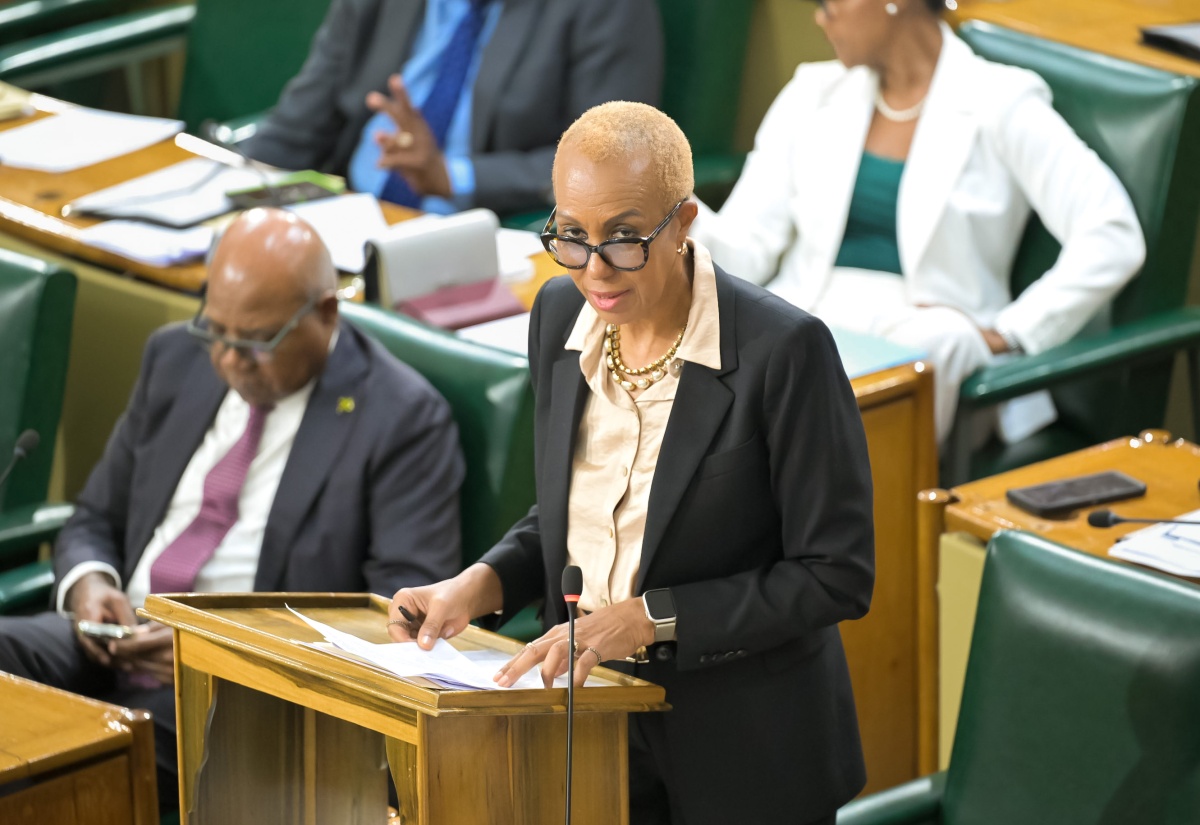
Photo: JIS File
Minister of Finance and the Public Service, Hon. Fayval Williams, speaking in the House of Representatives on Tuesday (September 22).The Full Story
The House of Representatives, on Tuesday (September 22), commenced the debate on the Virtual Assets Service Providers Act, which seeks to establish a formal licensing and supervisory framework for virtual asset businesses to ensure compliance with international anti-money laundering standards.
A virtual asset service provider is any business that handles cryptocurrency or other digital assets for or on behalf of other people as a commercial service.
Piloting the legislation, Minister of Finance and the Public Service, Hon. Fayval Williams, explained that a person or company counts as a virtual asset service provider if, as a business, it exchanges crypto for regular money, such as selling Bitcoin for dollars; transfers crypto from one person’s wallet or account to another; and holds or looks after crypto for others, including holding the keys that control it.
Mrs. Williams noted that virtual asset service providers have the same anti-money laundering duties as banks.
“They must verify customer identities, monitor transactions, report suspicious activity, and share sender and recipient information on transfers. This is what’s called the travel rule. Most countries also require them to be registered or licensed. Many may ask why we are acting now. The first is that virtual assets are already here. Jamaicans are already buying them, already holding them, already sending them across borders through platforms based overseas with no licence, no protection, no recourse, and no one in this country able to help them when something goes wrong,” she pointed out.
“We are not legislating because virtual assets are good or bad. We are legislating because they are here and our people are exposed,” she added.
Mrs. Williams noted that anyone who wants to run a virtual asset business serving Jamaicans, must hold a licence from the Financial Services Commission (FSC).
She further noted that it does not matter where in the world they are based, “if they serve a person located in Jamaica, this law reaches them”.
“Operating without a licence is a criminal offence. Licensed operators come under the same anti-money laundering laws that govern banks… the Proceeds of Crime Act, the Terrorism Prevention Act [and] the United Nations Security Council Resolution Implementation Act,” the Minister said.
“They must know who their customers are, keep records, and report suspicious transactions,” she added.
Minister Willimas said that the bill does not make any virtual asset legal tender, noting that “the Jamaican dollar remains the only legal tender in this country. The bill does not endorse, approve, or guarantee any virtual assets”.
Mrs. Williams noted, further, that a licence issued under this Act is a licence for a business to operate and that it is not a seal of approval on anything that the business sells.
“This bill meets our international obligation. It puts a perimeter around an activity that currently has none. It gives the Financial Services Commission the power to license, to supervise, and to shut down. These are the urgent things that we need to do that cannot wait. I know I’ll be the first to say that the bill is not perfect. It is a first step,” she said.