



DCS Outlines Challenges Faced by IRMS
By: , January 27, 2026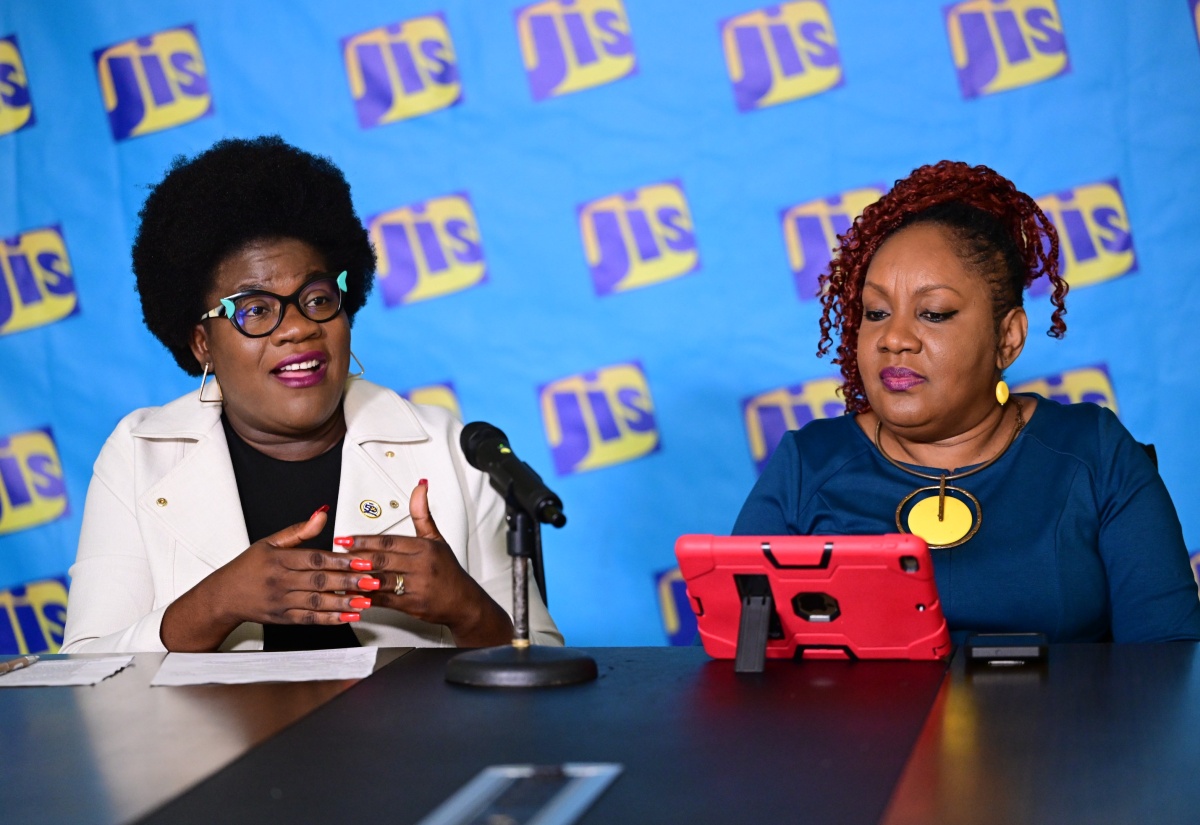
Photo: Adrian Walker
Principal Probation Aftercare Officer in the Department of Correctional Services, Kerryann Davis (left), and Technical Specialist for Socio-Economic Development in the Community Renewal Programme at the Planning Institute of Jamaica (PIOJ), Charmaine Brimm, participate in a Jamaica Information Service Think Tank on January 12.The Full Story
The Department of Correctional Services (DCS) has outlined some of the biggest challenges faced by involuntarily returned migrants (IRMs) and persons who have had conflict with the law.
Principal Probation Aftercare Officer in the DCS, Kerryann Davis, told a JIS Think Tank on January 12 that one of the biggest hurdles is how they are viewed in society.
“I believe we need to change the language that we use when we’re describing these individuals. Things like prison bird, prison boy – those languages we must, as a people, change because the whole idea behind rehabilitation is to ensure that the persons go in, serve their sentences and are returned [for those who can be returned to society],” she said.
For her part, Technical Specialist for Socio-Economic Development in the Community Renewal Programme at the Planning Institute of Jamaica (PIOJ), Charmaine Brimm, noted that involuntarily returned migrants also struggle with finding suitable living arrangements.
She noted that the 10th staging of the Best Practice Symposium, to be held from January 27 to 28 at The Jamaica Pegasus hotel in New Kingston, will seek to provide solutions to the challenges faced.
“Another is the issue of housing. Not all IRMs or persons who were previously in conflict with the law are able to necessarily go back to the space that they came from. We also have to look at the issue of housing; where do we place these persons? And it brings to the fore, also, the issue of safety for these persons,” she said.
“I think one of the gaps is the access to financing. Their (ex-offenders) ability to access resources for instance. How we deal with, as a country, persons who may have had a record, but would have served their time well, and so really should be treated as any other person who wants to walk into a financial institution and get financing,” Ms. Brimm said.
In the meantime, Mrs. Davis explained that the DCS’ standpoint is that most IRMs need counselling and social support.
“For persons returning to the country, one of the biggest issues, certainly from the DCS standpoint, is if the individuals are returned because of their citizenship status, then they won’t necessarily interface with the DCS unless they would go to, for example, a probation office where they can be provided with counselling support,” Mrs. Davis said.
She explained that they are also introduced to a social service entity such as the Ministry of Labour and Social Security.
“From there, they are connected with the right social programmes, such as PATH or in some cases Food For the Poor,” she noted.
At this year’s staging of the Best Practice Symposium, IRMs and ex-offenders will be the focus.
Players within the space will discuss the best practices to treat with the challenges they face in society to promote greater social development and community renewal.