


Cocoa Farmers Urged to Remain Vigilant to Manage the Frosty Pod Rot Disease
By: , April 8, 2026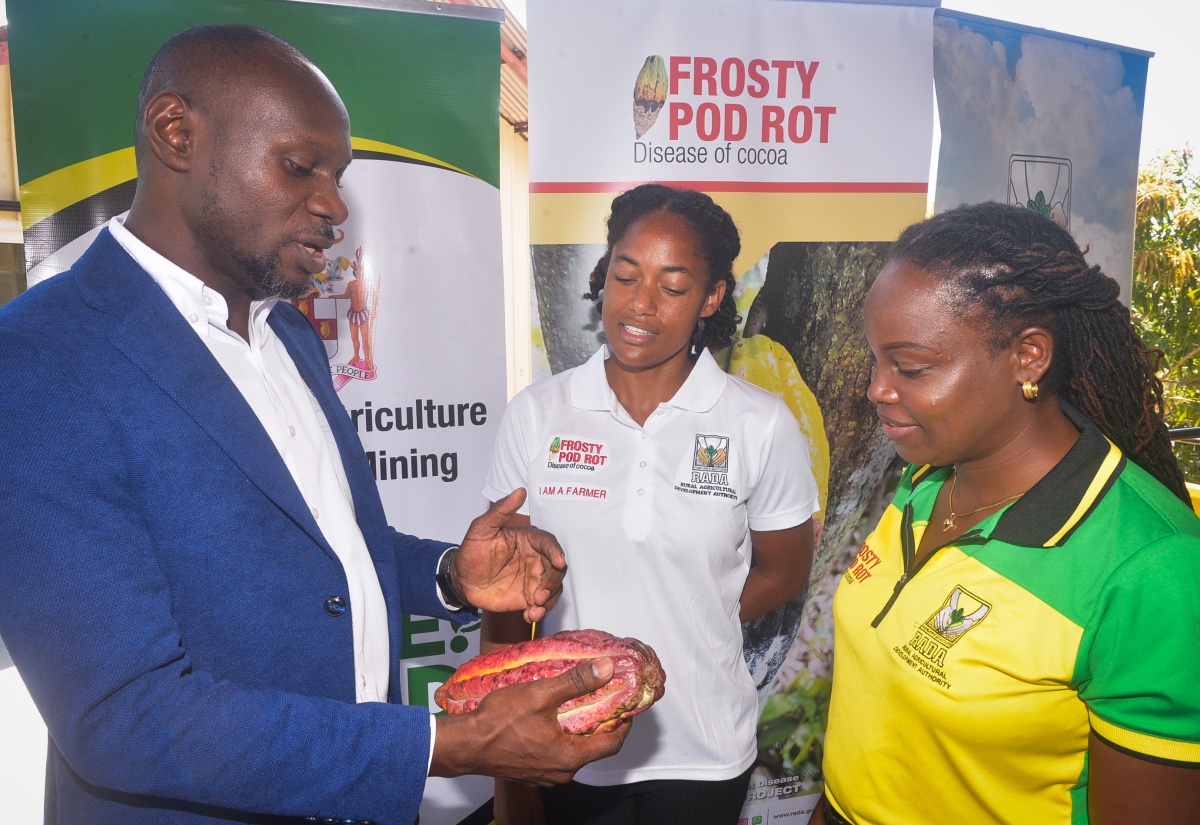
Photo: Dave Reid
Project Management Director and Coordinator at the Rural Agricultural Development Authority (RADA), Dwayne Henry (left), in discussion with cocoa farmer, Bennesa DeCambre-Hayden (centre), and Marketing Officer at RADA, Tassia Francis, during a recent graduation ceremony for 50 farmers who successfully completed training in Cocoa Frosty Pod Rot Disease Management, held at the Denbigh Showground in Clarendon.The Full Story
Cocoa farmers are being urged to remain vigilant and proactive in managing the devastating Frosty Pod Rot Disease, which continues to threaten the viability of Jamaica’s cocoa industry.
The call came from Project Management Director and Coordinator at the Rural Agricultural Development Authority (RADA), Dwayne Henry, who was addressing a recent graduation ceremony for 50 farmers who successfully completed training in Cocoa Frosty Pod Rot Disease Management, held at the Denbigh Showground in Clarendon.
Mr. Henry explained that Frosty Pod Rot, a fungal disease, can reduce marketable cocoa yields by as much as 80 per cent, noting that while infected trees may continue to bear fruit, much of it would be unfit for sale.
He emphasised that without proper management, farmers’ earning potential could be drastically reduced.
Mr. Henry outlined a multi-pronged approach being implemented to combat the disease, including integrated pest and crop management systems, climate-smart extension support, and the use of disease-tolerant cocoa varieties.
Additionally, farmers are being equipped with tools and inputs through a revolving loan system, while partnerships with stakeholders have facilitated the development of specialised fertilisers tailored for cocoa production.
Mr. Henry said the training forms part of a broader strategy to strengthen farmers’ resilience and sustain cocoa production amid persistent disease challenges.
He said the graduation ceremony marked a significant milestone for the participants, who were presented with seeds and agricultural tools by the Ministry of Agriculture, Fisheries and Mining, as part of ongoing support to put the sector on a sustainable path.
Central to Mr. Henry’s presentation was the scientific explanation of how the disease spreads.
He cited the interaction among the host (cocoa pod), the pathogen (fungus), and the environment, noting that all three elements must be present for the disease to thrive.
Using the analogy of a three-legged stool, he explained that disrupting any one of these factors, whether through fungicide application, environmental management, or removal of infected pods can effectively halt the disease.
The Technical Director stressed that cultural practices, such as pruning, under-brushing, and regular harvesting, play a critical role in modifying environmental conditions that favour the fungus.
He added that timely application of fungicides, ideally within the same week of field sanitation, greatly improves the chances of controlling outbreaks.
Farmers were also encouraged to practise regular field scouting to detect and remove infected pods before they reach the stage where spores are widely dispersed.
Providing an update on the programme’s impact, Mr. Henry reported that participating farmers have recorded up to a 91 per cent reduction in disease levels, with an average reduction of about 85 per cent across the board.
He added that improved field management has also resulted in as much as a 76 per cent increase in pod production among attentive farmers, demonstrating the effectiveness of the interventions.
Marketing Officer at RADA, Tassia Francis, who served as one of the trainers, described the programme as a timely and valuable initiative that has strengthened the capacity of extension officers and farmers alike.
She noted that the hands-on, participatory training model improved knowledge transfer, and encouraged farmers to adopt best practices to get healthier crops, increased productivity, and improved livelihoods.
Chief Executive Officer at RADA, Garnet Edmondson, underscored the broader significance of the programme, noting that Jamaica’s cocoa remains among the finest in the world and commands premium prices on the global market.
He said the Authority remains committed to equipping farmers with modern techniques and fostering partnerships to overcome challenges such as frosty pod rot, adding that continued collaboration will be key to transforming the future of the country’s cocoa industry.