


Boost for Agricultural Education In High Schools
By: , January 23, 2026
Photo: Adrian Walker
Minister of State in the Ministry of Agriculture, Fisheries and Mining, Hon. Franklyn Witter (third left), presents a vertical hydroponic tower to Vice Principal of Manchester High School, Hillary Morgan (fourth left), during a ceremony held at the school on January 22. Others pictured (from left) are Form Captain, Demarco-De Pryce; Chief Executive Officer at the Rural Agricultural Development Authority (RADA), Garnet Edmondson; Head of the Natural Science Department at the school, Donna Reid; Form Captain, Liaje Waysome, and Agricultural Science Teacher, Suzanne Samuels-Dixon.
Photo: Adrian Walker
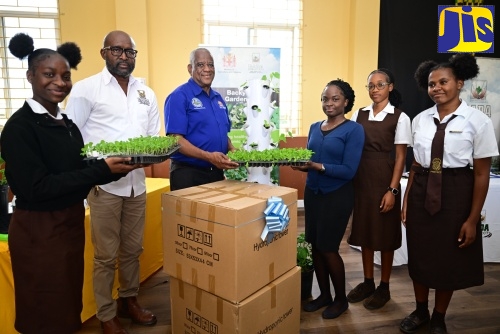
Minister of State in the Ministry of Agriculture, Fisheries and Mining. Hon. Franklyn Witter, addresses a ceremony at Manchester High School, in Mandeville, on January 22, where he presented vertical hydroponic towers and goat houses to Manchester High and Holmwood Technical High Schools.The Full Story
Manchester High and Holmwood Technical High Schools are set to improve agricultural education, with the donation of vertical hydroponic towers and goat houses by the Ministry of Agriculture, Fisheries and Mining.
Speaking at a handover ceremony, held at Manchester High School on January 22, Minister of State in the Ministry, Hon. Franklyn Witter, said both initiatives “reflect how we are transforming agriculture by combining education, technology and production”.
Vertical hydroponic towers are highly productive, water-efficient methods for growing fresh produce in urban areas (using up to 95 per cent less water). The systems, often using aeroponics or nutrient film techniques (NFT), are ideal for tropical climates, allowing for year-round cultivation of lettuce, herbs, peppers, and tomatoes.
“We want to expose the students and younger persons to new agricultural practices… and the vertical farming towers really represent the future of farming in Jamaica. They show that agriculture can thrive, even where land space is limited, using modern climate-smart technologies that conserve water and increase productivity,” Mr. Witter said.
Stressing that the towers will become “living classrooms”, the State Minister said they will allow students to learn science, nutrition, technology and entrepreneurship in a “very practical way”, and that the Ministry wants young people to understand that agriculture is not outdated, because the island cannot survive without agriculture.
He said that it is innovative, more data-driven, and equipping the schools is an “investment in the next generation of farmers, agribusiness and agricultural scientists”.
“Jamaica, like many developing nations, faces real and growing challenges in achieving food security. We can recall what happened just immediately after the storm (Hurricane Melissa), when the price of all foods went up. If we had more of these kinds of innovations, then that would help to solve some of those issues,” the State Minister said.
Mr. Witter underscored that the Ministry’s “forward-thinking solution” to address challenges in the sector, is to bring food production directly into urban communities through the use of vertical hydroponic towers, which allow crops to be grown in very small spaces.
He said this would increase the availability of fresh and nutritious produce all year long while promoting sustainable urban agricultural practices that are adaptable in modern living conditions.
“This initiative is fully aligned with the Government’s new phase of food strategy, which focuses on food security, agribusiness development, climate-smart technologies and export expansion.
Growing food is about empowering households and schools, strengthening communities and creating economic opportunities by equipping families and students with the knowledge, skills and tools to grow their own vegetables and herbs,” the State Minister said.
Also, under the National Small Ruminant Development Programme, more than 50 young farmers (ages 18–35) have received two goats each and pre-assembled, durable goat houses.