



BOJ Projects Full Economic Recovery Within Two to Three Years After Hurricane Melissa
By: , February 25, 2026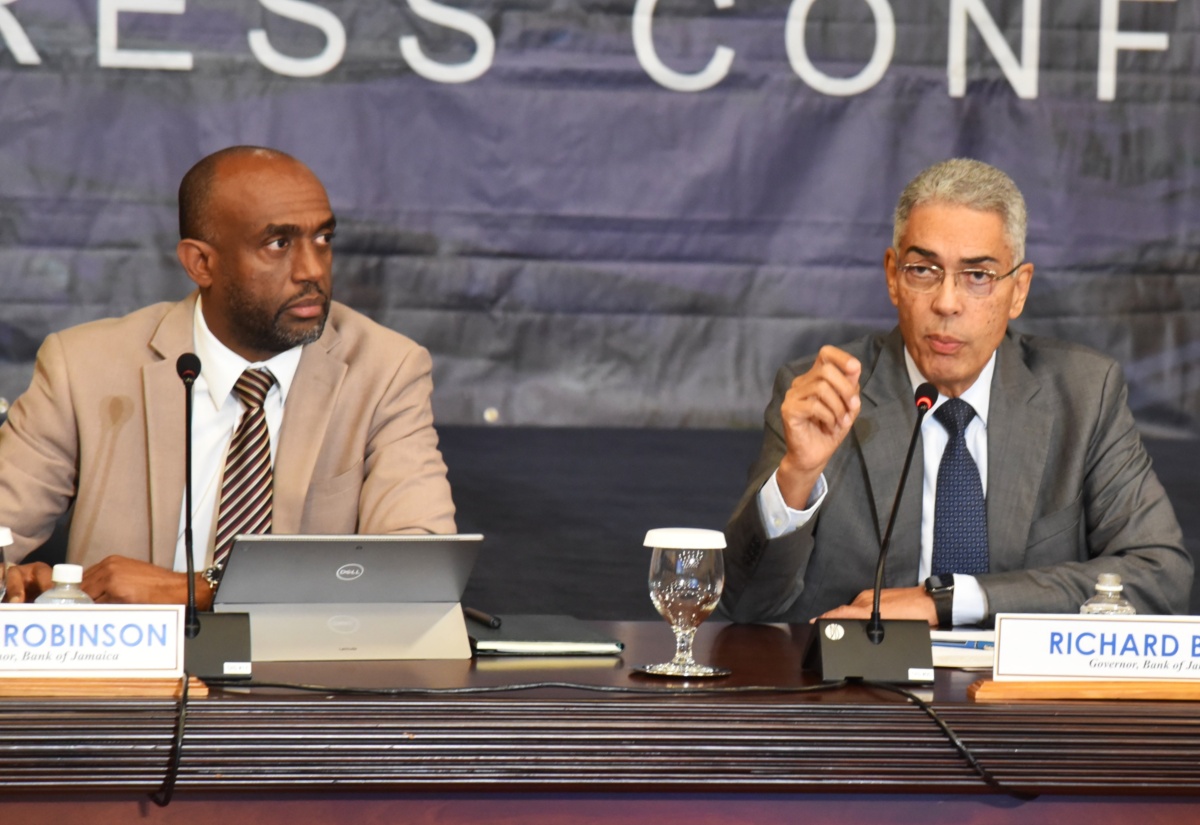
Photo: Mark Bell
Bank of Jamaica (BOJ) Governor, Richard Byles (right), addresses Tuesday’s (February 24) Quarterly Monetary Policy Report press conference at the BOJ auditorium in downtown Kingston. Listening is Senior BOJ Deputy Governor, Dr. Wayne Robinson.The Full Story
The Bank of Jamaica (BOJ) is anticipating full recovery in economic activity after Hurricane Melissa within two to three years.
BOJ Governor, Richard Byles, says this is faster than the previous estimate of three to four years.
“This improved recovery outlook anticipates a faster rebound in agricultural activity and factors in a faster than initially anticipated recovery in electricity and telecommunications services,” he said.
Mr. Byles was addressing the Bank’s Quarterly Monetary Policy Report press conference at the BOJ auditorium in downtown Kingston on Tuesday (February 24).
He noted that for fiscal year 2025/26, BOJ is expecting a decline in real gross domestic product (GDP) in the range of -1 to -3 per cent.
“[This is] a smaller contraction than our previous estimate. As the economy recovers, real GDP growth for financial year 2026/27 is projected in the range of one to three per cent,” the Governor further indicated.
Meanwhile, Mr. Byles said Jamaica’s current account balance is expected to deteriorate in the medium term.
He explained that this is primarily due to the hurricane’s adverse impact on the tourism industry, coupled with increased imports required for infrastructure rebuilding and relief supplies.
“The deterioration in the current account, however, will be slowed by increased remittance inflows and insurance receipts. In this context, the Bank anticipates that the current account balance will fall within a range of a deficit of 0.5 per cent of GDP to a surplus of 0.5 per cent of GDP for financial year 2025/26, compared with a surplus of three per cent of GDP recorded in financial year 2024/25,” Mr. Byles stated.
Notwithstanding the deterioration in the balance of payments current account, the Central Bank Governor noted that Jamaica’s international reserves remain robust, reaching a historic high of US$6.8 billion as of February 19, 2026.
This represents approximately 155.8 per cent of the benchmark considered adequate.
In the meantime, Mr. Byles noted that the domestic financial system has demonstrated resilience in the aftermath of the hurricane.
Deposit-taking institutions (DTIs) maintained capital adequacy regulatory benchmark and demonstrated broad resilience ratios above the potential market, credit, and liquidity risk scenarios.
“While there has been a mild deterioration in DTIs’ asset quality, with a ratio of total non-performing loans to total loans increasing to 2.8 per cent at the end of 2025 from 2.5 per cent at the end of 2024, the ratio remains more than comfortable within the prudential benchmark of 10 per cent,” Mr. Byles said.
He further advised that private-sector credit has remained relatively stable, recording annual growth of eight per cent in 2025, compared with 7.3 per cent a year earlier.