


High Yields at Agro Park in New Forrest/Duff House
By: , August 12, 2014The Key Point:
The Facts
- Mr. Kellier pointed out that when all nine agro parks are in full operation, “we will not be able to consume all that they produce; so we have to ensure that we go overseas to seek markets."
- Emphasizing that the Government’s large investment in irrigation systems is another reason for the current buoyancy in agriculture, he noted that “irrigation guarantees sustainable production.”
The Full Story
Acting Minister of Agriculture and Fisheries, Hon. Derrick Kellier, says the new technology being used by farmers at the New Forrest/Duff House Agro Park, in Manchester, has turned the once desolate area into a well run farm.
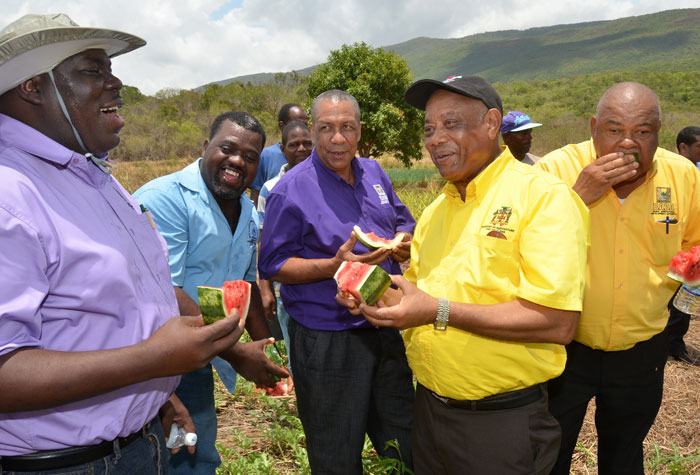
“The farmers have done a lot of work; they have accepted the new technology, which is the way to go where agriculture is concerned. We can see from the kind of production and the yields that are here…that intervention has turned what would have been a desert, into an oasis,” the Minister told journalists after he toured the park on August 11.
“The production here is very high, and it is helping to balance the difficulties that we are experiencing in other areas,” he added.
Mr. Kellier pointed out that when all nine agro parks are in full operation, “we will not be able to consume all that they produce; so we have to ensure that we go overseas to seek markets, so that more farmers can get involved, and those that are farming can expand, and create more job opportunities.”
Emphasizing that the Government’s large investment in irrigation systems is another reason for the current buoyancy in agriculture, he noted that “irrigation guarantees sustainable production.”
“Rainwater harvesting is also crucial, because we lose too much of our rainwater. It is a less costly operation, as once you establish a micro dam, particularly if it is an area from which you can gravity flow the water to lower areas of farm lands, it will bring down the price of the cost to the farmers. They will make more money, and the young people who were skeptical over the years, they will see that agriculture is good business, and we want to encourage that,” Mr. Kellier said.
When the Minister addressed the Denbigh Agricultural, Industrial and Food Show in May Pen, Clarendon, on August 2, he noted that the government’s establishment of the agro parks has turned around food production in the country and has placed farmers in a position to reap high yields and increase their earnings.
Meanwhile, the farmers at New Forrest/Duff House reported to the Minister that they have little, and in most cases, no theft of their produce, and that the police are giving them adequate support.
The main crops being produced are escallion, sweet potato, thyme, melon, tomato, and pineapple.
The nine agro parks are projected to realize foreign exchange savings of some $4 billion, and provide employment for about 5,000 persons, when fully implemented.
Scheduled for completion in 2015, the project aims to modernize Jamaica’s agricultural sector; and contribute to reducing the island’s almost US$1 billion food import bill, while increasing exports and creating jobs.