


Justice Ministry Projects Five-year Timeline for Alternative Dispute Resolution Policy Rollout
By: , May 31, 2026
Photo: Adrian Walker
Senior Policy Analyst in the Ministry of Justice and Constitutional Affairs, Sandy-Lou Cole-Jarrett, addresses the recent launch of the Alternative Dispute Resolution (ADR) Policy Development and Estate Planning Public Education Campaign at the Ministry’s office in Kingston.The Full Story
The Ministry of Justice and Constitutional Affairs is projecting a five-year timeline for the completion and national rollout of Jamaica’s Alternative Dispute Resolution (ADR) Policy.
The Policy is a framework being developed to expand mediation, arbitration, and restorative justice as alternatives to litigation, aimed at reducing court backlogs, addressing community conflicts, and strengthening access to justice.
Senior Ministry Policy Analyst, Sandy-Lou Cole-Jarrett, noted that work on the Policy’s development is already underway, following Cabinet’s approval in December 2025 for its formulation to proceed.
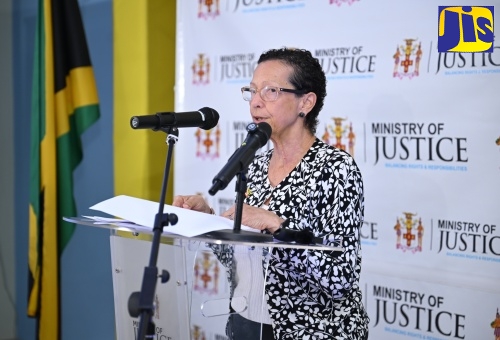
“So, we are in the process of preparing the Green Paper, and we have commenced stakeholder consultations,” she explained, while speaking during the recent launch of the ADR Policy Development and Estate Planning Public Education Campaign at the Ministry’s office in Kingston.
A Green Paper is an official government document that sets out proposals for discussion before a policy is finalised. It is essentially a consultation paper — designed to invite feedback from stakeholders, experts, and the public on the ideas being put forward.
Mrs. Cole-Jarrett advised that Hanover, St. James and Trelawny were the initial parishes targeted for public feedback on the Policy.
She indicated that, as part of the public education and consultation campaign, brochures and posters are being distributed to citizens to provide an overview of what ADR is and highlight the elements of the framework currently being developed by the Ministry.
Once the islandwide consultations are complete, the Justice Ministry official stated that relevant recommendations from stakeholders will be incorporated into the Policy, which will then be tabled in the Houses of Parliament for approval, followed by a subsequent national rollout.
“Our anticipated timeline is over a five-year period, and that would be from 2027 to 2031,” Mrs. Cole-Jarrett informed.
The ADR Policy is poised to serve as a pivotal pathway to justice, efficiency, and social harmony.
Mrs. Cole-Jarrett emphasised that the Policy is essential in addressing the pervasive challenges of crime and violence across the nation.
“Law enforcement and punitive measures can fall short in addressing the root causes, leading to recurring cycles of crime and violence,” she explained.
Mrs. Cole-Jarrett pointed out that ADR promotes dialogue as opposed to bringing matters before the court.
In her presentation titled – ‘Advancing Justice Through Alternative Dispute Resolution: A National Policy for Jamaica’, she explained that ADR encompasses a range of approaches that provide parties in conflict with options to resolve disputes outside of the traditional court process.
“So, there are arbitration, mediation, restorative justice… negotiation, adjudication, and med-arb (mediation-arbitration)… conciliation, settlement conferences, expert determination, and neutral evaluation… all of these methods can be used in various ways,” the Senior Policy Analyst outlined.
She highlighted research showing that Jamaicans generally have limited awareness of ADR.
As a result, the national policy seeks to provide a comprehensive framework that outlines the various ADR methods, guidance on how they can be applied, and the specific categories or spheres in which they are most relevant.
Mrs. Cole-Jarrett emphasised that ADR is designed to preserve relationships while identifying workable resolutions for all parties involved.
“ADR places strong emphasis on building better relationships. Adversarial processes are not necessarily good for longstanding amicable relationships, and what ADR tries to do is to make sure that once parties leave an ADR resolution session, they are both leaving happy,” she explained.
The Senior Policy Analyst further underscored that ADR is a voluntary process, distinguished by its flexibility in application.
“I also want to clarify that ADR will not be applicable to every scenario. As it is now, it is more appropriate for civil matters,” she states.
Mrs. Cole-Jarrett pointed out that the expected outcome of increased use of ADR is a cultural shift that will lead to shorter resolution times and a reduced judicial burden, including a decrease in the backlog of court cases — typically referring to matters that remain before the courts for more than two years without resolution.
Meanwhile, she advised that ADR can be applied across a wide range of sectors and spheres of national life.
“[These include] school or workplace conflicts, family/community disputes, and commercial industries. It is also heavily used in the construction industry…[to address] labour disputes, consumer disputes, and environmental related disputes,” Mrs. Cole-Jarrett further outlines.
She noted that the anticipated benefits for the country include higher rates of dispute resolution outside of the courts, a reduced caseload for the judiciary, greater flexibility in conflict resolution, enhanced access to justice, and improved relations among citizens.
The development of a national ADR Policy has been commended by key partners within Jamaica’s justice system.
Assistant Resident Representative at the United Nations Development Programme (UNDP) Multi-Country Office in Jamaica, Lesley-Ann Dixon-Ennevor, noted that approval for the Policy’s development signals Jamaica’s intent to strengthen viable options for resolving disagreements and conflicts.
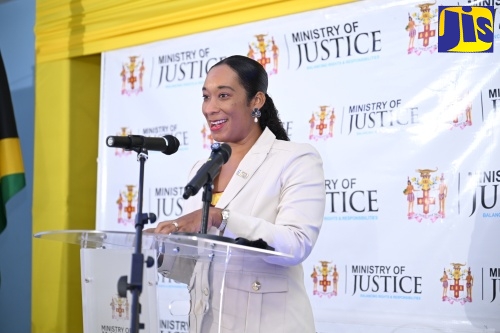
“We believe that such a policy can break new ground in the people-to-people relations in Jamaica, leading to a reduction in violence. This is what every community wants and deserves,” she stated.
Mrs. Dixon-Ennevor added that the UNDP stands ready to provide support beyond the development stage, extending into the implementation phase, in pursuit of the shared objective of a justice system that fosters nonviolence and peace.
Meanwhile, Senior International Assistance Officer at the High Commission of Canada in Jamaica, Dr. Deborah Duperly-Pinks, noted that Canada supports ADR because the rule of law and stability are foundational to inclusive economic growth and effective justice systems which, in turn, reduce violence, corruption, and social exclusion.
“The development of a national ADR Policy is a critical step on Jamaica’s social justice roadmap. It provides a coherent framework across justice institutions, standardises quality and access to services, ensures sustainability beyond individual projects, and signals a national shift towards people-centred justice,” she detailed.
Dr. Duperly-Pinks emphasised that the Policy will also strengthen public awareness, positioning ADR as a first rather than a last option for dispute resolution.
She affirmed that ADR aligns with Canada’s values by prioritising equity, inclusion, and rights-based approaches.