


99 Per Cent of NWC Facilities Restored After Hurricane Melissa
By: , April 29, 2026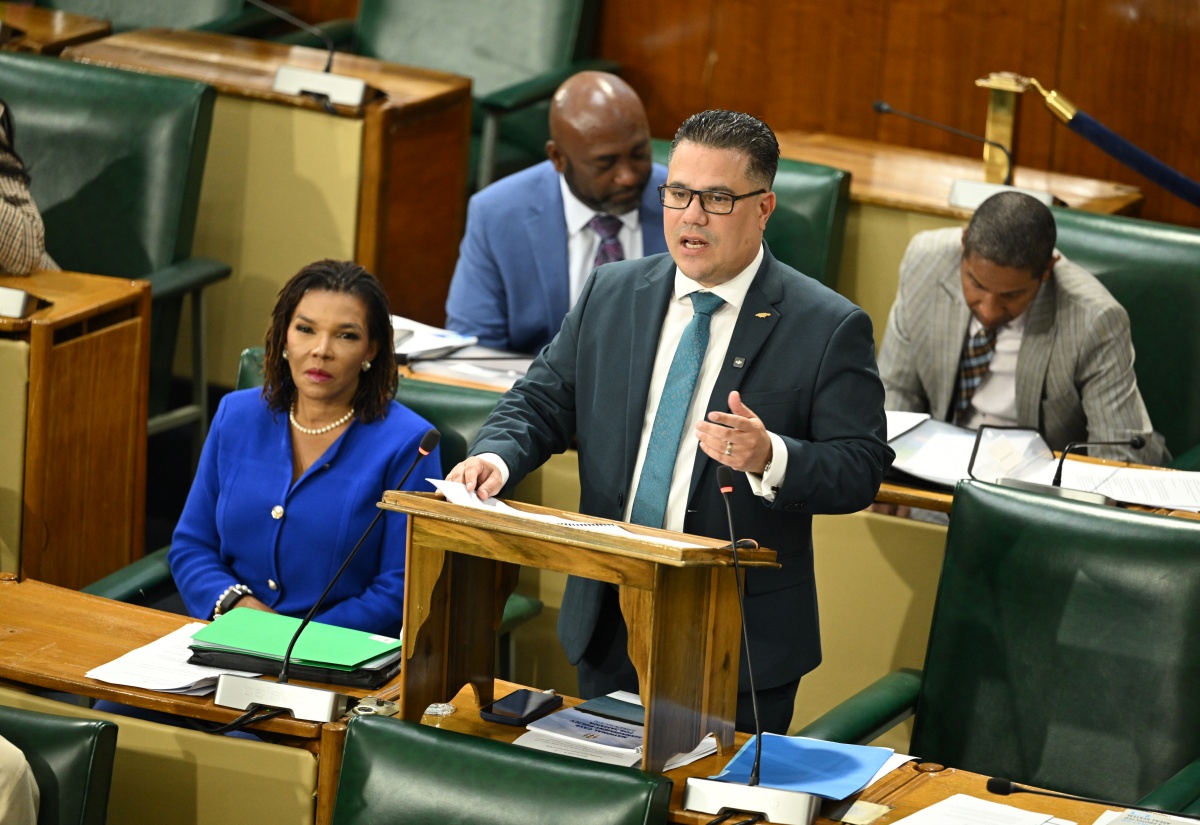
Photo: Adrian Walker
Minister of Water, Environment and Climate Change, Hon. Matthew Samuda, makes his contribution to the 2026/27 Sectoral Debate in the House of Representatives on Tuesday (April 28).The Full Story
As of April 2026, approximately 99 per cent of National Water Commission (NWC) facilities have been restored to full operational status in the aftermath of Hurricane Melissa, with most reconnected to the national power grid.
Additionally, by December 31, 2025, the NWC had restored water supply to more than 90 per cent of customers, supported by expanded water trucking operations, temporary supply arrangements, and coordinated field interventions.
This was disclosed by Minister of Water, Environment and Climate Change, Hon. Matthew Samuda, during his contribution to the 2026/27 Sectoral Debate in the House of Representatives on Tuesday (April 28).
He noted that, despite the significant impact of Hurricane Melissa on both infrastructure and operations, the NWC demonstrated remarkable resilience and responsiveness.
“Ongoing works are being undertaken to address the remaining facilities requiring additional intervention, and to restore pipelines in remote communities that were affected by land slippage,” Mr. Samuda said.
“This performance underscores the Government’s capacity to respond effectively to national emergencies and to maintain service continuity under challenging conditions. That is the result of planning, not an accident,” he added.
The Minister also addressed the issue of non revenue water (NRW), which refers to water that is produced, treated, and pumped but does not reach a paying customer.
Mr. Samuda noted that NRW drives up energy costs, constrains available supply, and renders the NWC financially unsustainable if left unaddressed.
“NRW is acknowledged as a crisis that we must fix. The islandwide NRW reduction programme is valued at some US$340 million, and will be phased over 11 years. It will target reduced NRW from 71 per cent to 30 per cent. It is already in procurement through international competitive bidding.
“Jamaica has an NRW target of 30 per cent by 2035. The annual financial return is clear – $10.7 billion, comprising $7.7 billion in additional revenue at current tariff rates from improved billing and collection, and $2.8 billion in annual electricity savings, and $167 million in chemical cost savings. We are already seeing these benefits in Kingston and St. Andrew, and Portmore [in St. Catherine],” he added.
Minister Samuda noted that the case for expanding the programme islandwide is straightforward, pointing out that, “quite frankly, it pays for itself”.