
Medical Training Being Transformed by Community Health Junior Clerkship
By: , March 31, 2026
Photo: Contributed
Fourth-year medical students in the University of the West Indies Faculty of Medicine’s Community Health Junior Clerkship after disembarking the Disney Treasure cruise liner where they accompanied public health inspectors for the parish of Trelawny, who boarded the ship to grant pratique, which is approval for the ship to disembark passengers and crew on the island.The Full Story
For many medical students, the image of a doctor’s work begins and ends within hospital walls, wards, clinics, emergency rooms, and operating theatres.
Across Jamaica, however, the University of the West Indies (UWI) Faculty of Medicine’s Community Health Junior Clerkship is challenging that perception by placing doctors-in-training at the centre of the systems that safeguard the nation’s health, long before patients arrive at a hospital.
Through structured exposure to public health operations, community engagement, environmental health, disease surveillance, and policy-driven decision-making, the Clerkship is reshaping how students understand medicine.

Conversations with students, public health leaders, and academic administrators reveal a programme that is quietly transforming medical training and producing doctors who can think beyond individual patients to the well-being of entire populations.
At its core is a shared understanding that modern healthcare cannot function without strong public health systems, and doctors must be prepared to operate within and alongside those systems.
For many students, the one-week immersion into Jamaica’s primary healthcare system, often in rural parishes, begins as an unknown.
Prior to the rotation, their knowledge of public health is largely theoretical, confined to lectures on epidemiology, disease notification, and health promotion.
At parish health departments such as Trelawny, students encounter the “behind-the-scenes” work that safeguards communities.
District Medical Officer at the Trelawny Health Department, Dr. Kahmar Pearce, explains to JIS News how the students are prepared for the field through placement within the system.
“Any event or condition of public health interest is reported to the health department. Our role is to analyse those reports, coordinate investigations, and intervene early to limit spread and protect communities,” Dr. Pearce notes.
Students accompany public health teams on disease surveillance visits, food safety inspections, water treatment assessments, port and cruise-ship inspections, and vector-control operations.

For many, it is their first time witnessing the scale and organisation of Jamaica’s public health infrastructure.
“I didn’t know there were departments dedicated to inspecting ships, planes, and food products,” Fourth-year medical student, Brianna Miller, tells JIS News.
“Seeing how these systems function changed how I think about healthcare,” she adds.
Dr. Pearce supports this perspective by pointing out that the exposure is intentional. “When students arrive, we familiarise them with how primary care functions. They’re aspiring physicians, so it’s important for them to appreciate what primary care is about and the essential roles doctors play within it,” he adds.
Concepts such as Class One notifiable diseases, sentinel surveillance, and environmental risk assessment, which may be abstract in lectures, become tangible when applied in real time.
Students learn during the Clerkship that doctors, whether in public hospitals or private practice, are integral to disease surveillance.
Reporting suspected cases and collaborating with public health authorities are professional obligations.
“Our job is really to curtail the spread of disease as much as possible. In doing so, we preserve the health of the population and prevent the re-emergence of diseases like measles or polio,” Dr. Pearce explains.
For students, the realisation is both sobering and empowering.
“Now I know how surveillance actually works. It’s something we’ll all be responsible for as doctors,” Deandray Robinson says.
He adds that his experience, which included the observation of the management of hazards at a macaroni factory as well as at the seaport, helped him to see a more holistic approach to practising medicine.
Direct community engagement is often the most transformative element. Students visit rural and urban communities, observe living conditions, and speak with residents about their experiences.
“Being out in the community made me see parts of life I hadn’t experienced and it made me realise that some problems in the health system need fixing, and that change can start with us,” Chavanna Anthony shares.
Dr. Pearce notes that rural communities often leave a lasting impression on the students. “
They usually tell us that people here are very welcoming and attentive,” he says, adding that the experience differs from what many students are accustomed to. These encounters deepen students’ understanding of access to care, health literacy, trust in institutions, and socio-economic inequality lessons not easily taught in classrooms.
“It was a necessary experience. It reminded me why public health is so important to what we do clinically,” Arianne Dwarika notes.
In St. James, Medical Officer of Health, Dr. Francine Phillips-Kelly, views the Clerkship as one of the most important, and often underestimated, components of medical education.
“When students come to us, I see it as an opportunity to show them what primary care and public health actually look like in action,” she explains, highlighting that she prioritises immersion over replicating clinic exposure.
“When they come to primary care, I want them to see public health, not just hear about it,” Dr. Phillips-Kelly points out.
Students observe inspections at seaports and airports, where public health inspectors “grant pratique”, which is the clearance, allowing vessels and aircraft to disembark passengers safely following the relevant onboard checks.
“They get to see how decisions that affect thousands of people at once are made. It’s preventive medicine at its highest level,” she notes.
The medical students also visit hotels, food establishments, schools, and rural communities such as Maroon Town and Cambridge, learning about sanitation, meat inspection, burial site inspection, and food safety monitoring. Another major focus of their immersion is vector control and surveillance around ports of entry. Students learn about barrier zones, sentinel sites, and ovi traps used to monitor mosquito-borne diseases, including dengue, Zika, chikungunya, and yellow fever.
“We try to keep our barrier zones, especially around the seaport and airport, as close to zero Aedes aegypti as possible…,” Dr. Phillips Kelly explains, “…because people are coming from many countries, some of which are endemic for diseases which we don’t want here,” she adds. By observing the collection and analysis of surveillance data, students can see how outbreaks are prevented before patients appear in emergency rooms. “This is how we protect Jamaica, and doctors are an integral part of that system,” Dr. Phillips Kelly says.
She has seen the impact extend beyond the Clerkship, where students have returned to the health department for elective courses, which tells her that “something clicked”.
“They come to realise that they are keepers of the gate, and that they are part and parcel of disease prevention and protection of the population,” Dr. Phillips Kelly says.
For Head of Department of Community Health and Psychiatry in the Faculty of Medicine at UWI and Programme Director, Dr. Ken James, the Clerkship is a strategic element of Jamaica’s medical education pipeline.
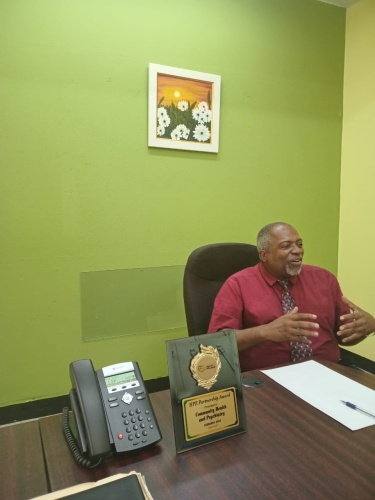
“You have to look at it in the context of the entire programme. Each year contributes to the overall vision of the kind of graduate the Ministry of Health would like to see,” he points out. He notes that postgraduate pathways, including a Master of Public Health, family medicine training, a Doctor of Public Health, and a PhD in Public Health, are aligned with strengthening administration, management, and clinical quality across the system.
Collaboration with the Ministry ensures relevance, while research strengthens evidence-based policy.
“Sometimes good work is being done, but it’s not fully known or fully appreciated,” Dr. James says.
Taken together, the voices of students, public health leaders, and educators paint a clear picture: the Community Health Clerkship is producing more holistic physicians, and doctors who understand that health is shaped as much by systems, environments, and policies as by prescriptions and procedures.
In an era defined by emerging diseases, environmental threats, and widening inequities, Jamaica’s Community Health Clerkship stands as a vital pillar in preparing doctors who are informed, adaptable, and committed to safeguarding the health of the population, both inside and beyond the wards.