


Primary School to Benefit from Guanaboa Vale Police Goat Project
By: , March 31, 2026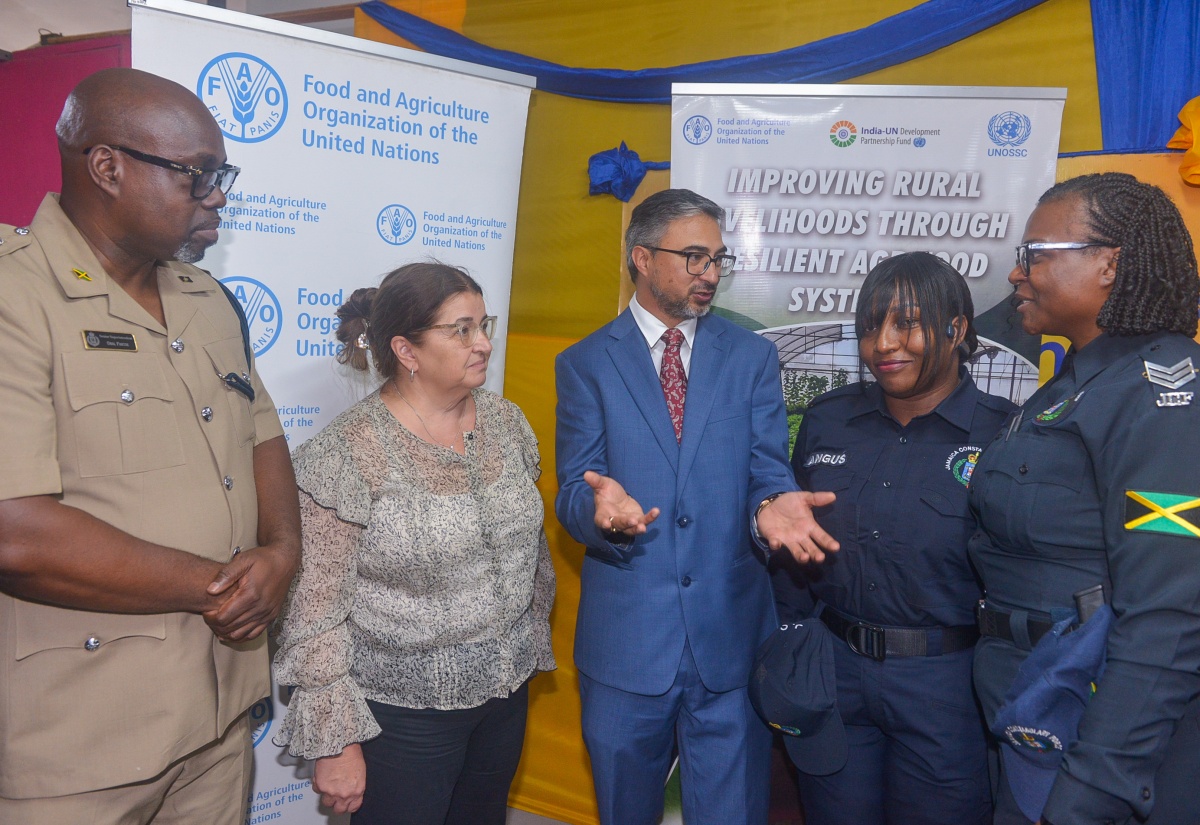
Photo: Dave Reid
Indian High Commissioner to Jamaica, His Excellency Mayank Joshi (centre), makes a point to Head of the Guanaboa Vale Police, Sergeant Navelette Davis-Leachman (right), and Constable Leonie Angus (second right), during the recent certification ceremony for persons who participated in the Improving Rural Livelihoods Through Resilient Agrifood Systems Project, held at the Spring Village Community Centre in St. Catherine. Sharing in the conversation are Commanding Officer of the Jamaica Constabulary Force (JCF) Agricultural Protection Branch (APB), Senior Superintendent of Police (SSP) Oral Pascoe (left), and Food and Agriculture Organization of the United Nations (FAO) Representative for Jamaica, The Bahamas and Belize, Dr. Ana Touza.The Full Story
The Guanaboa Vale police in rural St. Catherine are undertaking a goat-rearing project that will benefit the primary school in the community.
Under the venture, which began in June 2024, a goat house has been established on the station grounds to raise animals for the commercial sale of goat meat and milk to the public.
Currently, the operation involves 26 goats.
The police fund and operate the entire project, including the supply of feed and grass and taking care of the animals.
Head of the Guanaboa Vale Police, Sergeant Navelette Davis-Leachman, informed said the project was conceived as a way of assisting students with uniforms, school shoes and books, and as well as addressing the needs at the Guanaboa Vale Primary School.
She was speaking about the initiative during the closing ceremony for the Improving Rural Livelihoods Through Resilient Agrifood Systems Project, held at the Spring Village Community Centre in the parish.
While the goat-rearing project has faced some challenges, including the loss of several of the animals, the police is pushing ahead with the hope of being able to deliver assistance to the students and the school in short order.
Sergeant Davis-Leachman said that the initiative has brought the police and the community closer together.
“It is achieving togetherness and this togetherness has bridged the gap between the community with the police,” she added.
Indian High Commissioner to Jamaica, His Excellency Mayank Joshi, commended the project, which he noted, is providing an example of good community enterprise.
He encouraged residents to move forward with similar goat-rearing activities as a means of ensuring sustainable livelihoods.
Food and Agriculture Organization of the United Nations (FAO) Representative for Jamaica, The Bahamas and Belize, Dr. Ana Touza, also hailed the goat project, noting that it aligns with the country’s focus on food security.
She said that the use of goathouses could be adopted by others who are reluctant to get into goat farming due to praedial larceny.
“I think the model… is one of the more secure ways of rearing goats,” she pointed out.
The US$1-million Improving Rural Livelihoods Through Resilient Agrifood Systems Project was implemented by the FAO in collaboration with the Government of Jamaica and supported through the India–UN Development Partnership Fund with coordination from the United Nations Office for South-South Cooperation.
The initiative has strengthened agricultural practice in Kitson Town through a combination of training, productive assets and enterprise support.